Question

In: Physics

A glass flask whose volume is 1000cm3 at a temperature of 1.00?C is completely filled with...

A glass flask whose volume is 1000cm3 at a temperature of 1.00?C is completely filled with mercury at the same temperature. When the flask and mercury are warmed together to a temperature of 52.0?C , a volume of 8.35cm3 of mercury overflows the flask. If the coefficient of volume expansion of mercury is ?Hg = 1.80

Solutions

Expert Solution

Heated volume of Hg = Original volume of Hg{1 + }
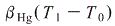
Orginal volume of Hg = 1000 cm^3, =1.80 x 10^-4,

T1-T0 = change in temperature = 52-1= 51 C

Heated volume of Hg= 1000{ 1+ 1.80x10^-4 x 51}

heated volume of Hg= 1009.18 cubic centimeter

Heated volume of glass= Heated volume of Hg- amount of mercury overflowing

Heated volume of glass = 1009.18-8.35= 1000.83 cubic centimeter

Heated volume of glass=Original volume of glass { 1 + glass(T1-T0)}

1000.83 = 1000{ 1+(51)}

1.00083 = 1 + beta(51)

0.00083 = 51*beta

coefficient of expansion of glass = 0.00083/51

                                                 = 1.627 x 10^-5 /K


Related Solutions

A glass flask whose volume is 1000 cm3 at a temperature of 0.100 ∘C is completely...
A glass flask whose volume is 1000 cm3 at a temperature of 0.100 ∘C is completely filled with mercury at the same temperature. When the flask and mercury are warmed together to a temperature of 52.0 ∘C , a volume of 8.50 cm3 of mercury overflows the flask. If the coefficient of volume expansion of mercury is βHg = 1.80×10⁻⁴ /K , compute βglass, the coefficient of volume expansion of the glass.
Wine bottles are never completely filled: a small volume of air is left in the glass...
Wine bottles are never completely filled: a small volume of air is left in the glass bottle's cylindrically shaped neck (inner diameter dd = 18.5 mmmm) to allow for wine's fairly large coefficient of thermal expansion. The distance H between the surface of the liquid contents and the bottom of the cork is called the "headspace height"(Figure 1), and is typically H = 1.5 cmcm for a 750-mLmL bottle filled at 20 ∘C∘C. Due to its alcoholic content, wine's coefficient...
A 1.00 L flask is filled with 1.45 g of argon at 25 ∘C. A sample...
A 1.00 L flask is filled with 1.45 g of argon at 25 ∘C. A sample of ethane vapor is added to the same flask until the total pressure is 1.000 atm What is the partial pressure of argon, PAr, in the flask? What is the partial pressure of ethane, Pethane, in the flask?
A 1.00 L flask is filled with 1.20 g of argon at 25 ∘C. A sample...
A 1.00 L flask is filled with 1.20 g of argon at 25 ∘C. A sample of ethane vapor is added to the same flask until the total pressure is 1.450 atm . What is the partial pressure of argon, PAr, in the flask?
A 1.00 L flask is filled with 1.45 g of argon at 25 ∘C. A sample...
A 1.00 L flask is filled with 1.45 g of argon at 25 ∘C. A sample of ethane vapor is added to the same flask until the total pressure is 1.450 atm . What is the partial pressure of ethane, Pethane, in the flask? Express your answer to three significant figures and include the appropriate units.
Finding the volume of a flask. A student obtained a clean dry glass-stoppered flask.
  1. Finding the volume of a flask. A student obtained a clean dry glass-stoppered flask. She weighed the flask and stopper on an analytical balance and found the total mass to be 31.601 g. She then filled the flask with water and obtained a mass for the full stoppered flask of 60.735 g. From these data, and the fact that at the temperature of the used water its density is 0.9973 g/cm3, find the volume of the stoppered flask....
A flask has a volume of 159.6 mL . When filled with air at a pressure...
A flask has a volume of 159.6 mL . When filled with air at a pressure of 749.2 torr and a temperature of 25.54 ∘C, the flask and air have a mass of 55.598 g . When filled with carbon dioxide at the same temperature and pressure, the mass of the flask and CO2 is 55.699 g . What is the mass of the carbon dioxide gas in the flask (when the flask is filled with carbon dioxide)? What is...
a study was made of the effect of the temperature on the volume of 1.00 g...
a study was made of the effect of the temperature on the volume of 1.00 g of helium, with the pressure held at 1 atm. The data for this experiment were: Temp(in Celsius) : -50 -10 0 25 50 100 Volume (in liters): 4.58 5.5 5.6 6.12 6.53 7.66 a. which property is the independent variable? b. prepare a graph using the data c. is there a direct relationship between the volume and the temperature of He at constant pressure...
A balloon filled with helium has a volume of 30.0 L at a pressure of 75 kPa and a temperature of 35.0°C.
A balloon filled with helium has a volume of 30.0 L at a pressure of 75 kPa and a temperature of 35.0°C. What will the volume of the balloon be if the temperature is increased to 67.0°C and the pressure remains constant?
A helium-filled balloon has a volume of 0.010 m3. The temperature in the room and in...
A helium-filled balloon has a volume of 0.010 m3. The temperature in the room and in the balloon is 20 C What are the average speed of a particle of helium inside the balloon? What is the thermal energy of the helium in the balloon? Assume that due to stretching of the balloon the pressure inside it is 1.1 atm.
ADVERTISEMENT
ADVERTISEMENT
ADVERTISEMENT