Question
In: Physics
Sketch a simple pendulum displaced at a small angle. Draw and label all forces acting on...
Sketch a simple pendulum displaced at a small angle. Draw and label all forces acting on the mass. Resolve the component of gravity in the direction of motion. Use Newton's 2nd law to write the dynamic equation that predicts the acceleration of the mass.
Why must the angle be kept small? (Here, it's asking about the experiment with a pendulum that I just did and why the angle had to be kept smaller than 10 degrees)
Solutions
Expert Solution
free body diagram is given below
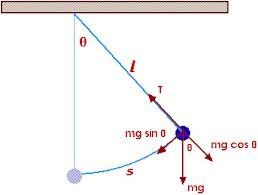
Simple pendulum's are used to describe simple harmonic motion. If the amplitude becomes large, then the oscillations become chaotic and can no longer be described by simple harmonic motion.
A point mass hanging on a massless string is an idealized example of a simple pendulum. When displaced from its equilibrium point, the restoring force which brings it back to the center is given by:
For small angles ?, we can use the approximation
in which case Newton's 2nd law takes the form
Even in this approximate case, the solution of the equation uses calculus and differential equations. The differential equation is
and for small angles ? the solution is:
|
 |


 genius_generous answered 4 months ago
Related Solutions
A simple pendulum in a clock is displaced to initial angle of 5.00° and released from...
A simple pendulum is displaced to the left of its equilibrium position and is released from...
make a simple sketch of the complete, static system. Label buildings and structures by name. Label...
Two forces, 80 N and 100 N acting at an angle of 60° with each other,...
(a) draw and label a sketch of the normal curve (b) identify and shade the area...
(a) draw and label a sketch of the normal curve (b) identify and shade the area...
2. A pendulum exhibits simple harmonic motion when it is released at an angle θ =...
You pull a simple pendulum of length 0.240m to the side through an angle of 3.50°...
What does it mean for the pendulum to have a small angle? How far does the...
Draw a simple circuit to open and close a double acting hydraulic cylinder.
- Power Music owns five music stores, where it sells music, instruments, and supplies. In addition, it...
- 4) A client wants to finance the purchase of a house costing $50,000 over a period...
- [The following information applies to the questions displayed below.] In 2018, Sheryl is claimed as a...
- Show that the acceleration of any object down a frictionless incline that makes an angle theta...
- Do Cell Phones Cause Cancer? In 5-6 sentences in length using information from the article or...
- Visual Basic program in visual studio please Write a function that checks whether a string has...
- Write a memo by answering following questions. Overview: Identify a current topic impacting financial statements or...