Question
In: Chemistry
Is groundwater quality affected by PCBs? state reasons
Is groundwater quality affected by PCBs? state reasons
Solutions
Expert Solution
PCB are a class of man-made organic chemicals. Each PCB molecule contains two phenyl rings. A phenyl ring is a ring of 6 carbon atoms to which hydrogen atoms are attached. In PCBs, chlorine atoms replace some of these hydrogen atoms.
Chlorine atoms may be present at some or all of the 10 possible positions which are numbered 2–6 on one ring, and 2'–6' on the other ring (see figures below). In total, 209 different PCBs can be formed. These different combinations are called congeners, each having a specific number of chlorine atoms located at specific positions.
One example below shows a PCB with five chlorine atoms, two chlorine atoms at the 3 and 5 positions on one ring and three chlorine atoms at the 2’, 4’ and 6’ positions on the other ring. The other example shows a PCB with chlorine atoms at the 2 position on one ring, and the 2’ position on the other.
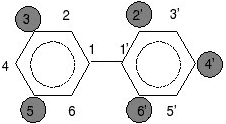
2’,3,4’,5,6’-pentachlorobiphenyl (PCB 121)
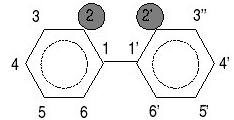
2,2’-dichlorobiphenyl (PCB 4)
Dioxins Study
Two different systems are used for naming PCBs. In the IUPAC
system used in the examples above, the numbers at the beginning of
the name specify the sites where chlorines are attached to the
phenyl rings. Another system assigns a separate number, from 1 to
209, to each of the 209 specific PCB congeners.
PCBs which have the same number of chlorine atoms attached but at different positions, are referred to as isomers.
The two rings in a PCB molecule can rotate around the bond connecting them. The shape of the molecule is further influenced by the repulsion between nearby chlorine atoms so that the rings of a specific PCB will either lie approximately in the same plane (called coplanar) or in different, more perpendicular planes (termed non-planar). Those PCBs which have both rings lying in the same plane are considered to be most toxic, based on combined health effects considerations. They are also referred to as "dioxin-like".
Physical properties of PCBs:
- PCBs persist in the environment because they are highly unreactive and are largely resistant to breakdown by acids, bases and heat
- Generally, PCBs are not very soluble in water, but readily soluble in fats. This solubility in fat explains why PCBs can build up in animal fat and along the food chain The degree of solubility is largely dependent on the number and position of chlorine atoms in the PCB molecule.
Although in general PCBs do not easily evaporate, especially those with more chlorine atoms, PCB evaporation does occur, and can account for significant amounts of PCB transport
 queen_honey_blossom answered 5 months ago
Related Solutions
Shown below are the results of water quality analyses of a groundwater source. Because all of...
Polchlorinated biphenyls (PCBs)? the decomposition of (PCBs): 2C12H4Cl6 + 23O2 + 2H2O --> 24CO2 + 12HCL...
Discuss the differences in the quality of water obtained from groundwater sources and water obtained from...
What is the Effect of septic tank leakage on shallow groundwater quality and its remedial measures?...
As part of the economy, each of us will be affected by the state of the...
Groundwater flow. Conduct a detailed study on ground water quality parameters (physical, chemical and biological parameters)...
State the various reasons for international trade
state the reasons for government participation in business activities
Explain the purification measures for groundwater pollution. Cadmium groundwater contamination was found in wells of multiple...
Describe the various reasons that caused the power crisis in California and how it affected America?...
- Question 3 (a) What do you understand by a time series forecasting approach? Describe each of...
- 1 Which of the following overflow values clips all content that extends beyond the containing element’s...
- What are the key environmental and biological controls over decomposition rate in ecosystems?
- describe why independent oversight is important to taxpayers.
- Graph a Monopoly. Compare the price, quantity, and ATC of a monopoly with a perfectly competitive...
- Problem 18-12 Various shareholders' equity topics; comprehensive [LO18-1, 18-4, 18-5, 18-6, 18-7, 18-8] Part A In...
- Hello There, This is discussion Question For Advanced Database Systems Question: (a) Please define what a...