Question

In: Physics

A pen contains a spring with a spring constant of 208 N/m. When the tip of...

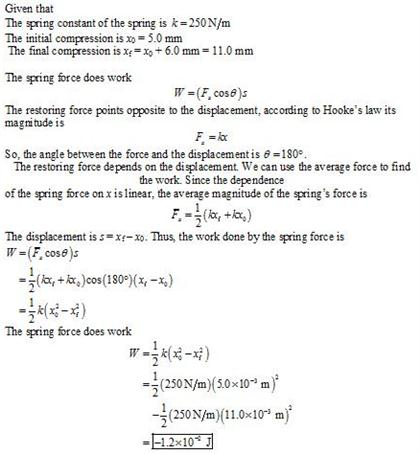
A pen contains a spring with a spring constant of 208 N/m. When the tip of the pen is in its retracted position, the spring is compressed 5.60 mm from its unstrained length. In order to push the tip out and lock it into its writing position, the spring must be compressed an additional 6.90 mm. How much work is done by the spring force to ready the pen for writing? Be sure to include the proper algebraic sign with your answer.
Solutions

Expert Solution

Here is what I solved before, please modify the figures as per your question. Please let me know if you have further questions. Ifthis helps then kindly rate 5-stars.

A pen contains a spring with a spring constant of 250 N/m. When the tip of the pen is in its retracted position, the spring is compressed 5.0 mm from its unstrained length. In order to push the tip out and lock it into its writing position,the spring must be compressed an ad- ditional 6.0 mm. How much work is done by the spring force to ready the pen for writing? Be sure to include the proper algebraic sign with your answer.


Related Solutions

When a 5 kg mass is attached to a spring whose constant is 180 N/m, it...
When a 5 kg mass is attached to a spring whose constant is 180 N/m, it comes to rest in the equilibrium position. Starting at  t = 0, a force equal to  f (t)  =  20e−3t cos 6t  is applied to the system. In the absence of damping, (a) find the position of the mass when  t = π. (b) what is the amplitude of vibrations after a very long time
When a 6 kg mass is attached to a spring whose constant is 24 N/m, it...
When a 6 kg mass is attached to a spring whose constant is 24 N/m, it comes to rest in the equilibrium position. Starting at  t = 0, a force equal to  f (t)  =  42e−7t cos 4t  is applied to the system. In the absence of damping, (a) find the position of the mass when  t = π. (b) what is the amplitude of vibrations after a very long time?
When a 6 kg mass is attached to a spring whose constant is 294 N/m, it...
When a 6 kg mass is attached to a spring whose constant is 294 N/m, it comes to rest in the equilibrium position. Starting at  t = 0, a force equal to  f (t)  =  12e−4t cos 3t  is applied to the system. In the absence of damping, (a) find the position of the mass when  t = π. (b) what is the amplitude of vibrations after a very long time?
A spring with a spring constant 4 N/m is loaded with a 2 kgmass and allowed...
A spring with a spring constant 4 N/m is loaded with a 2 kgmass and allowed to reach equilibrium. It is then displaced 1 meter downward and released. Suppose the mass experiences a damping force in Newtons equal to 1 times the velocity at every point and an external force of F(t)=4sin(3t) driving the system. Set up a differential equation that describes this system and find a particular solution to this non-homogeneous differential equation:
A spring cannon has a spring constant of 350 N / m and the bullet weighs...
A spring cannon has a spring constant of 350 N / m and the bullet weighs 10 grams. What is the maximum height, measured above the equilibrium position of the spring, that the spring cannon can shoot the ball up to if the maximum compression of the spring is 3.0 cm? (Continuation of the previous question) Before firing, the spring is compressed 2.0 centimeters in relation to the equilibrium position and the firing angle is set to ?? = 41...
A 0.5-kg mass is attached to a spring with spring constant 2.5 N/m. The spring experiences...
A 0.5-kg mass is attached to a spring with spring constant 2.5 N/m. The spring experiences friction, which acts as a force opposite and proportional to the velocity, with magnitude 2 N for every m/s of velocity. The spring is stretched 1 meter and then released. (a) Find a formula for the position of the mass as a function of time. (b) How much time does it take the mass to complete one oscillation (to pass the equilibrium point, bounce...
In a spring gun system, a spring with a spring force constant 420 N/mN/m  , is compressed...
In a spring gun system, a spring with a spring force constant 420 N/mN/m  , is compressed 0.13 mm . When fired, 80.9 %% of the elastic potential energy stored in the spring is eventually converted into kinetic energy of a 6.10×10⁻² kgkg uniform ball that is rolling without slipping at the base of a ramp. The ball continues to roll without slipping up the ramp with 89.6 %% of the kinetic energy at the bottom converted into an increase in...
A block of mass 1.59 kg is connected to a spring of spring constant 148 N/m...
A block of mass 1.59 kg is connected to a spring of spring constant 148 N/m which is then set into oscillation on a surface with a small coefficient of kinetic friction. The mass is pulled back 30.6 cm to the right and released. On the first right to left oscillation, the mass reaches 29.38 cm to the left. Part A What is the coefficient of friction? Part B To what distance does the mass return on the slide back...
A 1.40 kg block is attached to a spring with spring constant 16.5 N/m . While...
A 1.40 kg block is attached to a spring with spring constant 16.5 N/m . While the block is sitting at rest, a student hits it with a hammer and almost instantaneously gives it a speed of 43.0 cm/s . What are The block's speed at the point where x= 0.350 A?
A spring has a Hooke's law spring constant of 3.4 N/m. If you load it with...
A spring has a Hooke's law spring constant of 3.4 N/m. If you load it with 1.3 kg, how far will it extend from its equilibrium length? A spring 10 cm long extends 0.5 cm when a mass of 8 kg is hung from it. Suppose you made an similar spring of the same material, but twice as long. How much would it extend with the same mass? If you apply a force {f} newtons on a spring, and it...
ADVERTISEMENT
ADVERTISEMENT
ADVERTISEMENT