Question
In: Economics
According to the Law of One Price, assuming there are no transport costs and freecompetition exists,...
According to the Law of One Price, assuming there are no transport costs and freecompetition exists, identical goods sold in different locations will have the same price.2Using the concepts of Arbitrage and Supply & Demand, explain why this must be thecase – at least in theory. Your answer should include a diagram. Why doesn’t the Lawof One Price hold in real life?
Solutions
Expert Solution
Law of One Price: The law states that, given there are no transportation costs, free competition and free trade i.e., no quotas or tariffs, the identical goods will be sold for same prices, adjusting for exchange rate, in two different locations.
If not the case, then the trader may purchase in from the location where it is available for a lesser price and will sell it in the market with the higher prices, so as to earn profits. This process is called as arbitrage.
For example, a good is available for $100 in US and Rs 6000 in India, exchange rate being Rs 60/$. The price of the good is same in both the countries, after taking exchange rate into consideration. If the price in US is lesser, the trader would buy it US and sells in India to earn profits. This will happen till the price in both the countries are same for the same commodity.
In the diagram below, the equilibrium of demand and supply gives the price P1* in US and P1 in India for the same commodity Good1. P1 < P1* . This reduced price in India increases the demand for the product in India raising its prices in the country. At the same time, the trader will sell the product at higher prices in US, brought from India at lower prices, thereby registering profits. This increases the supply in US and lowering prices in the country. This process will happen until the price in both the countries equals at P.
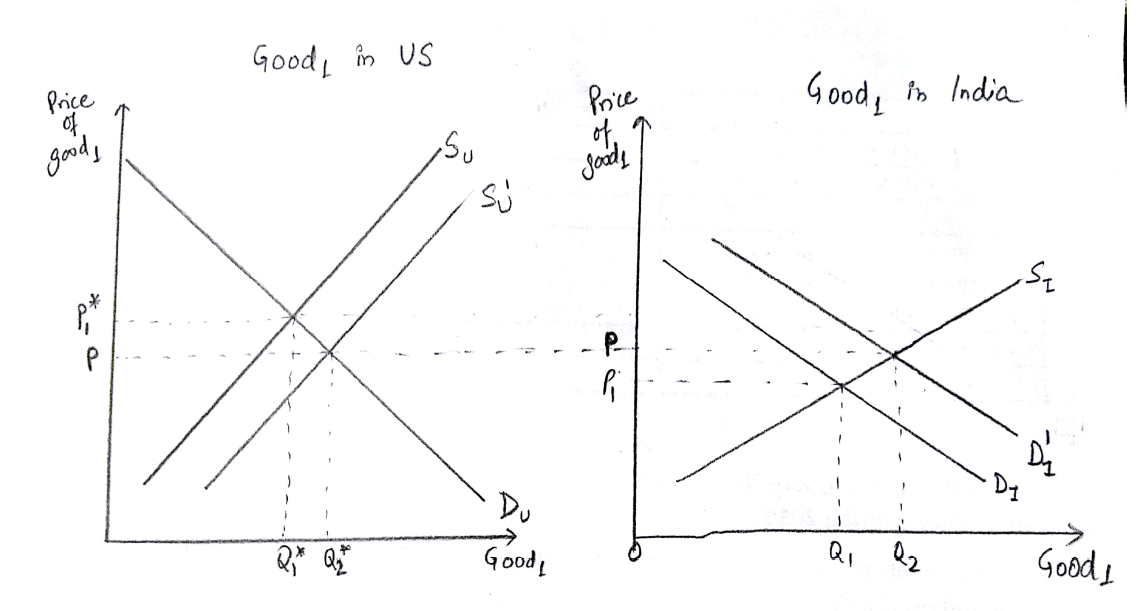
The law holds because of arbitrage opportunities. In the real world, it may not hold. The reasons could be many such as in real life the transportation costs do exist, there are transaction costs for each transaction carried out by the trader, trade barriers too exist and also it depends on the availability of substitutes in the market.
 Rahul Sunny answered 3 months ago
Related Solutions
(a) According to the law of one price, if the exchange rate between British pound and...
What is law of demand? Explain why there exists a negative relationship between the price of...
What is the Law of One Price? Describe the mechanism through which the Law of One...
Law of one price. Suppose the price of a pair of Crocs in the U.S. is...
According to the law of demand, if price increases, quantity demanded of a good or service...
How does the law of one price work? What happens if this law is violated?
1. What is the moral difference (if one exists) between withholding treatment and withdrawing treatment according...
Considering Purchasing Power Parity and the Law of One Price: a. Assume that the current price...
The pH gradient established by the electron transport chain in photosynthesis: a.) Exists between the matrix...
ACCORDING TO SARTRE, THE INDIVIDUAL ( 1 ) exists in the world , ( 2 )...
- Which of these statements is true? Cost-push inflation causes a decline in output, an increase in...
- QUESTION 5 Phoebe has gone to the local mobile phone store to purchase a new phone...
- Price the following option using the binomial method. Show all work Stock price = 10 Strike...
- 1-) Please submit the solution of your final as Ms-word or PDF document 2-) Complete THREE...
- Determine the magnitude of the force between two parallel wires. Express your answer to two significant...
- How many hours would be required to make a 3900 km trip across the United States...
- Using the following schema, write a SQL query to satisfy the question: What are the names...