Question

In: Finance

Six years from today you need $10,000. You plan to deposit $1,600 annually, with the first...

Six years from today you need $10,000. You plan to deposit $1,600 annually, with the first payment to be made a year from today, in an account that pays a 6% effective annual rate. Your last deposit, which will occur at the end of Year 6, will be for less than $1,600 if less is needed to reach $10,000. How large will your last payment be? Do not round intermediate calculations. Round your answer to the nearest cent.

$  

Solutions

Expert Solution

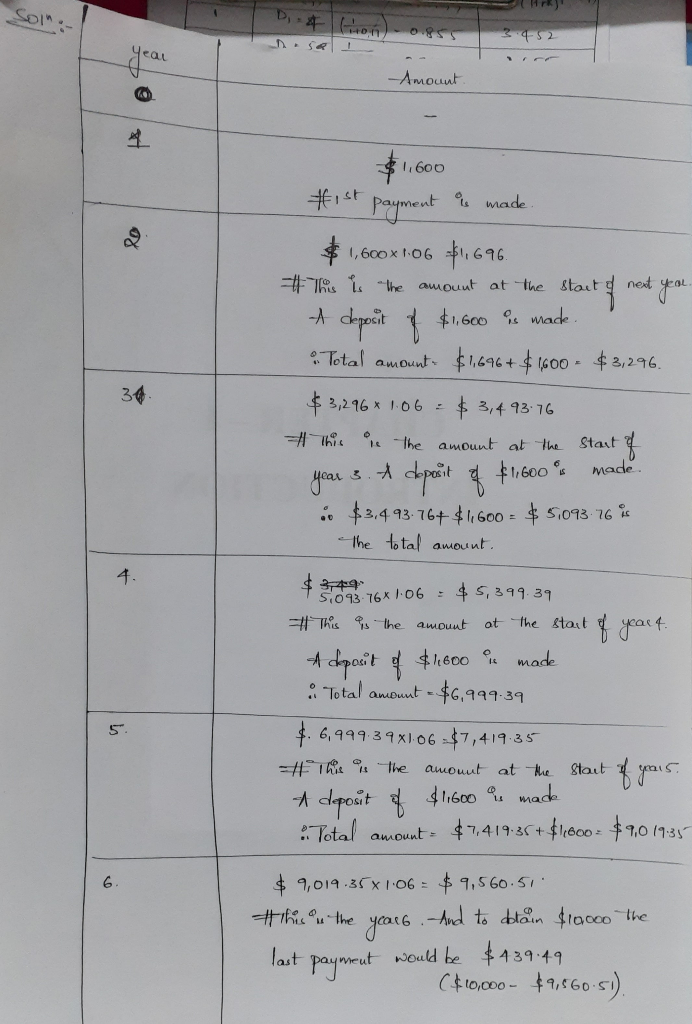
It is required to deposit $1,600 annually every year from a year from today for 6 years to get a total of $10,000. The effective annual rate is given as 6% i.e., it yields an interest of 6% on the total amount every year. If the amount in the account is A, it yields a interest of A*r%, which makes the total amount as A+(A*r%) = A*(1+r%). Here we are considering the initial year as year 0 and the deposits are deposited from year 1 to year 6. All the calculations are shown in the below images:

Related Solutions

3.  If you deposit $1,600 in an account paying 8% today and deposit $1,600 every year into...
3.  If you deposit $1,600 in an account paying 8% today and deposit $1,600 every year into the account, how much will you have in 4 years? 4.  The average price for a new car today is $29,000.  If the rate of inflation is expected to be 3.5% annually, what will a new car cost in 7 years? 5.  You bought a stock 7 years ago for $45.  Today, the stock is selling for $79.  If you sell today, what rate of return have you earned...
You plan to make a deposit today to an account that pays 6% compounded annually that...
You plan to make a deposit today to an account that pays 6% compounded annually that will found the following withdrawals with nothing left in the account after the withdrawals, starting at the end of year 4 you plan to make 5 annual withdrawals (withdraw in year 4,5,6,7,8) that will increase by 2% over the previous year's withdrawals. The amount for withdrawals in year 4 will be $2000, what amount do you need to deposit today?
Quantitative Problem 1: You plan to deposit $1,600 per year for 5 years into a money...
Quantitative Problem 1: You plan to deposit $1,600 per year for 5 years into a money market account with an annual return of 2%. You plan to make your first deposit one year from today. What amount will be in your account at the end of 5 years? Do not round intermediate calculations. Round your answer to the nearest cent. $   Assume that your deposits will begin today. What amount will be in your account after 5 years? Do not...
How much will be in an account at the end of 5 years if you deposit $10,000 today at 8.7% annual interest, compounded semi-annually?
Practice Time Value of Money Problems 1. How much will be in an account at the end of 5 years if you deposit $10,000 today at 8.7% annual interest, compounded semi-annually? 2. What is the balance at the end of 10 years if $2.500 is deposited today and the account earns 4% interest annually? What about if it's quarterly interest? Which one should be more and why? 3. Suppose you want to have $500,000 saved by the time you reach 30 years old....
You deposit $10,000 annually into a life insurance fund for the next 10 years, at which...
You deposit $10,000 annually into a life insurance fund for the next 10 years, at which time you plan to retire. Instead of a lump sum, you wish to receive annuities for the next 25 years. What is the annual payment you expect to receive beginning in year 15 if you assume an interest rate of 4 percent for the whole time period? (Show you work and calculations)
You deposit $10,000 annually into a life insurance fund for the next 10 years, at which...
You deposit $10,000 annually into a life insurance fund for the next 10 years, at which time you plan to retire. Instead of a lump sum, you wish to receive annuities for the next 25 years. What is the annual payment you expect to receive beginning in year 15 if you assume an interest rate of 4 percent for the whole time period?
4. Find the value twenty years from now of a $10,000 deposit today at an annual...
4. Find the value twenty years from now of a $10,000 deposit today at an annual interest rate of 0.1% per year if the interest on the account compounds daily.
How much money is required now to provide an income of $1,600 per month for six years if the money earns interest at 6% p.a. compounding monthly and the first $1,600 payment is payable 2 years from today?
You deposit $10,000 annually into a life insurance fund for the next 12 years, after which...
You deposit $10,000 annually into a life insurance fund for the next 12 years, after which time you plan to retire. a. If the deposits are made at the beginning of the year and earn an interest rate of 8 percent, what will be the amount in the retirement fund at the end of year 12? (Do not round intermediate calculations. Round your answer to 2 decimal places. (e.g., 32.16)) Future value $ ? b. Instead of a lump sum,...
You deposit $10,000 annually into a life insurance fund for the next 10 years, after which...
You deposit $10,000 annually into a life insurance fund for the next 10 years, after which time you plan to retire. a. If the deposits are made at the beginning of the year and earn an interest rate of 6 percent, what will be the amount in the retirement fund at the end of year 10? (Do not round intermediate calculations. Round your answer to 2 decimal places. (e.g., 32.16)) b. Instead of a lump sum, you wish to receive...
ADVERTISEMENT
ADVERTISEMENT
ADVERTISEMENT