Question
In: Economics
CASE STUDY 3 : SMOKING AT IKE’S BAR-B-Q PIT By 2013, only 10 states in the...
CASE STUDY 3 : SMOKING AT IKE’S BAR-B-Q PIT
By 2013, only 10 states in the U.S. had not issued statewide bans on smoking in any nongovernment-owned spaces. Ike’s Bar-B-Q Pit is located in a state that allows smoking in restaurants and bars. Some of Ike’s nonsmoking customers, including some who suffer from asthma, have petitioned Ike to adopt a no-smoking rule for his restaurant. Upon hearing of the petition, some of Ike’s other customers complained that they have smoked in Ike’s restaurant for years and would not patronize the restaurant if the no-smoking rule were adopted. Ike is greatly concerned because he does not wish to lose business from either his smoking or nonsmoking customers.
|
Private Solutions to Externalities: The Coase Theorem Learning Objective: Discuss the Coase theorem and explain how private bargaining can lead to economic efficiency in a market with an externality. Although government intervention may increase economic efficiency in markets where externalities are present, it is possible for people to find private solutions to the problem of externalities. Ronald Coase made this argument in a 1960 article. To understand Coase’s argument, it is important to understand that completely eliminating an externality is usually not economically efficient. A. The Economically Efficient Level of Pollution Reduction The optimal decision is to continue any activity up to the point where the marginal benefit equals the marginal cost. This applies to reducing pollution just as much as other activities. As pollution declines, society benefits, but the marginal benefit from eliminating another unit of pollution declines as emissions are reduced. As pollution declines, the marginal cost of further reductions rises. The net benefit to society from reducing pollution is equal to the difference between the benefit of reducing pollution and the cost. To maximize the net benefit to society, any type of pollution should be reduced to the point where the marginal benefit from another ton of reduction is equal to the marginal cost. B. The Basis for Private Solutions to Externalities In arguing that private solutions to the problem of externalities were possible, Ronald Coase emphasized that when more than the optimal level of pollution is occurring, the benefits from reducing the pollution to the optimal level are greater than the costs. C. Do Property Rights Matter? Ronald Coase pointed out that the amount of pollution reduction will be the same whether polluters or the victims of pollution are legally liable for damages. Bargaining between the parties will result in the same reduction in pollution, where the marginal benefit of the last unit of reduction is equal to the marginal cost. D. The Problem of Transactions Costs There are frequently practical difficulties in the way of a private solution to the problem of externalities. For example, if many people suffer from the negative effects of pollution, bringing all the victims together with all the producers of the pollution to negotiate an agreement often fails due to high transactions costs. Transactions costs are the costs in time and other resources that parties incur in the process of agreeing to and carrying out an exchange of goods or services. E. The Coase Theorem The Coase theorem is the argument of economist Ronald Coase that if transactions costs are low, private bargaining will result in an efficient solution to the problem of externalities. Private bargaining is most likely to reach an efficient outcome when the number of bargaining parties is small and all parties are willing to accept a reasonable agreement. |
|
Because Ike’s restaurant is not in a state that regulates smoking in public places, Ike decides to meet with his smoking and nonsmoking customers to accommodate both of their wishes regarding his smoking policy.
- Draw a graph illustrating the externality associated with smoking in Ike’s Bar-B-Q Pit
- Explain how this externality causes a deviation from economic efficiency in this market.
- Do you think the Coase Theorem applies to this case?
- Suggest a solution that would be consistent with the Coase theorem, that is a solution that would enhance the well-being of Ike’s customers and increase economic efficiency.
Solutions
Expert Solution
The diagram demonstrates the negative externality associated with smoking in the bar. Due to presence of negative externality in consumption, the Social Marginal Benefit is less than the Private Marginal Benefit, both represented by SMB and PMB respectively.
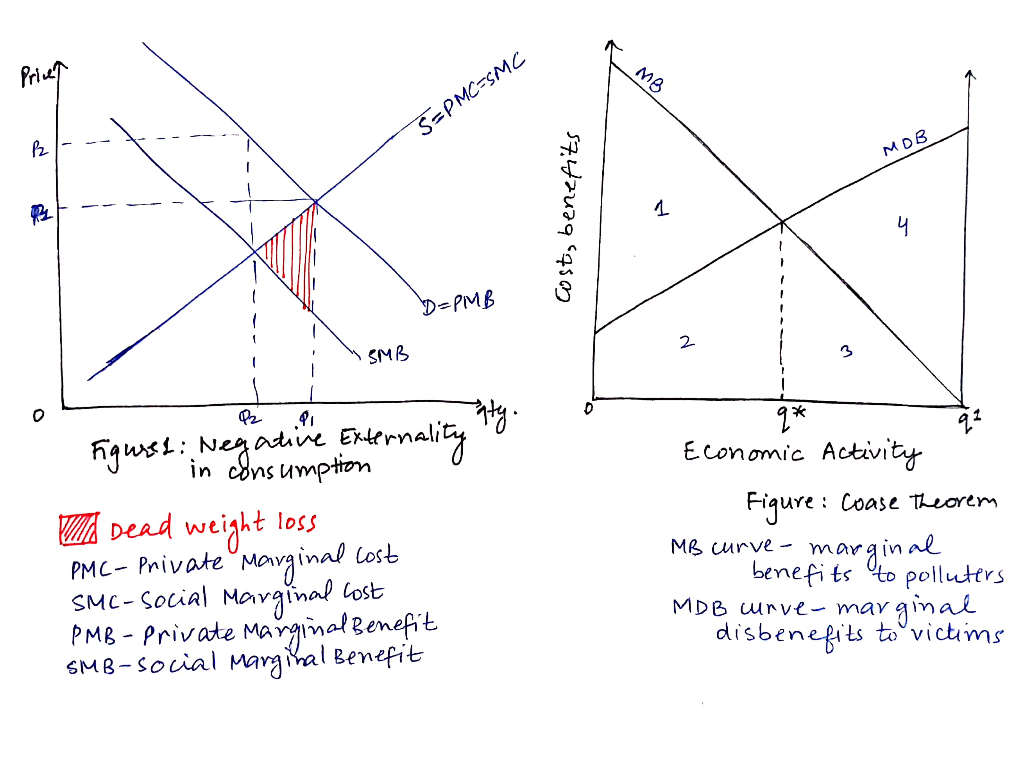
At market equilibrium, Q1 and P1 are the quantity and price levels respectively but this is inefficient allocation. This is so because at Q1, Social Marginal Cost (SMC curve) exceeds the Social Marginal Benefit (SMB curve). Thus, economic efficiency occurs at the lower output level of Q2 where Social Marginal Cost= Social Marginal Benefit. At Q2, the price is also higher at P2 level. The red shared triangle is the resultant welfare loss.
Yes, the Coase Theorem is applicable in this case.
Explanation: The MB curve represents marginal benefits from smoking to smoking customers while MDB curve represents marginal disbenefits from smoking to non smoking customers. The area under MB curve represents the payment the smokers are willing to receive to avoid smoking in the bar while the area under MDB curve represents the level of payment the non smokers are willing to offer to pursue smokers to not smoke in the bar.
According to Coase Theorem, a payment by non smoking customers to smoking customers can achieve an efficient allocation of resources and make both parties better off. It would reduce the magnitude of smoking from q1 level to q*.
Here, the non smokers are ready to pay area denoted by 3 and 4 to reduce the smoking levels from q1 to q*. If this happens then smokers gain area 4. On the other hand, if they are ready to offer only area 3 then the non smokers gain area 4. Thus, area 4 represents gain from this trade which can be divided into smokers and non smokers. Thus, this solution enhances well being of the customers and increases economic efficiency by reducing the levels of smoking in the bar.
 Rahul Sunny answered 6 months ago
Related Solutions
Case Study: For the case study section only: Only provide short answers for the case study...
Case Study: For the case study section only: Please only provide short answers for the case...
For the case study section only: Please only provide short answers for the case study No...
For the case study section only: Only provide short answers for the case study No more...
For the case study section only: Please only provide short answers for the case study No...
For the case study section only: Please only provide short answers for the case study No...
From the case study and discussion preparation study, evaluate the effectiveness of laws on smoking in...
**Case Study question** Suppose you are on a process improvement team (PIT) to evaluate an HCO’s...
Case Study 3: QWERTY It is now June 2013. Qwerty Limited is an Irish based company...
Case Study 3: QWERTY It is now June 2013. Qwerty Limited is an Irish based company...
- Problem 18-12 Various shareholders' equity topics; comprehensive [LO18-1, 18-4, 18-5, 18-6, 18-7, 18-8] Part A In...
- Hello There, This is discussion Question For Advanced Database Systems Question: (a) Please define what a...
- Physicians at a clinic gave what they thought were drugs to 860860 patients. Although the doctors...
- On January 1, 2018, bonds with a face value of $ 79,000 were sold. The bonds...
- How do I make this sort in true alphabetical order instead of ascii(ABCabc) order? I am...
- As a healthcare provider in physical therapy, athletic training, or as an exercise scientist and personal...
- in the market for makeup artists, what happens after the invention of high-definition tv allowing viewers...