Question
In: Physics
Two frictionless “hoverpucks” (puck 1 and puck 2) with mass 0.20 kg are travelling on a...
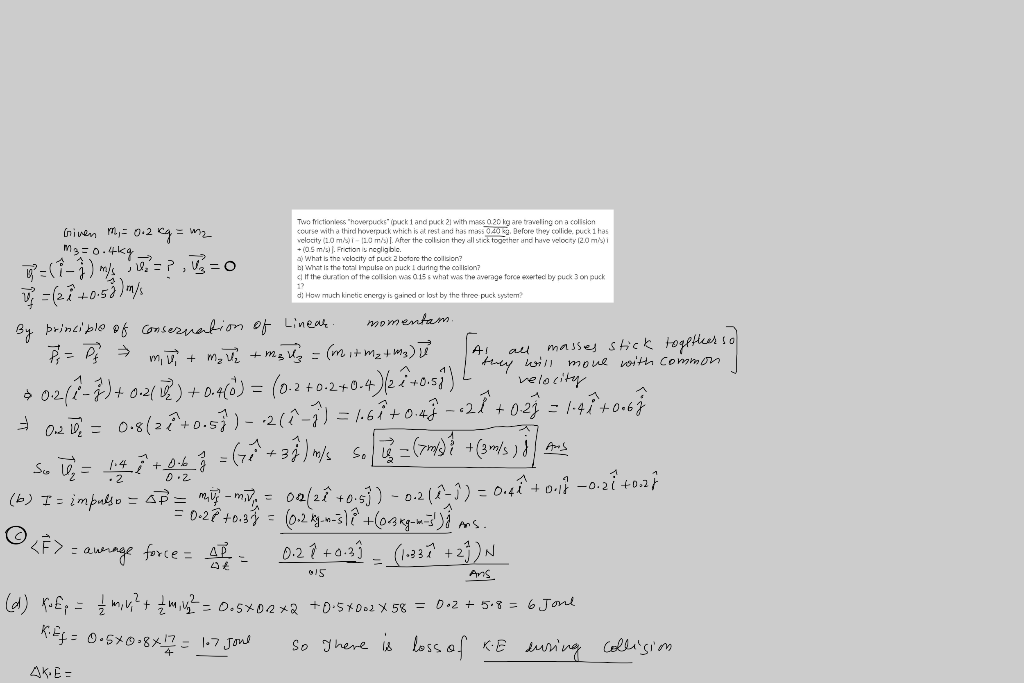
Two frictionless “hoverpucks” (puck 1 and puck 2) with mass 0.20 kg are travelling on a collision course with a third hoverpuck which is at rest and has mass 0.40 kg. Before they collide, puck 1 has velocity (1.0 m/s) î – (1.0 m/s) ĵ. After the collision they all stick together and have velocity (2.0 m/s) î + (0.5 m/s) ĵ. Friction is negligible.
a) What is the velocity of puck 2 before the collision?
b) What is the total impulse on puck 1 during the collision?
c) If the duration of the collision was 0.15 s what was the average force exerted by puck 3 on puck 1?
d) How much kinetic energy is gained or lost by the three-puck system?
Solutions
 genius_generous answered 6 months ago
Related Solutions
2. a) A 0.20 kg hockey puck on a frictionless surface is hit with a stick....
2. a)
A 0.20 kg hockey puck on a frictionless surface is hit with a
stick. The force of the stick on the puck, during the 0.4 seconds
while they are in contact, causes the puck to go from rest to 36
meters per second east. What was the magnitude of the average force
of the stick on the puck while they were in contact?
b)
A 3-kg block is placed on a frictionless ramp-incline, where it
slides from rest,...
A 0.30-kg puck, initially at rest on a frictionless horizontal surface, is struck by a 0.20-kg...
A 0.30-kg puck, initially at rest on a frictionless horizontal
surface, is struck by a 0.20-kg puck that is initially moving along
the x-axis with a velocity of 9.0 m/s. After the collision, the
0.20-kg puck has a speed of 5.4 m/s at an angle of θ = 53° to the
positive x-axis.
a)Determine the velocity of the 0.30-kg puck after the
collision.
magnitude-?
direction-? (from the positive X-axis)
(b) Find the fraction of kinetic energy lost in the
collision.
A 0.30-kg puck, initially at rest on a frictionless horizontal surface, is struck by a 0.20-kg...
A 0.30-kg puck, initially at rest on a frictionless horizontal
surface, is struck by a 0.20-kg puck that is initially moving along
the x-axis with a velocity of 8.6 m/s. After the
collision, the 0.20-kg puck has a speed of 5.2 m/s at an angle of
θ = 53° to the positive x-axis.
(a) Determine the velocity of the 0.30-kg puck after the
collision.
(b) Find the fraction of kinetic energy lost in the collision.
On a frictionless horizontal air table, puck A (with mass 0.253 kg) is moving toward puck...
On a frictionless horizontal air table, puck A (with mass 0.253
kg) is moving toward puck B (with mass 0.374 kg) which is initially
at rest. After the collision, puck A has velocity 0.119 m/s to the
left and puck B has velocity 0.649 m/s to the right. Part A: What
was the speed vAi of puck A before the collision? Part B:
Calculate ΔK, the change in the total kinetic energy of
the system that occurs during the collision.
On a frictionless air table, Puck A with mass ?A = 0.120 kg is moving at...
On a frictionless air table, Puck A with mass ?A =
0.120 kg is moving at speed ?A = 2.80 m/s in the +?
direction when at the origin it hits Puck B (of mass ?B
= 0.140 kg), which is initially at rest. Puck A is deflected in the
collision into a final velocity of ?'A = 2.10 m/s at an
angle of 30° from the + ? axis. The collision is not elastic.
a) Write down equations expressing...
Two pucks are sliding across a frictionless surface. Puck A has a mass of .330 kg...
Two pucks are sliding across a frictionless surface. Puck A has
a mass of .330 kg and a velocity of 5.50 m/s in the x direction.
puck be has a mss of .440 kg and a velocity of 6.60 m/s in the
negative x direction.
the pucks collide an bounce of each other. after the collision
puck a has a velocity of 1.10 m/s in the positive y-direction. What
are the x and y components of the velocity of puck...
On a frictionless horizontal air table, puck A (with mass 0.245 kg ) is moving toward...
On a frictionless horizontal air table, puck A (with mass 0.245
kg ) is moving toward puck B (with mass 0.374 kg ), which is
initially at rest. After the collision, puck A has velocity 0.118
m/s to the left, and puck B has velocity 0.655 m/s to the
right.
A: What was the speed vAi of puck A before the collision?
B: Calculate ΔKΔKDeltaK, the change in the total kinetic energy
of the system that occurs during the collision.
On a frictionless, horizontal air table, puck A (with mass 0.250 kg ) is moving toward...
On a frictionless, horizontal air table, puck A (with mass 0.250
kg ) is moving toward puck B (with mass 0.400 kg ), which is
initially at rest. After the collision, puck A has a velocity of
0.150 m/s to the left, and puck B has a velocity of 0.620 m/s to
the right.
a.What was the speed of puck A before the
collision?
b. Calculate the change in the total kinetic energy of the
system that occurs during the...
On a frictionless horizontal air table, puck A (with mass 0.255 kg ) is moving toward...
On a frictionless horizontal air table, puck A (with mass 0.255
kg ) is moving toward puck B (with mass 0.375 kg ), which is
initially at rest. After the collision, puck A has velocity 0.117
m/s to the left, and puck B has velocity 0.650 m/s to the
right.
What was the speed vAi of puck A before the
collision?
Calculate ΔK, the change in the total kinetic energy of
the system that occurs during the collision.
On a frictionless horizontal air table, puck A (with mass 0.245 kg ) is moving toward...
On a frictionless horizontal air table, puck A (with mass 0.245
kg ) is moving toward puck B (with mass 0.373 kg ), which is
initially at rest. After the collision, puck A has velocity 0.118
m/s to the left, and puck B has velocity 0.647 m/s to the
right.
a. What was the speed vAi of puck A before the collision?
b. Calculate ΔK, the change in the total kinetic energy of the
system that occurs during the collision.
ADVERTISEMENT
ADVERTISEMENT
Latest Questions
- On January 1, 2018, bonds with a face value of $ 79,000 were sold. The bonds...
- How do I make this sort in true alphabetical order instead of ascii(ABCabc) order? I am...
- As a healthcare provider in physical therapy, athletic training, or as an exercise scientist and personal...
- in the market for makeup artists, what happens after the invention of high-definition tv allowing viewers...
- 10. What are the three monetary policy tools of the Fed? Briefly describe how each tool...
- In what ways would the role of a manager working in a nonstandard international assignment arrangement...
- Write a Bash script called move that could replace the UNIX command mv. 'move' tries to...
ADVERTISEMENT