Question
In: Computer Science
Language: Python Create a graph and then set initial and goal states such that the number...
Language: Python
Create a graph and then set initial and goal states such that the number of nodes visited for BFS is smaller than that in DFS. Now modify the initial and goal state such that the number of nodes visited for BFS is larger than that in DFS.
Solutions
Expert Solution
Consider the following graph:
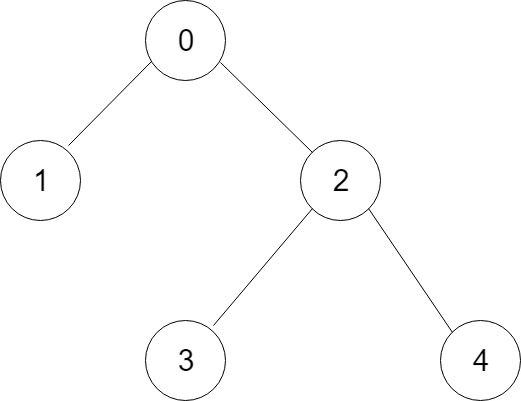
Two searches are done
0 to 1 and 0 to 4
PYTHON CODE:
def BFS(graph,start,goal):
       n=len(graph[0])
       list=[]
       list.append(start)
       visited=[]
       for i in range(0,n):
              visited.append(False)
       while True:
              count=0
              for i in range(0,n):
                     if visited[i]==True:
                            count=count+1
              if count==n:
                     break
              for i in range(0,n):
                     if visited[i]==False and graph[list[0]][i]==1:
                            list.append(i)
              visited[list[0]]=True
              if list[0]==goal:
                     print("Founded ",goal)
                     return
              else:
                     print("Visited ",list[0])
              list.pop(0)

def DFS(graph,start,goal):
       n=len(graph[0])
       list=[]
       list.append(start)
       visited=[]
       for i in range(0,n):
              visited.append(False)
       while True:
              count=0
              for i in range(0,n):
                     if visited[i]==True:
                            count=count+1
              if count==n:
                     break
              p=list.pop()
              for i in range(0,n):
                     if visited[i]==False and graph[p][i]==1:
                            list.append(i)
              visited[p]=True
              if p==goal:
                     print("Founded ",goal)
                     return
              else:
                     print("Visited ",p)

#Adjacency representation of graph
graph=[[0,1,1,0,0],
       [1,0,0,0,0],
       [1,0,0,1,1],
       [0,0,1,0,0],
       [0,0,1,0,0]]
print("No. of nodes visited in BFS smaller than DFS")
print("BFS")
BFS(graph,0,1)
print("DFS")
DFS(graph,0,1)
print("No. of nodes visited in BFS larger than DFS")
print("BFS")
BFS(graph,0,4)
print("DFS")
DFS(graph,0,4)
OUTPUT:
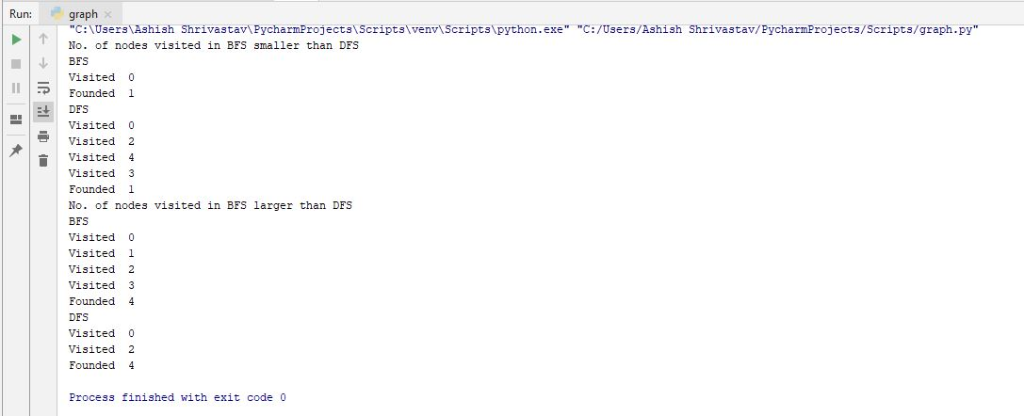
 venereology answered 6 months ago
Related Solutions
PYTHON LANGUAGE PLEASE DO NUMBER 5 ONLY """ # 1. Based on Textbook R6.28 # Create...
PYTHON LANGUAGE
PLEASE DO NUMBER 5 ONLY
"""
# 1. Based on Textbook R6.28
# Create a table of m rows and n cols and initialize with 0
m = 3
n = 4
# The long way:
table = []
for row in range(m) :
table.append([0]*n)
# The short way:
# 2. write a function to print the table in row, column
format,
# then call the function
'''
# using index
def printTable(t):
for i in range(len(t))...
Question 1: Using Python 3 Create an algorithm The goal is to create an algorithm that...
Question 1: Using Python 3 Create an
algorithm
The goal is to create an algorithm that can sort a
singly-linked-list with Merge-sort. The program should read
integers from file (hw-extra.txt) and create an unsorted
singly-linked list. Then, the list should be sorted using merge
sort algorithm. The merge-sort function should take the head of a
linked list, and the size of the linked list as parameters.
hw-extra.txt provided:
37 32 96 2 25 71 432 132 76 243 6 32...
The programming language is Python Instructions: Create a function that will delete a node in a...
The programming language is Python
Instructions:
Create a function that will delete a node in a Linked List based
on position number. On below example, if you want to delete
position #2, it will remove the Banana
(arrangement of nodes below is Apple, Banana, Cherry, Grapes,
Orange).
myLinkedList = LinkedList()
myLinkedList.append("Banana")
myLinkedList.append("Cherry")
myLinkedList.append("Grapes")
myLinkedList.append("Orange")
myLinkedList.prepend("Apple")
myLinkedList.deleteByPositionNum(2)
node = myLinkedList.head
while node:
print(node.value, " ")
node = node.next_node
You may start with the function head:
def deleteByPositionNum(self, positionNum):
Python Language Only! Python Language Only! Python Language Only! Python 3 is used. When doing this...
Python Language Only!
Python Language Only!
Python Language Only!
Python 3 is used.
When doing this try to use a level one skill python, like as if
you just learned this don't use anything advanced if you can
please. If not then do it as you can.
Assume you have a file on your disk named floatnumbers.txt
containing float numbers. Write a Python code that reads all the
numbers in the file and display their average. Your code must
handle...
This program (in python) will display a set of authors and the number of novels written...
This program (in python) will display a set of authors and the
number of novels written by each author in both a table and a
histogram. You will ask the user for all of the information. Using
what you learned about incremental development, use the following
approach to create your program:
Prompt the user for the information about the table. First, ask
for the title of this data set by prompting the user for a title
for data. Output the...
Please solve this problem with Python Language. P#2. A Pythagorean triplet is a set of three...
Please solve this problem with Python Language.
P#2. A Pythagorean triplet is a set of three natural numbers, a
< b < c, for which a2 + b2 = c2 . For example, 32 + 42 = 52.
And a + b + c = 3 + 4 + 5 = 12. There exists exactly two
Pythagorean triplet for which a + b + c = 300. Find a, b, c.
Hints: Level-0 Algorithm:
1. Find the possible ranges of...
Draw a single graph in Python showing the performance of both algorithms against the number of...
Draw a single graph in Python showing the performance of both
algorithms against the number of elements (100,000). Consider the
worst case scenario. In the graph we want to see: labeling of the
axes, a legend, a title and the graphs for both linear and binary
search, again correctly labeled. Explain what you see.
(Programming Language: Python) It's trivial that the value of a number remains the same no matter...
(Programming Language: Python)
It's trivial that the value of a number remains the same no
matter how many zeros precede it. However, adding the zeros at the
end of the number increases the value * 10. Jasmine is tired of
seeing \001/100" on her tests (well yes, no one really writes 001,
but Jasmine's teacher finds it funny to do so). So, she managed to
login to her teacher's computer and now wants to design a function
that can move...
(Programming Language: Python) Complete the function remove number such that given a list of integers and...
(Programming Language: Python)
Complete the function remove number such that given a list of
integers and an integer n, the function removes every instance
of
n from the list. Remember that this function needs to modify the
list, not return a new list.
# DO NOT ADD ANY OTHER IMPORTS from typing import List
def remove_number(lst: List[int], number: int) -> None:
"""
Remove every instance of number in lst. Do this *in-place*, i.e.
*modify* the list. Do NOT return a...
Solve the polynomial inequality and graph the solution set on a real number line. Express the...
Solve the polynomial inequality and graph the solution set on a
real number line. Express the solution set in interval
notation.
(x-6)(x+3)>0
Use the inequality in the form f(x)>0, to write the intervals
determined by the boundary points as they appear from left to right
on a number line.
Interval Sign
-
-
-
(Simplify yours answers. Type your answer in interval notation.
Type exact answers, using radicals as needed. Use integers or
fractions for any numbers in the expressions.)
ADVERTISEMENT
ADVERTISEMENT
Latest Questions
- 2. Compare and compare the matrix multiplication algorithm and the Floyd-Warshall algorithm to find all pairs...
- Q: 50.00 ml of 0.5216 M copper(II) nitrate solution is combined with 100.0 ml of 0.5580...
- This is a business law question. Explain how environmental laws regulate the use of toxic substances...
- A sky diver and her parachute system weigh a total of 800 N. She is falling...
- Need solution: HSL Company produces rugs. The following cost information from last year is available: Total...
- You are the network administrator for your organization. Your DHCP server (Server1) has a scope of...
- python3 Let x0,...,xn−1 be n numbers stored in the list x. The median of x, denoted...
ADVERTISEMENT