Question
In: Computer Science
Given the following list of values, perform a binary search for the indicated search item. Use...
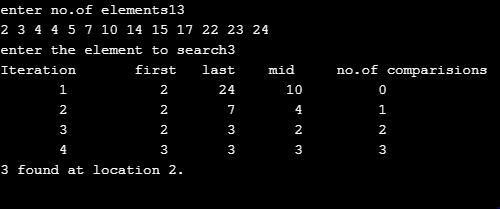
Given the following list of values, perform a binary search for the indicated search item. Use the binary search algorithm on pg. 1026 of our textbook. Show the values of first, last and middle, and the number of comparisons made after each iteration of the loop. Your should create a table like the following to show your work, where first and last are the values of the variables at the beginning of the loop, and mid is the midpoint used during that iteration, list[mid] is the value in the list at the midpoint, and No. of key comparisons should be the number of comparisons made during this iteration by the algorithm:
Iteration  first   last    mid  list[mid]   No. of key comparisons
1          0       12      ?    ?           ?
List:
[ 2, 3, 4, 4, 5, 7, 10, 14, 15, 17, 22, 23, 24 ]
Searching for value: 3
Solutions
Expert Solution
#include <stdio.h>
int main()
{
int f,l,mid,i,comp=0,key,n;
int list[20];
printf("enter no.of elements");
scanf("%d",&n);
for(i=0;i<n;i++)
scanf("%d",&list[i]);
printf("enter the element to search");
scanf("%d",&key);
f= 0;
l=n-1;
i=0;
mid=(f+l)/2;//caluculate mid
printf("Iteration\tfirst\tlast\tmid\tno.of comparisions\n");
while (f<= l) {//while the first value becomes greater than last
then element not found
printf("%8d%12d%8d%8d%10d\n",i+1,list[f],list[l],list[mid],comp);//print
values
i++;
if (list[mid] < key){//if mid is less than key it is in second
half
f = mid+1;
comp++;//increase comparisions
}
else if (list[mid] == key) {
comp++;//check if equals and increment comparisions
printf("%d found at location %d.\n", key, mid+1);
break;
}
else//if mid greater than key it is in first half
{
l= mid-1;
comp++;//increment comparisions
}
mid = (f+ l)/2;//change the mid value
}
if(f>l)
{
printf("The element not found");
}
return 0;
}
 venereology answered 6 months ago
Related Solutions
Design a program which uses functions to sort a list and perform a binary search. Your...
Perform the following arithmetic in Binary assuming 16 bit registers (67)10 + (-89)10 List the values...
A binary search tree can be built with a traditional insertion method given a list of...
A binary search tree can be built with a traditional insertion method given a list of...
Binary Search. Write a MIPS assembly program to perform a binary search on A[10], which is an array of 10 positive integers.
Consider the recursive formulation of the Binary Search algorithm. Given a sorted and non-decreasing list of...
Create a List object that uses the binary search algorithm to search for the string "A"....
A search for “car” on a shopping website gave a list of the following items: Item...
Suppose I have a list of 128 unsorted numbers. If I use the binary search to...
Given the array a and the binary search function below, list all ACTIVATIONS IN FINDING t=19....
- Two 10-cm-diameter charged rings face each other, 15cm apart. The left ring is charged to -29nC...
- Under what conditions would it be possible for an excise tax to have no efficiency cost...
- explain the difference between activities and financial statements of service businesses and merchandising businesses.
- 2. Compare and compare the matrix multiplication algorithm and the Floyd-Warshall algorithm to find all pairs...
- Q: 50.00 ml of 0.5216 M copper(II) nitrate solution is combined with 100.0 ml of 0.5580...
- This is a business law question. Explain how environmental laws regulate the use of toxic substances...
- A sky diver and her parachute system weigh a total of 800 N. She is falling...