Question
In: Biology
Explain why 1 additional net ATP is produced when the beginning substrate is glycogen compared to...
Explain why 1 additional net ATP is produced when the beginning substrate is glycogen compared to glucose. In your answer provide the name of the enzyme responsible for this difference.
Solutions
Expert Solution
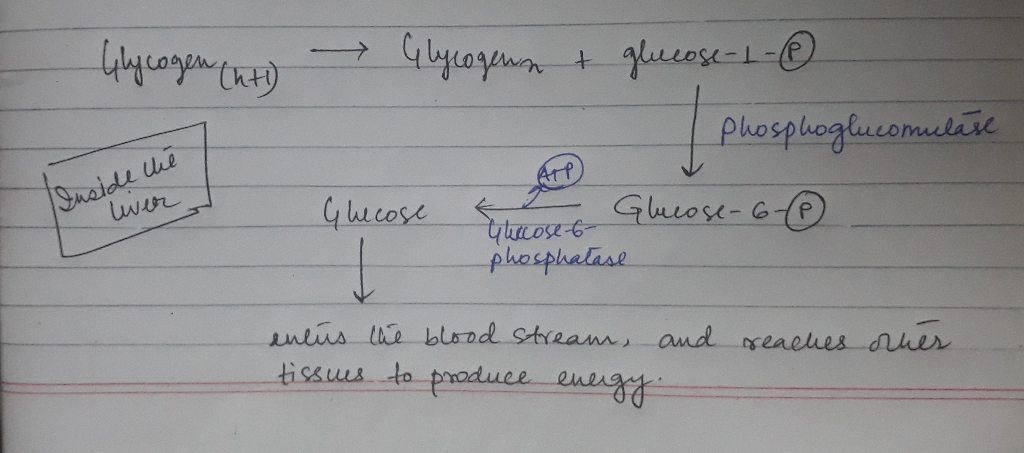
The breakdown of glycogen to provide glucose is known as glycogenolysis. This process can take place in muscles, liver etc. , i.e., in places where there are glycogen reserves present in the body. Glycogen reserves are usually broken down in the body, when glucose is limiting. In skeletal muscles, glycogen is broken down to glucose-1-phosphate, which is then converted to glucose-6-phosphate, and this then enters the glycolytic pathways to release energy. But, in the liver, the glucose-6-phosphate is first converted to glucose by an enzyme glucose-6-phosphatase, so that it can be transported to other cells of the body, and then this glucose can enter the various catabolic pathways to produce energy. In this process inside the hepatic cells, under the action of the enzyme glucose-6-phosphatase, when glucose-6-phosphate is converted to glucose, one molecule of ATP is liberated. So, an additional net ATP molecule is produced when the beginning substrate is glycogen compared to glucose(in the conversion of glucose-6-phosphate to glucose by glucose-6-phosphatase), but this is true only when this glycogen comes from the liver.
 gladiator answered 7 months ago
Related Solutions
The ATP that is generated in glycolysis is produced by substrate-level phosphorylation
Approximately how many net molecules of ATP are used or generated by gluconeogenesis as compared to...
1. ATP is needed to phosphorylate enzymes in the cascade pathway for glycogen phosphorylase. It also...
. Explain how glycogen phosphorylase is regulated by AMP, ATP, G6Pand phosphorylation/dephosphorylation? What is the physiological...
1. Glycogen synthase is active when _______________. A. phosphorylated B. Glycogen synthase activity is not affected...
The nucleophile that is used to free most glucose from glycogen is__________, 1. ATP 2. Tyrosine...
How many net ATP equivalents (including GTPs) would be produced from the complete catabolism of a...
Aerobic Respiration Steps Where in the cell Inputs or Reactants Outputs or Products Net ATP Produced...
What is substrate-level phosphorylation ? What is oxidative phosphorylation ? Explain how cellular respiration produces ATP...
Glycogen is the body’s storage form of glucose. When glycogen is degraded, glucose 1-P is formed....
- Do you think that CAFTA will have a major impact on the U.S. economy? Why?
- Assignment 4, Fraction Comparable Instructions For this assignment, you will be updating the Fraction class from...
- what crystal claim that English is doing across the world?
- Site map for your e-commerce site. How many webpages this site has? What’s the name of...
- A skier of mass 60 kg starts at the top of a steep slope with an...
- If banks must hold $4 in reserves for each $10 in deposits, and the public decides...
- A 244 g mass is hung on a spring. As a result the spring stretches 20.5...