Question
In: Physics
Two carts (100 g and 150 g) on an air track are separated by a compression...
Two carts (100 g and 150 g) on an air track are separated by a compression spring. The spring is released. Represent the process with a momentum bar chart (a) with one cart as the system and (b) with both carts as the system. (c) Write expressions for all the physical quantities you can from this information. Identify your object of reference.
Solutions
Expert Solution
We define impulse of a particle

where,
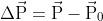 , the change of momentum of a particle. In a particle system
momentum is conserved, it means
, the change of momentum of a particle. In a particle system
momentum is conserved, it means
 , the change of momentum of a particle. In a particle system
momentum is conserved, it means
, the change of momentum of a particle. In a particle system
momentum is conserved, it means
 force apply by the spring on the carts
 force apply by the spring on the carts
then,

First case) only m1=100g (to the right of spring)
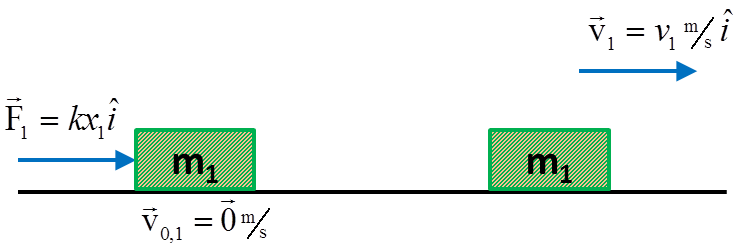
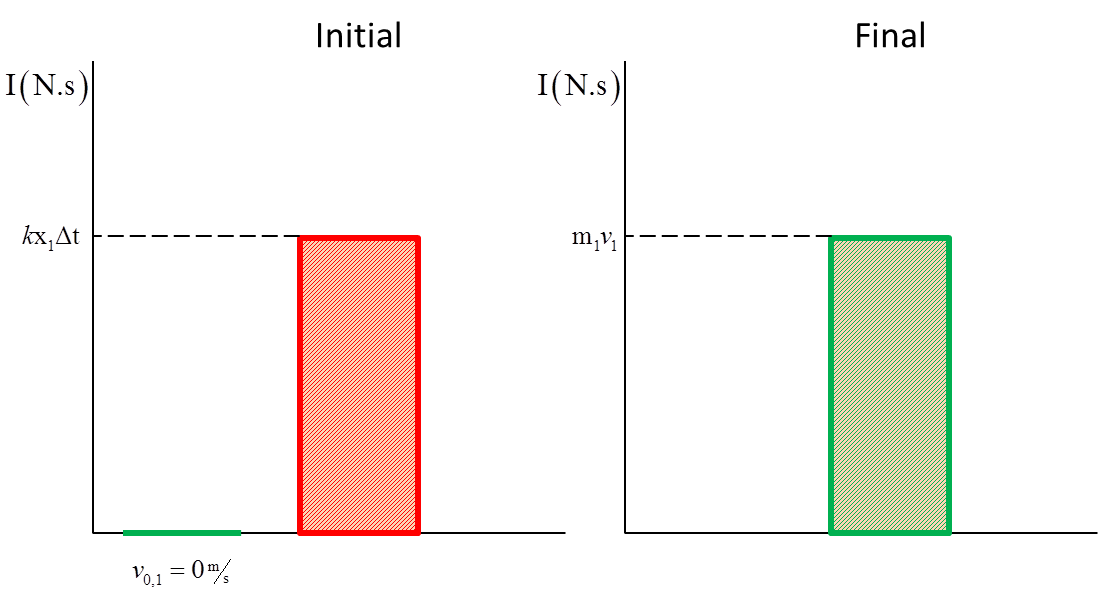
the impulse of the cart is

or

therefore, the momentum bar chat


Second case) only m2 =150g (to the left of spring)
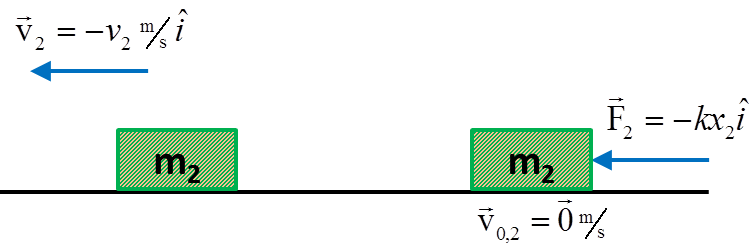
the impulse of the cart is

or

therefore, the momentum bar chat
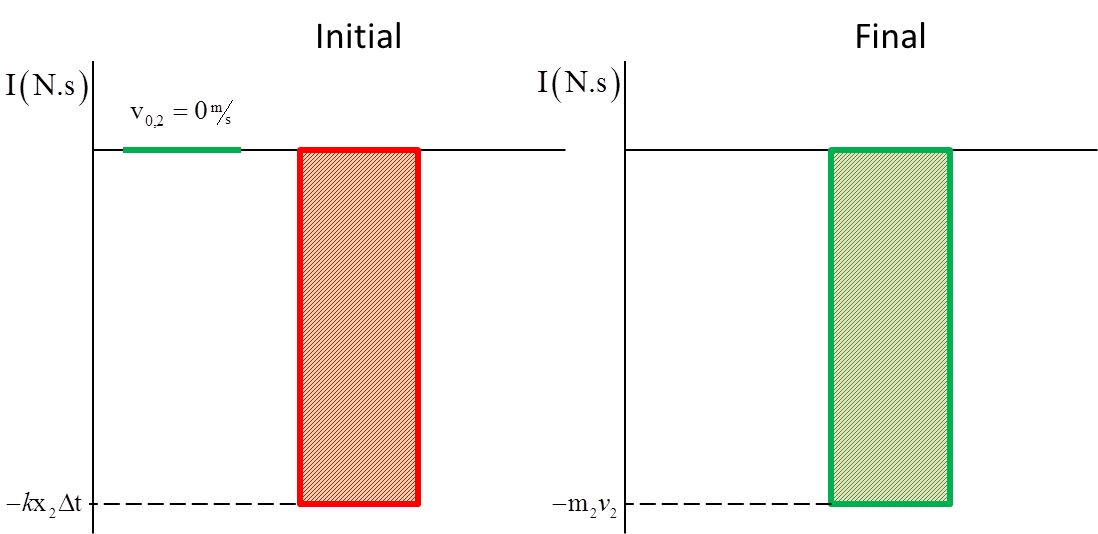


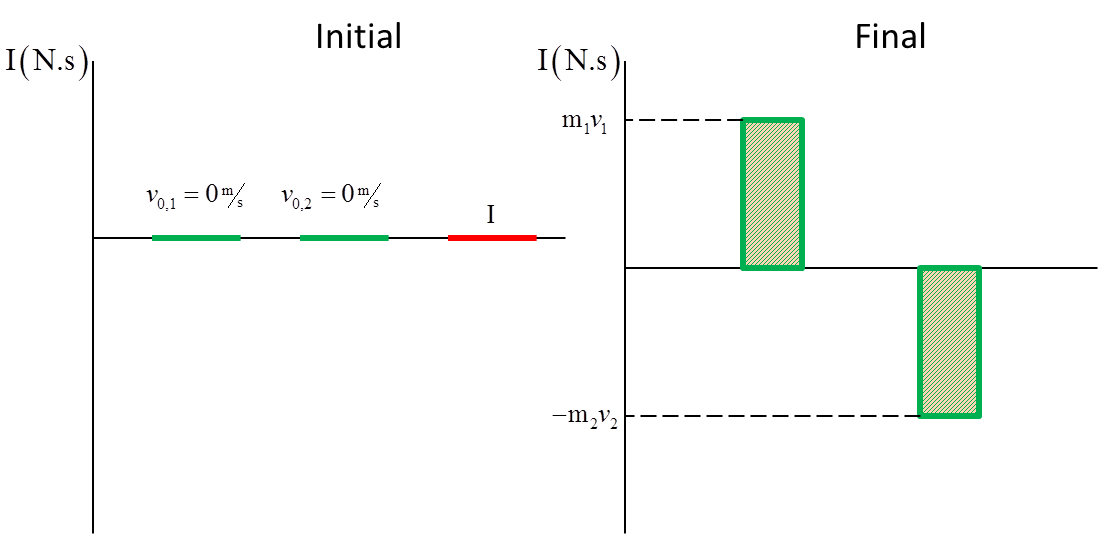
Third case) two masses m1 and m2
As for a particle system

then, impulse and net internal force of the particle system are zero too

Therefore, the momentum bar chat

 genius_generous answered 6 months ago
Related Solutions
Two carts on an air track have the same mass and speed and are traveling towards...
Two carts mounted on an air track are moving toward one another. Cart 1 has a...
A student runs an experiment with two carts on a low-friction track. As measured in the...
Two air track gliders of mass 400.0 g and 300.0 g are moving towards each other...
4) Two carts collide on a level track. Cart A has mass of 3 kg and...
Two carts sit on a horizontal, frictionless track; the spring between them is compressed. The small...
Two low-friction physics demo carts collide on a horizontal track. The first cart, with a mass...
Two carts with masses 250. g and 200. g are free to slide without friction on...
A 283 g air track glider moving at 0.69 m/s on a 2.4 m long air...
a cart of mass of 420 g moving on a frictioless horizontal linear air track at...
- Students performed a procedure similar to Part III of this experiment (Analyzing a Vitamin Supplement for...
- The output of the function is a dictionary whose keys represent the bins and whose values...
- The shape of a graph of a binomial distribution depends on the value of both n...
- In 2012, cost per Medicare beneficiary did what?
- 3. A. What techniques can a firm use to optimize demand deposit holdings? B. How do...
- The half-life of mercury-197 is 64.1 hours. If a patient undergoing a kidney scan is given...
- Double bonds react with Br2 to form a dibromide. Isobutylene undergoes cationic polymerization under conditions where...