Question
In: Chemistry
Balancing Redox Equations in Acidic or Basic Solutions In addition to mass balance, oxidation-reduction reactions must...
Balancing Redox Equations in Acidic or Basic Solutions
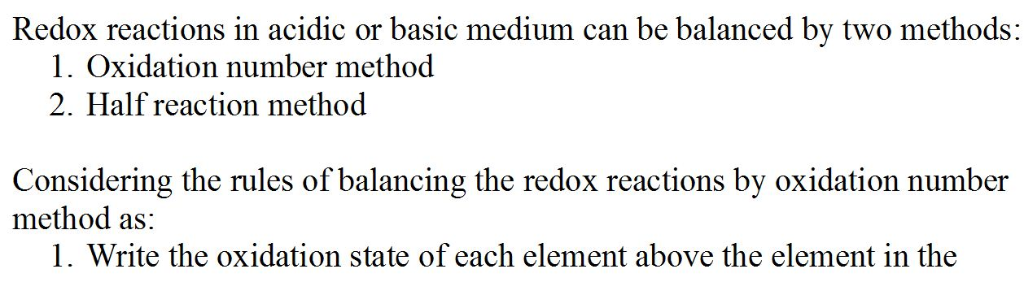
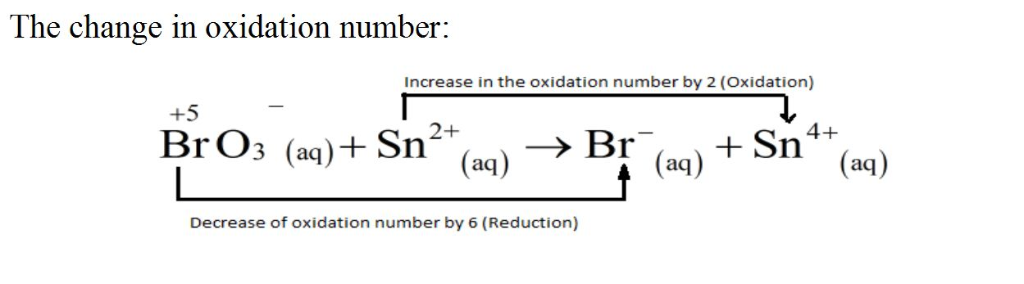
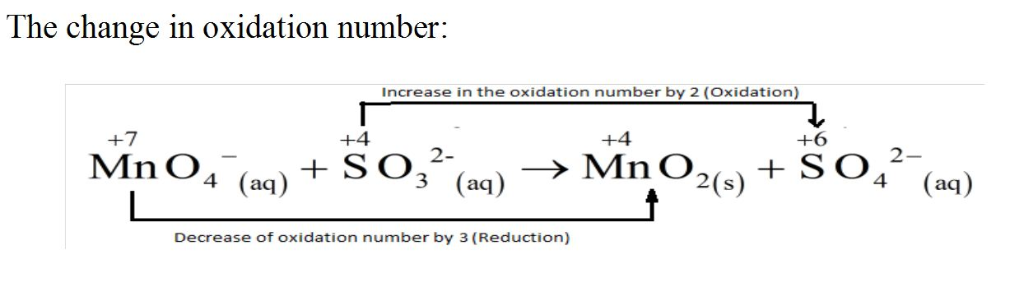
In addition to mass balance, oxidation-reduction reactions must be balanced such that the number of electrons lost in the oxidation equals the number of electrons gained in the reduction. This balancing can be done by two methods. The oxidation number method balances the net increase in oxidation of the substance oxidized with the net decrease in the oxidation number of the substance reduced. The half-reaction method balances the electrons lost in the oxidation half-reaction with the electrons gained in the reduction half-reaction. In both methods
H2O(l),OH?(aq), and H+ (aq) may be added to complete the mass balance. Which substances are used depends on the reaction conditions.
Acidic solution
In acidic solution, bromate ion can be used to react with a number of metal ions. One such reaction is
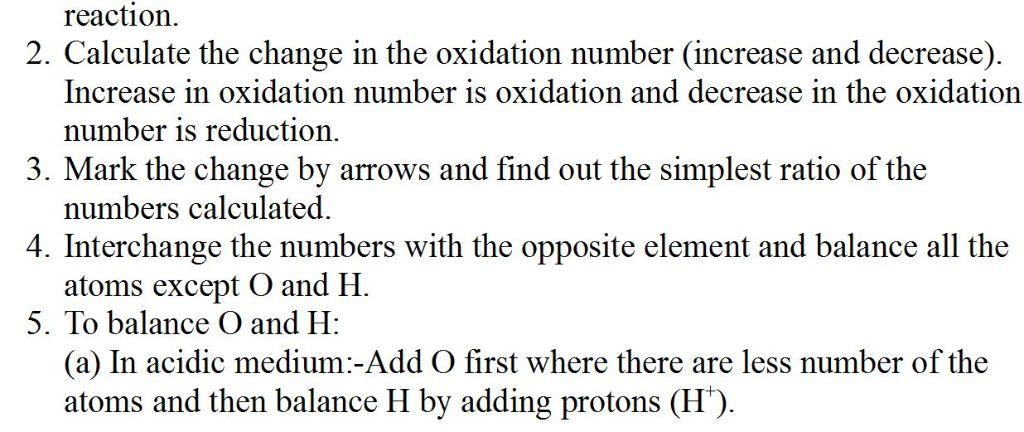
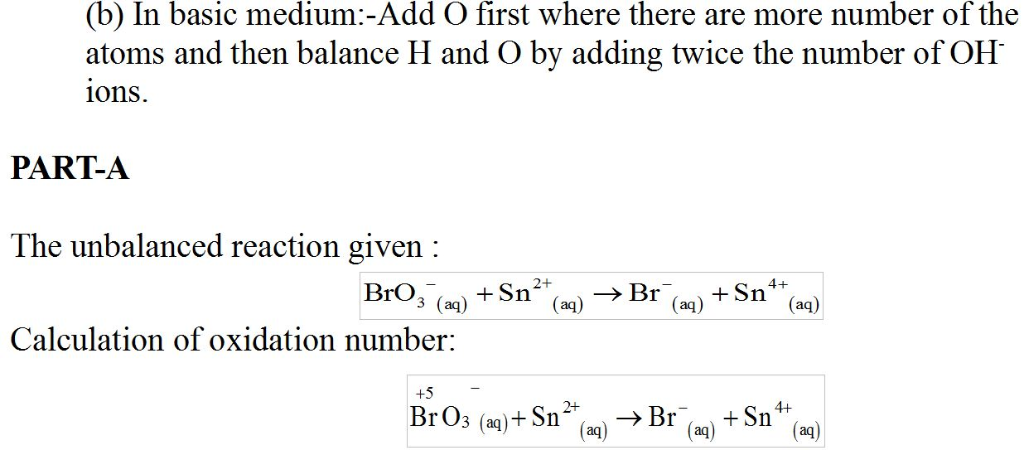
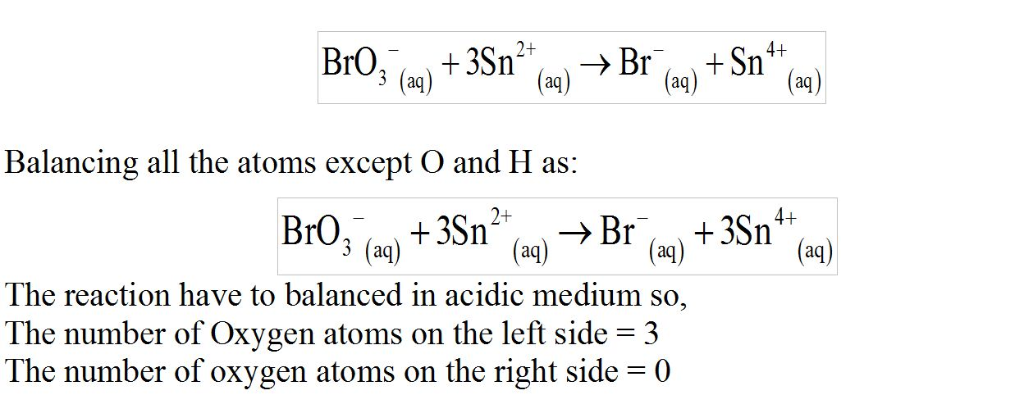
BrO3?(aq)+Sn2+(aq)?Br?(aq)+Sn4+(aq)
Since this reaction takes place in acidic solution,
H2O(l)andH+(aq) will be involved in the reaction. Places for these species are indicated by the blanks in the following restatement of the equation:
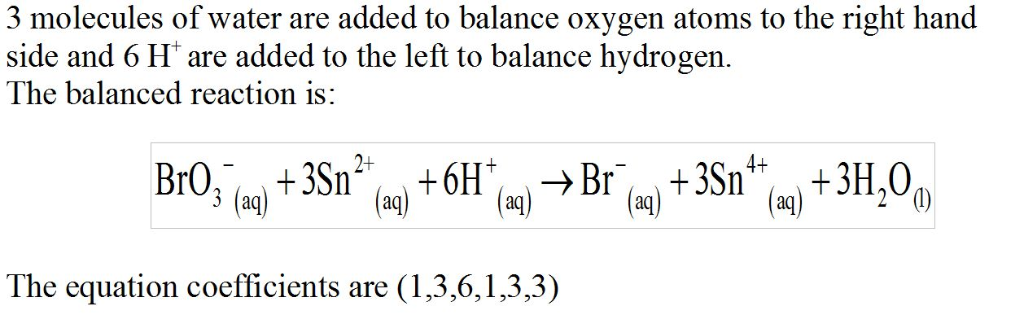
BrO3?(aq)+Sn2+(aq)+ ____ ?Br?(aq)+Sn4+(aq)+ ___
Part A
What are the coefficients of the six species in the balanced equation above? Remember to include coefficients for
H2O(l)andH+(aq)
in the appropriate blanks.
Enter the equation coefficients in order separated by commas (e.g., 2,2,1,4,4,3).
Basic solution
Potassium permanganate,
KMnO4, is a powerful oxidizing agent. The products of a given redox reaction with the permanganate ion depend on the reaction conditions used. In basic solution, the following equation represents the reaction of this ion with a solution containing sodium sulfite:
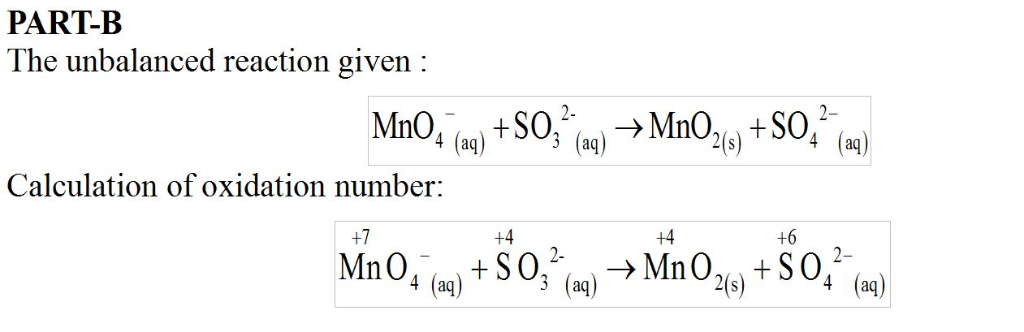
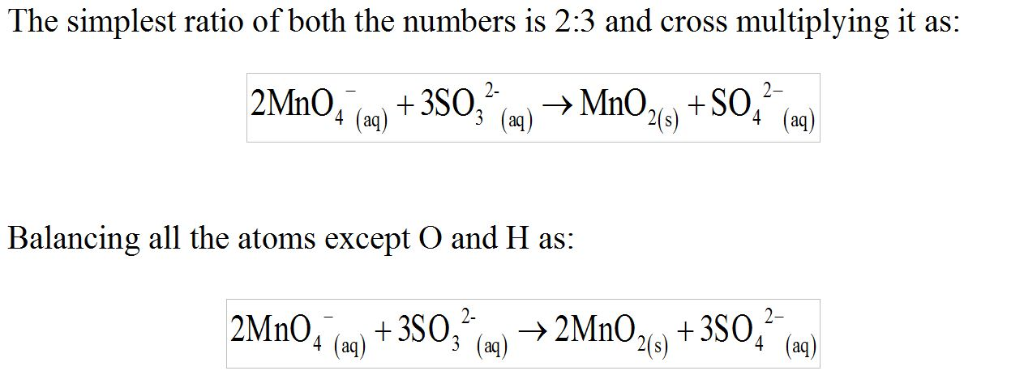
MnO4?(aq)+SO32?(aq)?MnO2(s)+SO42?(aq)Since this reaction takes place in basic solution,H2O(l)andOH?(aq)
will be shown in the reaction. Places for these species are indicated by the blanks in the following restatement of the equation:
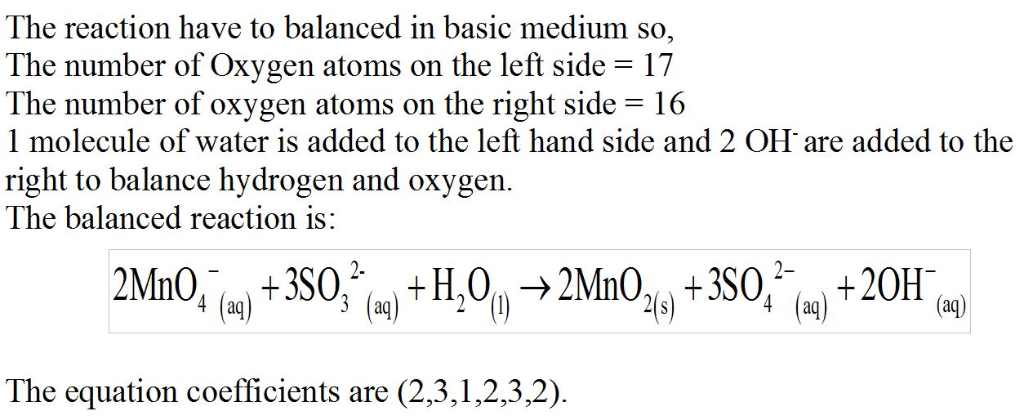
MnO4?(aq)+SO32?(aq)+ ____?MnO2(s)+SO42?(aq)+ ___
Part B
What are the coefficients of the six species in the balanced equation above? Remember to include coefficients for
H2O(l)andOH? (aq) in the blanks where appropriate.
Enter the equation coefficients in order separated by commas (e.g., 2,2,1,4,4,3).
Solutions

 queen_honey_blossom answered 7 months ago
Related Solutions
In addition to mass balance, oxidation-reduction reactions must be balanced such that the number of electrons...
Redox (oxidation-reduction) reactions in glycolysis
Why must the charge balance in oxidation-reduction reactions?
Using half equations for the oxidation and reduction, develop the redox equation for the oxidation of...
Balance the following redox reactions. Show the complete balanced reduction half and oxidation half reaction, and...
Separate the following redox reactions into half-reactions, and label each half-reaction as oxidation or reduction. Part...
Continue and balance the following reactions. Provide half-reactions for balancing of redox processes P4 + KOH...
2. Balance the first redox reaction in acidic solution and the second redox reaction in basic...
Balance the following oxidation–reduction equation. The reactions occur in a basic aqueous solution. Cd2++ H 2S → Cd...
use oxidation numbers to decide which of the following are redox reactions. for all redox reactions...
- Based on what you learned in this module, identify one person who you believe possesses primarily...
- An Auditor may decide to make use of a specialist in obtaining sufficient appropriate audit evidence...
- Dirac's Theorem states that "A simple graph with n vertices (n >= 3) is Hamiltonian if...
- Two 10-cm-diameter charged rings face each other, 15cm apart. The left ring is charged to -29nC...
- Under what conditions would it be possible for an excise tax to have no efficiency cost...
- explain the difference between activities and financial statements of service businesses and merchandising businesses.
- 2. Compare and compare the matrix multiplication algorithm and the Floyd-Warshall algorithm to find all pairs...