Question
In: Computer Science
In the previous question, you designed a simple algorithm to create a class list application. In...
In the previous question, you designed a simple algorithm to
create a class list application. In this question, you
will implement the same application in Java. To do this, you will
need a working version of a Student ADT, a List
ADT, and the List Iterator. You may start with your own Student
ADT, or you can start from the solutions to
Assignment 2. You will be given a working version of a List
ADT.
Recall that your application does the following:
• Create a class list of students
• Display every Student record in the class list to the
console.
• Give every student a bonus mark on the final exam. It does not
matter how much of a bonus you give.
• Display every Student record in the class list to the console, to
show the changes to the records.
You must store Student objects in a List, using the given List
ADT.
You are to use the List Iterator for any task that requires looking
at every element in a list (the last two items
above).
Here’s a guide for you to help you manage this task.
1. Download the BasicLinkedList.java and List.java files from
Moodle.
2. Obtain the StudentADT.java and Student.java files from either
your solution or the model solution of assignment
3. Create a new application class called ClassListApp.java, that
contains a main method. Make sure that you
include import java.util.*; on the top of the file.
4. Take your design for Exercise 1, and copy it into
ClassListApp.java, as comments. Implement the design in
steps (not all at once). Every time you have a step implemented,
compile and test.
Here are the java source file already given
List.java
import java.util.Iterator;
/**
* Defines the interface to a list collection.
* The implementation of the list is hidden.
*
*/
public interface List<E> extends Iterable<E>
{
/**
Pre:
Post: the list is unchanged.
* Return: true if this list contains no elements; false
otherwise
*/
public boolean isEmpty();
/**
Pre:
Post: the list is unchanged.
* Return: the number of elements in this list.
*/
public int size();
/**
* Check if an element exists in the list
Pre:
Post: the list is unchanged.
Return: true if the specified element is found in this list
and
false otherwise. Throws an EmptyCollectionException if the
list
is empty.
*/
public boolean contains (E targetElement);
/**
Deletes the first element in this list and returns a
reference
to it. Throws an EmptyCollectionException if the list is
empty.
Pre:
Post: the first element is removed from the list
Return: a reference to the removed element
*/
public E deleteHead();
/**
Removes the last element in this list and returns a reference
to it. Throws an EmptyCollectionException if the list is
empty.
Pre:
Post: the last element is removed from the list
Return: a reference to the removed element
*/
public E deleteTail();
/**
Removes the first instance of the specified element from this
list and returns a reference to it. Throws an
EmptyCollectionException
if the list is empty. Throws a ElementNotFoundException if
the
specified element is not found in the list.
Pre: targetElement :: E, the target element to be removed
Post: the element is removed from the list
Return: a reference to the removed element
*/
public E deleteElement(E targetElement);
/**
Insert a new node to the head of the list.
Pre: item :: E, content in the new node
Post: new node is inserted to the head of the list
Return: nothing
*/
public void insertHead(E item);
/**
Insert a new node to the end of the list.
Pre: item :: E, content in the new node
Post: new node is inserted to the end of the list
Return: nothing
*/
public void insertTail(E item);
/**
Insert a new node at a specific position in the list.
Pre: item :: E, content in the new node
position :: the position of the new node
Post: new node is inserted at position in the list
Return: nothing
*/
public void insertAtPosition (E item, int position);
/**
Retrive the element at a specific position in the list.
Pre: position :: Integer, a position in the list
Post: the list is unchanged
Return: the element at the position
*/
public E get(int position);
/**
* Useful method for pretty print for atomic data
Pre:
Post: the list is unchanged.
Return: Returns a string representation of this list.
*/
public String toString();
/**
* Returns an iterator for the elements in this list.
*
* @return an iterator over the elements in this list
*/
public Iterator<E> iterator();
}
Student.java
/**
* Defines the interface to the student ADT.
*
*/
public interface Student {
/**
displayStudentRecord()
Pre:
Post: displays Student info
Return: nothing
*/
public void displayStudentRecord();
/**
Algorithm changeAssignmentGradeForStudent(asnNum,grade)
Pre: asnNum :: Integer, the index of the assignment to grade
grade :: double, the amount to change the grade
Post: If the index is sensible, the appropriate grade is
changed
(this method allows grades to be changed arbitrarily)
Return: true if the change was made, false otherwise
*/
public boolean changeAssignmentGradeForStudent (int asnNum, double
grade);
/**
Algorithm changeExamGradeForStudent(grade)
Pre: grade :: double, the amount to change the grade
Post: the exam grade is changed
(this method allows grades to be changed arbitrarily)
Return: nothing
*/
public void changeExamGradeForStudent(double grade);
}
StudentADT.java
public class StudentADT implements Student {
private String firstName;
private String lastName;
private int stNum;
private double [] agrades;
private double egrade;
/**
Algorithm StudentADT(firstNm, lastNm, stNo, asn1Grade, asn2Grade,
asn3Grade, examGrade)
Constructor to create a student object
Pre: firstNm, lastNm :: String
stNo :: integer
asn1Grade, asn2Grade, asn3Grade :: double
examGrade :: double
Post: allocates memory on the heap for a new Student object
Return: a new Student object, with all fields filled in
*/
public StudentADT(String firstNm, String lastNm, int stNo, double
asn1Grade, double asn2Grade, double asn3Grade, double examGrade){
this.firstName = firstNm;
this.lastName = lastNm;
this.stNum = stNo;
this.agrades = (double[]) new double[3];
this.agrades[0] = asn1Grade;
this.agrades[1] = asn2Grade;
this.agrades[2] = asn3Grade;
this.egrade = examGrade;
}
/**
Algorithm displayStudentRecord()
Pre:
Post: displays Student info
Return: nothing
*/
public void displayStudentRecord() {
System.out.println("Record for " + this.lastName + ", " +
this.firstName + " (" + this.stNum + ") ");
System.out.println("Assignment grades");
for (int i = 0 ; i <= 2; i ++)
System.out.println(this.agrades[i]);
System.out.println("Exam grade: " + this.egrade);
}
/**
Algorithm changeAssignmentGradeForStudent(asnNum,grade)
Pre: asnNum :: Integer, the index of the assignment to grade
grade :: double, the amount to change the grade
Post: If the index is sensible, the appropriate grade is
changed
(this method allows grades to be changed arbitrarily)
Return: true if the change was made, false otherwise
*/
public boolean changeAssignmentGradeForStudent (int asnNum, double
grade) {
if (asnNum < 0 || asnNum > 2)
return false;
else {
this.agrades[asnNum] = this.agrades[asnNum] + grade;
return true;
}
}
/**
Algorithm changeExamGradeForStudent(grade)
Pre: grade :: double, the amount to change the grade
Post: the exam grade is changed
(this method allows grades to be changed arbitrarily)
Return: nothing
*/
public void changeExamGradeForStudent(double grade) {
this.egrade = this.egrade + grade;
}
}
Solutions
Expert Solution
import java.util.Iterator;

interface List<E> extends Iterable<E> {

    public boolean isEmpty();

    public int size();

    public boolean contains(E targetElement);

    public E deleteHead();

    public E deleteTail();

    public E deleteElement(E targetElement);

    public void insertHead(E item);

    public void insertTail(E item);

    public void insertAtPosition(E item, int position);

    public E get(int position);

    public String toString();

    public Iterator<E> iterator();

}

public class BasicLinkedList<E> implements List<E>, Iterable<E> {

    private Node<E> head;
    private Node<E> tail;
    private int numElements;

// basic constructor
    public BasicLinkedList() {
        head = null;
        tail = null;
        numElements = 0;
    }

    public boolean isEmpty() {
        return (numElements == 0);
    }

    public int size() {
        return numElements;
    }

    public boolean contains(E targetElement) {
        if (isEmpty())
            throw new IllegalStateException("List is empty and there are no elements to check");

        boolean found = false;
        Node<E> current = head;

        while (current != null && !found)
            if (targetElement.equals(current.getNodeItem()))
                found = true;
            else
                current = current.getNextNode();

        return found;
    }

    public E deleteHead() {
        if (isEmpty())
            throw new IllegalStateException("List is empty and there are no elements to delete");

        Node<E> result = head;
        head = head.getNextNode();
        if (head == null)
            tail = null;
        numElements--;

        return result.getNodeItem();
    }

    public E deleteTail() {
        if (isEmpty())
            throw new IllegalStateException("List is empty and there are no elements to delete");

        Node<E> previous = null;
        Node<E> current = head;

        while (current.getNextNode() != null) {
            previous = current;
            current = current.getNextNode();
        }

        Node<E> result = tail;
        tail = previous;
        if (tail == null) // only one element in list
            head = null;
        else
            tail.setNextNode(null);
        numElements--;

        return result.getNodeItem();
    }

    public E deleteElement(E targetElement) {
        if (isEmpty())
            throw new IllegalStateException("List is empty and there are no elements to delete");

        boolean found = false;
        Node<E> previous = null;
        Node<E> current = head;

        while (current != null && !found) {
            if (targetElement.equals(current.getNodeItem()))
                found = true;
            else {
                previous = current;
                current = current.getNextNode();
            }
        }

        if (!found)
            throw new IllegalStateException("Item is not found in the list");

        if (size() == 1) // only one element in the list
            head = tail = null;
        else if (current.equals(head)) // target is at the head
            head = current.getNextNode();
        else if (current.equals(tail)) // target is at the tail
        {
            tail = previous;
            tail.setNextNode(null);
        } else // target is in the middle
            previous.setNextNode(current.getNextNode());

        numElements--;

        return current.getNodeItem();
    }

    public void insertHead(E item) {
        Node<E> newNode = new Node<E>(item);

        newNode.setNextNode(head);
        head = newNode;

        if (tail == null) { // special case: when list is empty
            tail = newNode;
        }

        numElements++;
    }

    public void insertTail(E item) {
        if (head == null) { // special case: when list is empty
            head = new Node<E>(item);
            tail = head;
        } else {
            Node<E> newLastNode = new Node<E>(item);
            tail.setNextNode(newLastNode);
            tail = newLastNode;
        }
        numElements++;
    }

    public void insertAtPosition(E item, int position) {
        if (size() < position) {
            throw new IllegalStateException("The LinkedList is smaller than the position");
        }

        Node<E> currentNode = head;

        // start at 2 because we are already on the head node
        for (int i = 2; i < position; i++) {
            currentNode = currentNode.getNextNode();
        }

        // serves the link chain and reconnects with the new node
        Node<E> newNode = new Node<E>(item);
        Node<E> next = currentNode.getNextNode();
        currentNode.setNextNode(newNode);
        newNode.setNextNode(next);

        numElements++;
    }

    public E get(int position) {
        if (head == null) {
            throw new IllegalStateException("The LinkedList is empty and there are no items to get");
        }

        Node<E> currentNode = head;
        for (int i = 1; i < position; i++) {
            if (i == position) {
                return currentNode.getNodeItem();
            }

            currentNode = currentNode.getNextNode();
        }

        // if we didn't find it, return null
        return null;
    }

    public String toString() {
        StringBuffer contents = new StringBuffer();
        Node<E> curNode = head;

        while (curNode != null) {
            contents.append(curNode.getNodeItem());
            curNode = curNode.getNextNode();

            if (curNode != null) {
                contents.append(", ");
            }
        }

        return contents.toString();
    }

    public Iterator<E> iterator() {
        return new LinkedListIterator();
    }

//a class inside a class
    private class Node<E> {
        private Node<E> next;
        private E nodeItem;

        // constructor
        public Node(E item) {
            this.next = null;
            this.nodeItem = item;
        }

        public void setNextNode(Node<E> nextNode) {
            this.next = nextNode;
        }

        public Node<E> getNextNode() {
            return next;
        }

        public E getNodeItem() {
            return nodeItem;
        }
    }

    private class LinkedListIterator implements Iterator<E> {
        private int iteratorModCount; // the number of elements in the collection
        private Node<E> current; // the current position

        public LinkedListIterator() {
            current = head;
        }

        public boolean hasNext() {
            return (current != null);
        }

        public E next() {
            if (!hasNext())
                throw new IllegalStateException("Reach the end of the list");

            E result = current.getNodeItem();
            current = current.getNextNode();
            return result;
        }

    }


    public static void main(String args[]) {
        List<Student> myList = new BasicLinkedList<>();
        myList.insertTail(new StudentADT("F1", "L1", 1, 40, 50, 60, 70));
        myList.insertTail(new StudentADT("F2", "L2", 2, 50, 50, 90, 40));
        myList.insertTail(new StudentADT("F3", "L3", 3, 70, 90, 60, 50));

        // Your application uses the List Iterator to display every Student record
        Iterator<Student> studentIter = myList.iterator();

        while(studentIter.hasNext()) {
            studentIter.next().displayStudentRecord();
        }

        studentIter = myList.iterator();
        System.out.println("==============================");
        while(studentIter.hasNext()) {
            studentIter.next().changeExamGradeForStudent(10);
        }

        studentIter = myList.iterator();

        while(studentIter.hasNext()) {
            studentIter.next().displayStudentRecord();
        }

    }
}

interface Student {

    public void displayStudentRecord();

    public boolean changeAssignmentGradeForStudent(int asnNum, double grade);

    public void changeExamGradeForStudent(double grade);

}

class StudentADT implements Student {

    private String firstName;
    private String lastName;
    private int stNum;
    private double[] agrades;
    private double egrade;

    public StudentADT(String firstNm, String lastNm, int stNo, double asn1Grade, double asn2Grade, double asn3Grade,
            double examGrade) {
        this.firstName = firstNm;
        this.lastName = lastNm;
        this.stNum = stNo;
        this.agrades = (double[]) new double[3];
        this.agrades[0] = asn1Grade;
        this.agrades[1] = asn2Grade;
        this.agrades[2] = asn3Grade;
        this.egrade = examGrade;
    }

    public void displayStudentRecord() {
        System.out.println("Record for " + this.lastName + ", " + this.firstName + " (" + this.stNum + ") ");
        System.out.println("Assignment grades");
        for (int i = 0; i <= 2; i++)
            System.out.println(this.agrades[i]);
        System.out.println("Exam grade: " + this.egrade);
    }

    public boolean changeAssignmentGradeForStudent(int asnNum, double grade) {

        if (asnNum < 0 || asnNum > 2)
            return false;
        else {
            this.agrades[asnNum] = this.agrades[asnNum] + grade;
            return true;
        }
    }

    public void changeExamGradeForStudent(double grade) {
        this.egrade = this.egrade + grade;
    }

}
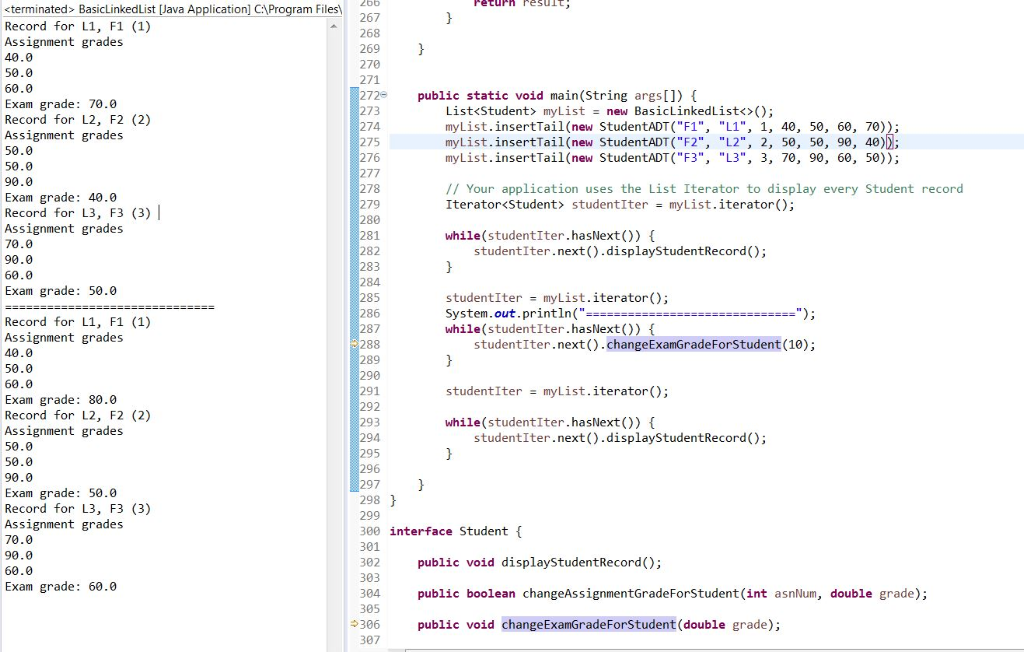
Please upvote, as i have given the exact answer as asked in
question. Still in case of any concerns in code, let me know in
comments. Thanks!
 venereology answered 1 hour ago
Related Solutions
Create a Java windows application to manage a list of stocks 1. Add a class Stock...
Question 1: Using Python 3 Create an algorithm The goal is to create an algorithm that...
Build a simple list implementation that uses arrays to store the values. Create a class SimpleArrayList...
Binary Search Algorithm a.) Create a Java application that utilizes the "Binary Search Algorithm" presented in...
Create a simple C++ application that will exhibit concurrencyconcepts. Your application should create two threads...
Create a List Create a class that holds an ordered list of items. This list should...
Below is a definition of the class of a simple link list. class Chain; class ChainNode...
Create a Java Application that implements a Selection sort algorithm to sort an array of 20...
Create a Java Application that implements a Selection sort algorithm to sort an array of 20...
In Java in previous question #1, you created a method called isDNAvalid() in the DNA class....
- Calculate the frequency in Hz of a typical green photon emitted by the Sun. What is...
- In the previous question, you designed a simple algorithm to create a class list application. In...
- Create a directory called CIS153 Create new files based on each line from mydata.txt. Each new...
- Calculate the pH of each of the following solutions at 25oC. (a) 0.10 M NH3 pH...
- Fogerty Company makes two products—titanium Hubs and Sprockets. Data regarding the two products follow: Direct Labor-Hours...
- 1. Imagine that you want to obtain a loan from a bank for a business that...
- Write a function named int2ordinal that takes an integer as its only parameter and returns the...