Question
In: Economics
describe 1. equilibrium condition in a savings model with not assets 2. equilibrium condition in a...
describe
1. equilibrium condition in a savings model with not assets
2. equilibrium condition in a saving model with government bonds
Solutions
Expert Solution
If there is no option to invest in the asset market like
government bonds then all the funds people want to save will put
them into savings. Hence absolute size of the savings size will
increase. It will put upward pressure in the savings supply. Hence
in the market loanable funds will increase. Hence we can see that
interest rate will be low and total equilibrium savings/investment
will be equal. 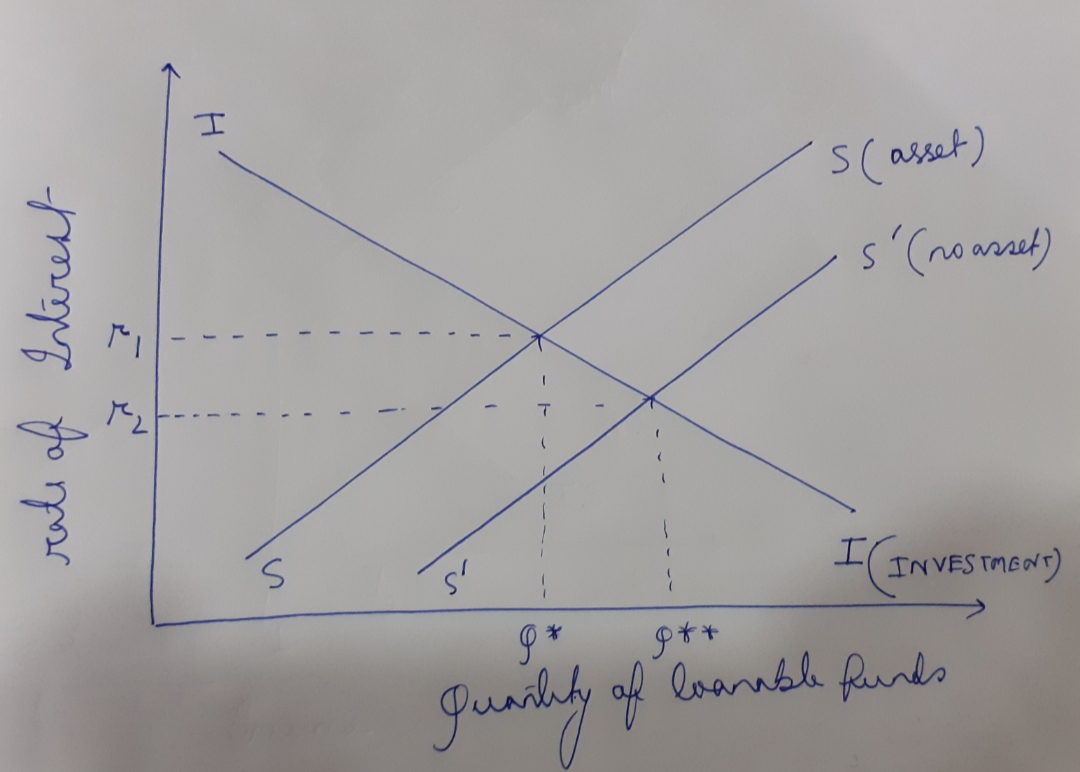 2. If there are provision of
government bonds, some people may choose to invest in them as a
alternative savings tool. Hence in the loanable fund market, there
will be a shortage in the supply of loanable funds. Hence now in
presence of the assets to invest in, the equilibrium interest rate
will be high and total amount of equilibrium savings/investment
will be low.
2. If there are provision of
government bonds, some people may choose to invest in them as a
alternative savings tool. Hence in the loanable fund market, there
will be a shortage in the supply of loanable funds. Hence now in
presence of the assets to invest in, the equilibrium interest rate
will be high and total amount of equilibrium savings/investment
will be low.
Now let's say price of government bond falls then people will buy more government bonds.
Why?
Government bonds are a security where government pays you back some amount after a period. Like you will be paid 120 dollars after 3momths. Now if the bond price is 100 then your gain will be 20% but if the price is 110 then your gain will be around 9%. Hence increasing the price of bonds will discourage people to invest in the bonds. Hence loanable market will have more supply of funds and interest rate will drop and equilibrium savings and investment will be higher. Hence bond price has a inverse relationship with interest rate and has a direct relationship between equilibrium savings and investment quantity.
I hope you understood the concept and I solved your question.
Have a great day ahead.
Give good feedback.
Comment down if you have anything to ask about the answer.
 Rahul Sunny answered 1 hour ago
Related Solutions
What is the equilibrium condition of the modified Harris-Tadoro Model?
What is the equilibrium condition of the modified Harris-Tadoro Model? Please explain this final condition maths...
1.What is the First Condition of Equilibrium? 2.Explain what Pythagorean Theorem is and give the formula....
1. Describe the three curves that describe the AD-AS model and show long run aggregate equilibrium...
(a) For overall chemical reactions that describe an equilibrium condition or balance between reactant and product...
There are two assets following single-factor model, Asset 1 and Asset 2. Their model parameters are...
Torque and Equilibrium Exercise Questions 1) Describe the conditions necessary for equilibrium on a balance. 2) When...
3) According to the paradox of thrift, an increase in planned savings _________ savings in equilibrium....
1. describe the methods for determining roadway condition
Question 1 a. Draw a diagram to show the long run equilibrium condition of the perfectly...
- 1.The standard cell potential (E°cell) for the voltaic cell based on the reaction below is ______...
- describe 1. equilibrium condition in a savings model with not assets 2. equilibrium condition in a...
- describe the process of ventilation
- Using Python: Write a program that takes a user-inputted integer and prints out the value of...
- Most health care organization now have some type of online portal where patients can review test...
- Instructions:DevelopaprogramnamedMakeStudentsthat Reads student data from Readme.txt and creates student instances o usetheStudentclassprovidedforthelab Saves student...
- What mass of potassium fluoride must be added to 500.0 mL of water to give a...