Question
In: Computer Science
You are given the partial implementation of class IntegerLinkedList which stores integers in the inked list....
You are given the partial implementation of class IntegerLinkedList which stores integers in the inked list. Add a public member function that does the following:
// Complete this for Problem 2
int getSmallestIndex(): return the smallest of integers stored in the linked list.
A main file (prob2.cpp) is provided:
#include <iostream>
#include <string>
#include "IntegerLinkedList.h"

using std::string;
using std::cout;
using std::endl;

int main() {
        {
                IntegerLinkedList mylist;
                mylist.addFront(10);
                mylist.addFront(17);
                mylist.addFront(23);
                mylist.addFront(17);
                mylist.addFront(92);

                if (mylist.getIndexSmallest() == 4)
                  cout << "PASSED" << endl;
                else
                  cout << "Result did not match expected answer: 4" << endl;
        }
        {
                IntegerLinkedList mylist;
                mylist.addFront(10);
                mylist.addFront(17);
                mylist.addFront(23);
                mylist.addFront(37);
                mylist.addFront(2);

                if (mylist.getIndexSmallest() == 0)
                  cout << "PASSED" << endl;
                else
                  cout << "Result did not match expected answer: 0" << endl;
        }
        // system("pause"); // comment/uncomment if needed
}
// ADD ANSWER TO THIS FILE

#pragma once

class SNode {
public:
  int data;
  SNode *next;
};

class IntegerLinkedList {
private:
  SNode *head;

  bool isLesser (SNode *ptr, int compare) {
    return false; // COMPLETE THIS FOR PROBLEM 3
  }

public:
  IntegerLinkedList() {
    head = nullptr;
  }

  void addFront(int x) {
    SNode *tmp = head;
    head = new SNode;
    head->next = tmp;
    head->data = x;
  }

  int getIndexSmallest(); // COMPLETE THIS FOR PROBLEM 2

  // recursion helper function called from main
  bool isLesserHelper (int compare) {
    return isLesser(head, compare);
  }

};
Add a recursive function called isLesser to class IntegerLinkedList to calculate the smallest of the linked list’s data values (same as in Problem 2 but recursive).
A recursion “helper” function is already included in class IntegerLinkedList. You only need to write the recursive function.
//PROBLEM 3
#include <iostream>
#include <string>
#include "IntegerLinkedList.h"

using std::string;
using std::cout;
using std::endl;

int main() {
        {
                IntegerLinkedList mylist;
                mylist.addFront(10);
                mylist.addFront(17);
                mylist.addFront(23);
                mylist.addFront(17);
                mylist.addFront(92);

                if (mylist.isLesserHelper(15))
                  cout << "PASSED" << endl;
                else
                  cout << "Result did not match expected answer: true" << endl;

                if (!mylist.isLesserHelper(5))
                  cout << "PASSED" << endl;
                else
                  cout << "Result did not match expected answer: false" << endl;

                if (mylist.isLesserHelper(100))
                  cout << "PASSED" << endl;
                else
                  cout << "Result did not match expected answer: true" << endl;
        }
        // system("pause"); // comment/uncomment if needed

}
// ADD ANSWER TO THIS FILE

#pragma once

class SNode {
public:
  int data;
  SNode *next;
};

class IntegerLinkedList {
private:
  SNode *head;

  bool isLesser (SNode *ptr, int compare) {
    return false; // COMPLETE THIS FOR PROBLEM 3
  }

public:
  IntegerLinkedList() {
    head = nullptr;
  }

  void addFront(int x) {
    SNode *tmp = head;
    head = new SNode;
    head->next = tmp;
    head->data = x;
  }

  int getIndexSmallest(); // COMPLETE THIS FOR PROBLEM 2

  // recursion helper function called from main
  bool isLesserHelper (int compare) {
    return isLesser(head, compare);
  }

};
Solutions
Expert Solution
DID BOTH THE FUNCTION, PLEASE CHECK, PLEASE UPVOTE
#pragma once
class SNode {
public:
int data;
SNode *next;
};
class IntegerLinkedList {
private:
SNode *head;
bool isLesser (SNode *ptr, int compare) {
if(ptr == NULL)
return false;
if(compare > ptr->data)
return true;
return isLesser(ptr->next, compare);
}
public:
IntegerLinkedList() {
head = nullptr;
}
void addFront(int x) {
SNode *tmp = head;
head = new SNode;
head->next = tmp;
head->data = x;
}
int getIndexSmallest(){
SNode *tmp = head;
int min = 100000, index = -1, count = 0;
while(tmp != NULL){
if(tmp->data < min){
index = count;
min = tmp->data;
}
++count;
tmp = tmp->next;
}
return index;
}
// recursion helper function called from main
bool isLesserHelper (int compare) {
return isLesser(head, compare);
}
};
============================
SEE OUTPUT
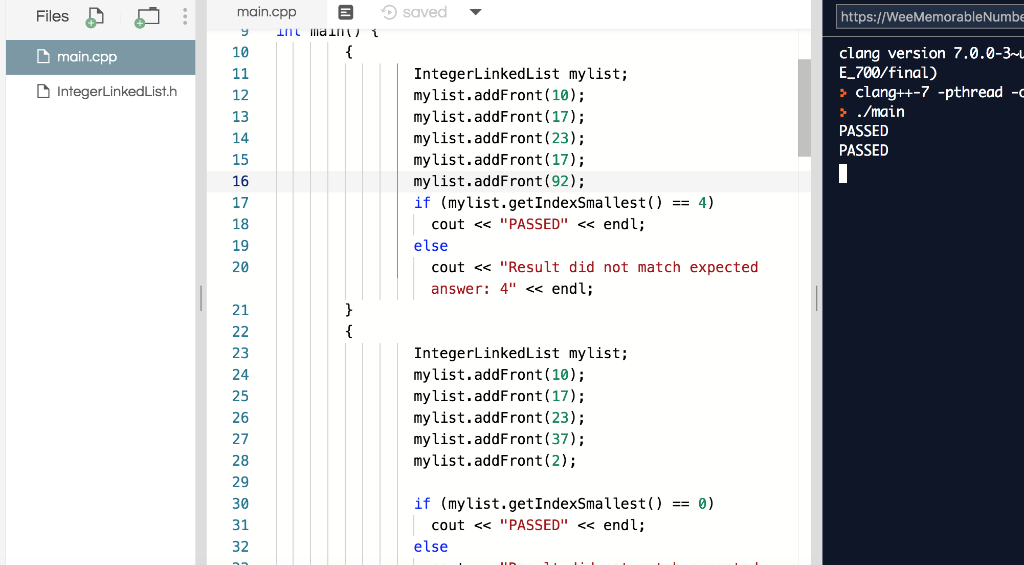
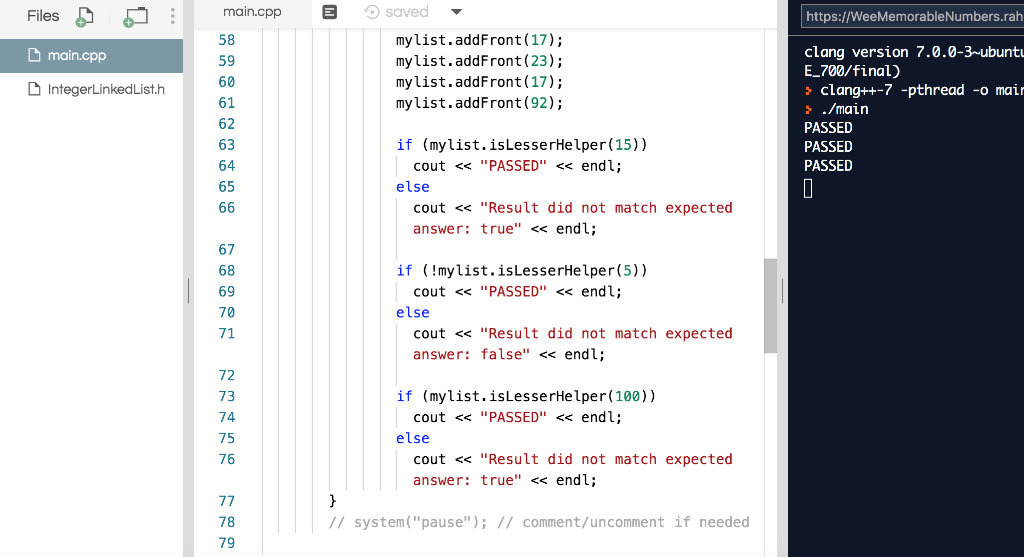
PLEASE COMMENT if there is any concern.
==========================================
 venereology answered 3 weeks ago
Related Solutions
You are given a reference to the head node of a linked list that stores integers....
You are given a reference to the head node of a linked list that stores integers....
You are given a reference to the head node of a linked list that stores integers....
You are given a reference to the head node of a linked list that stores integers....
You are given a reference to the head node of a linked list that stores integers....
You are given a reference to the head node of a linked list that stores integers....
Objective You are given a partial implementation of one header file, GildedRose.h. Item is a class...
You are provided with a partial implementation of a templated singly-linked list in LinkedList.h, with some...
Given the class below, which answer choice would be an implementation of the default constructor (without...
/** * This class maintains an arbitrary length list of integers. * * In this version:...
- Dirac's Theorem states that "A simple graph with n vertices (n >= 3) is Hamiltonian if...
- Two 10-cm-diameter charged rings face each other, 15cm apart. The left ring is charged to -29nC...
- Under what conditions would it be possible for an excise tax to have no efficiency cost...
- explain the difference between activities and financial statements of service businesses and merchandising businesses.
- 2. Compare and compare the matrix multiplication algorithm and the Floyd-Warshall algorithm to find all pairs...
- Q: 50.00 ml of 0.5216 M copper(II) nitrate solution is combined with 100.0 ml of 0.5580...
- This is a business law question. Explain how environmental laws regulate the use of toxic substances...