Question
In: Computer Science
Consider the quick sort algorithm. The quick sort algorithm is a divide and conquer approach which...
Consider the quick sort algorithm.
The quick sort algorithm is a divide and conquer approach which chooses a pivot value and divides the subarrays as the lower values on the left and the bigger values on the right (comparing them to pivot). Then, each subarray is processed similarly until the array becomes sorted.
Quick sort algorithm has an average time complexity of O(nlogn). However, if the array to be used in the quicksort is already sorted, then the complexity becomes O(n2).
In this question, modify the quicksort algorithm. Therefore, you will use a randomized partitioning algorithm that shuffles the array first and then chooses a pivot value. (in your cpp file)
Also analyze, what will change by following such an approach. What will be the complexity? Write down your analysis (in a docx file).
Solutions
Expert Solution
PLEASE GIVE IT A THUMBS UP
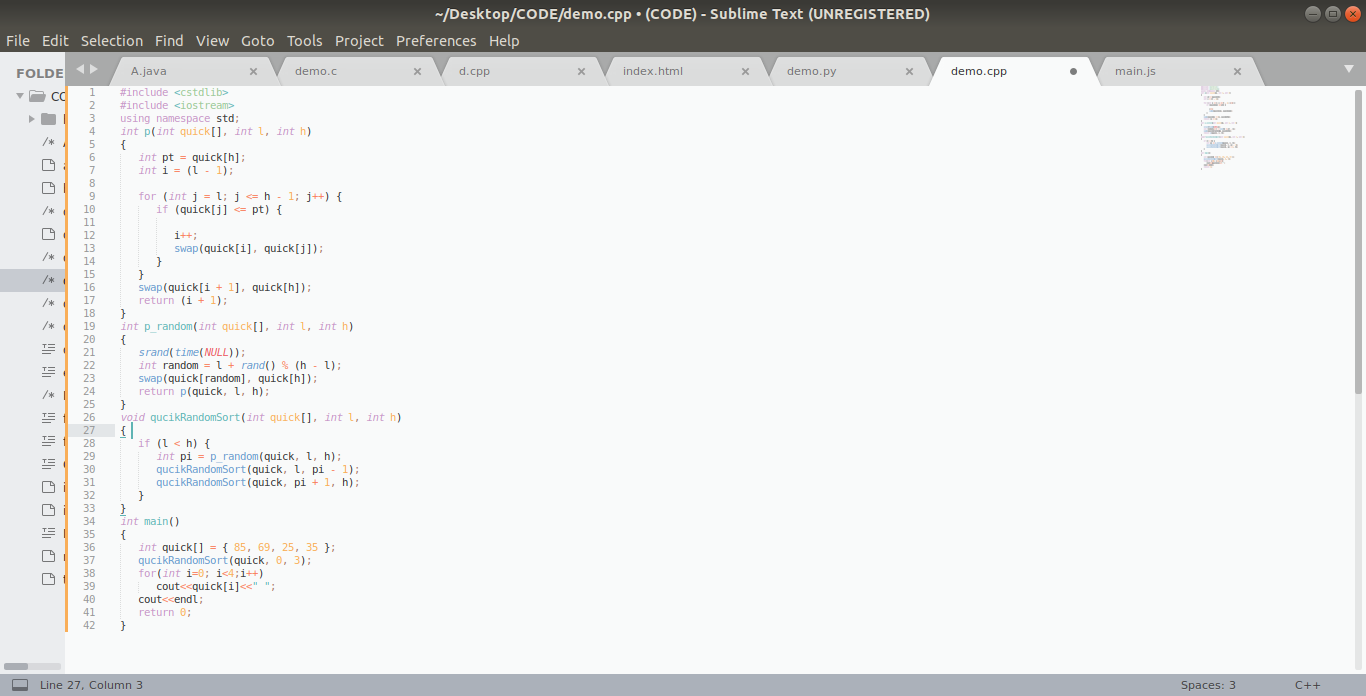
#include <cstdlib>
#include <iostream>
using namespace std;
int p(int quick[], int l, int h)
{
int pt = quick[h];
int i = (l - 1);
for (int j = l; j <= h - 1; j++) {
if (quick[j] <= pt) {
i++;
swap(quick[i], quick[j]);
}
}
swap(quick[i + 1], quick[h]);
return (i + 1);
}
int p_random(int quick[], int l, int h)
{
srand(time(NULL));
int random = l + rand() % (h - l);
swap(quick[random], quick[h]);
return p(quick, l, h);
}
void qucikRandomSort(int quick[], int l, int h)
{
if (l < h) {
int pi = p_random(quick, l, h);
qucikRandomSort(quick, l, pi - 1);
qucikRandomSort(quick, pi + 1, h);
}
}
int main()
{
int quick[] = { 85, 69, 25, 35 };
qucikRandomSort(quick, 0, 3);
for(int i=0; i<4;i++)
cout<<quick[i]<<" ";
cout<<endl;
return 0;
}
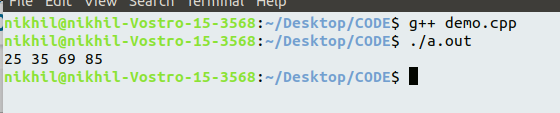
By using such type of approach we can improve the expected time complexity to O(Nlog N)
 venereology answered 3 weeks ago
Related Solutions
Explain why selection sort can be viewed as a divide and conquer algorithm. Compare selection sort...
a. Develop a divide-and-conquer algorithm to perform a parallel merge sort of an array. Hint: After...
Consider a sorting algorithm that combines merge sort and insertion sort algorithm. We still use divide...
1. If we view the selection sort as an application of "divide and conquer" strategy, what...
3. Suppose that a divide and conquer algorithm for multiplication of n x n matrices is...
The following divide-and-conquer algorithm is designed to return TRUE if and only if all elements of...
Q. Explain how a divide and conquer algorithm for detecting whether or not the number 5...
Let A be an integer array of length n. Design a divide and conquer algorithm (description...
Java 3. Describe the divide-and-conquer search algorithm and explain its efficiency. Consider two different Split functions:...
1a. Write pseudocode for a divide-and-conquer algorithm for finding the po- sition of the largest element...
- Two 10-cm-diameter charged rings face each other, 15cm apart. The left ring is charged to -29nC...
- Under what conditions would it be possible for an excise tax to have no efficiency cost...
- explain the difference between activities and financial statements of service businesses and merchandising businesses.
- 2. Compare and compare the matrix multiplication algorithm and the Floyd-Warshall algorithm to find all pairs...
- Q: 50.00 ml of 0.5216 M copper(II) nitrate solution is combined with 100.0 ml of 0.5580...
- This is a business law question. Explain how environmental laws regulate the use of toxic substances...
- A sky diver and her parachute system weigh a total of 800 N. She is falling...