Question
In: Physics
a. Assume that all of the pendulum’s mass M is contained in the “bob” at the...
a. Assume that all of the pendulum’s mass M is contained in the “bob” at the end of the pendulum rod. Write Newton’s 2nd Law for the force balance along the circular arc traced out by the pendulum bob as it swings back and forth. [Hint: You can relate the position of the pendulum bob along its arc to the angle ! formed by the pendulum rod and the vertical line when the pendulum bob is at the “base” of the arc. It may help to draw this.]
b. Using the “small angle approximation” sin(theta) ≈ theta(t) and assuming that the pendulum bob is released from rest at an angle theta(zero), show that theta(zero) = (theta(zero))cos (omega t) solves the force balance equation in (a) for a particular value of omega. What value is it?
c. The period of the pendulum corresponds to the time it takes the pendulum to oscillate through one cycle, i.e., from its initial position and back. Use the result in b to find the period. You should find the period to be a numerical factor times our estimate of the period from dimensional considerations.
Solutions
Expert Solution
Newton's second law states that the acceleration is deirectly propotional to the net force,or
F=ma,
where m=mass, a constant
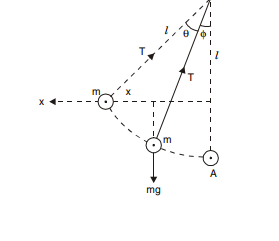
Consider the equilibrium position is given by the angle
 So the force on
the mass m along the horizontal axis is equal to ma at this
position. The angle is
determined by the equations.
So the force on
the mass m along the horizontal axis is equal to ma at this
position. The angle is
determined by the equations.
T sin = ma, T
cos =
mg
When the pendulum is displaced by a small amount  , it
will perform simple harmonic motion around the equilibrium
position. Its equation of motion is
, it
will perform simple harmonic motion around the equilibrium
position. Its equation of motion is
m  x = –T
sin(\theta + )
x = –T
sin(\theta + )
where x is the distance from the vertical OA.
For small angle \theta, sin(\theta + ) ≈ \theta cos
+ sin = θ mg
/T+ ma/ T
Thus
m = – ma –
mg\theta.
\theta and l are related geometrically as
x = l sin(\\theta + \phi) ≈ l \theta cos \phi + l sin \phi
or = l cos
\\phi \ddot{\theta}
Hence l cos \phi \ddotθ = –a –gθ or
\ddotθ = – g /(l a cos \phi )*(\theta+a/g)
If we make the following substitution ψ = θ + a/ g
we get \ddotψ = – g /l cos φ ψ = – ω2ψ
with time period of oscillation T = 2\pi /ω = 2 \pi(lcos φ /g)3/2
. Now, cos φ = mg /T = mg/\sqrt( m2a2 +m2g2) + = g/ (a2 g2)
So, T = 2\pi*(l/(\sqrt a2+g 2)3/2
 genius_generous answered 1 month ago
Related Solutions
An electron (mass m) is contained in a cubical box of widths Lx = Ly =...
Consider a conical pendulum with a bob of mass m = 28.0 kg on a string...
A mass of m=1kg of steam is contained in a closed rigid container. Initially the pressure...
Calculate the concentrations of all species contained in 0.15 M solution of carbonic acid at 25...
Assume that all the mass of a galaxy is in a massive uniform density ball of...
Now assume that Alice and Bob are twins, and Alice left Earth and Bob stayed behind...
Assume a planet with mass M and radius R. (a) Find the strength of its gravitational...
A person with mass m=80 kg is training for pushups. Assume that the distance between the...
A dart of mass m is fired at and sticks into a block of mass M...
On the planet Newtonia, a simple pendulum having a bob with a mass of 1.35kg and...
- An experiment to measure the value of g is constructed using a tall tower outfitted with...
- Discuss the two estimation methods of classification-type data mining models while considering ANN as a classifier.
- For the equilibrium: CO2(g) + H2(g) ⇌ CO(g) + H2O(g), Kp = 10-5 at 25°C and...
- Sanyu Sony started a new business and completed these transactions during December. Dec. 1 Sanyu Sony...
- A crate rests on a frictionless incline, and is attached to a bucket of nails through...
- e) LIST the three effects that account for the downward slope of the AD curve.
- Complete a 1- to 2-page table using the template provided comparing your opinion of the rights...