Question
In: Economics
Problem 2. Consider a duopoly with identical firms with no fixed cost and marginal cost of...
Problem 2. Consider a duopoly with identical firms with no fixed
cost and marginal cost of c. Let the
inverse demand curve for the industry be p(Y ) = A − bY , where Y
is the total industry output. Let y1 and
y2 be the output of each firm. Assume that the firms in the
industry each choose quantity, and then let the
market determine the price they will receive.
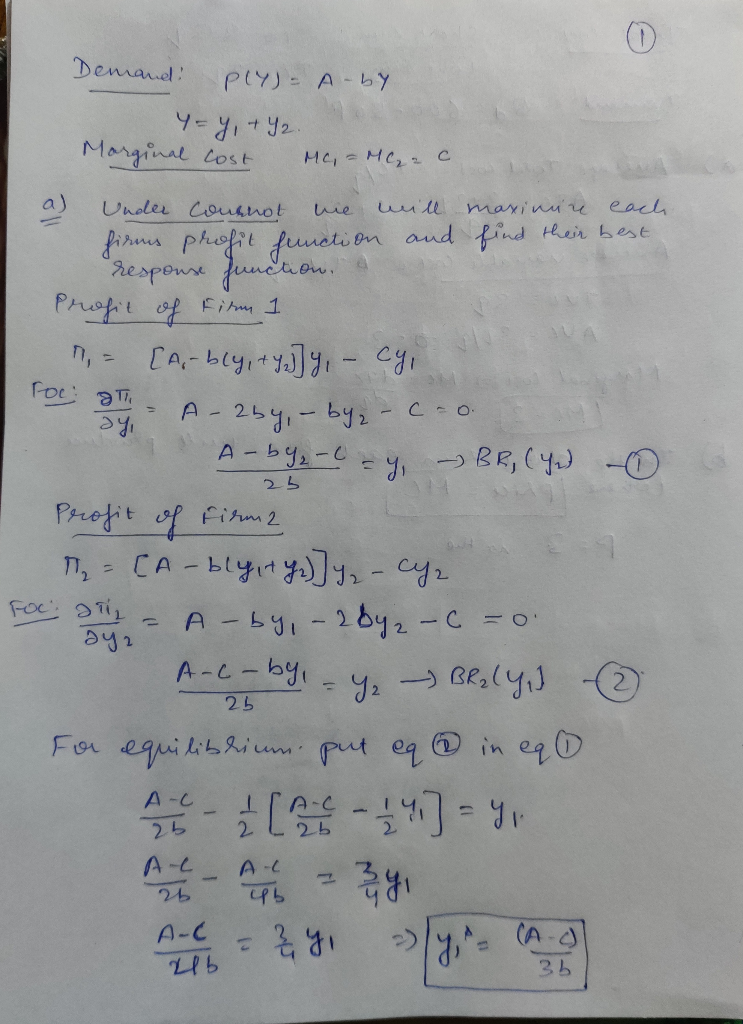
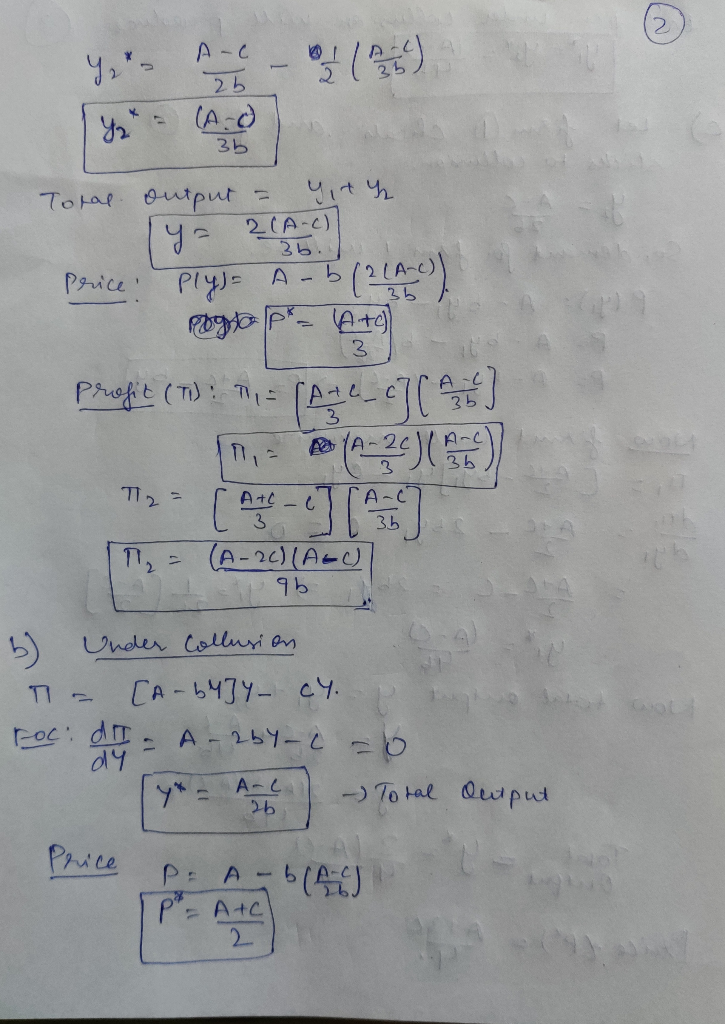
(a) Compute the total market output, the price, the quantity for
each firm, and the profit for each
firm, under Cournot competition. Make sure to start at the
beginning, setting up each firm’s profit-
maximization problem and proceeding from there.
(b) Compute the total market output, the price, the quantity for
each firm, and the profit for each firm, if
the firms collude and choose their quantities together to maximize
total profits. Assume that they split
the total output evenly. Again, make sure to set up the joint
profit-maximization problem and proceed
from there. [Hint: you will find that you cannot solve the system
of two first-order conditions. Indeed,
you will find that the two first-order conditions are identical,
leaving you with only one equation with
two unknowns. To solve this problem, simply take advantage of the
assumption that they split the
market evenly, y1 = y2. Now you have two equations with two
unknowns.]
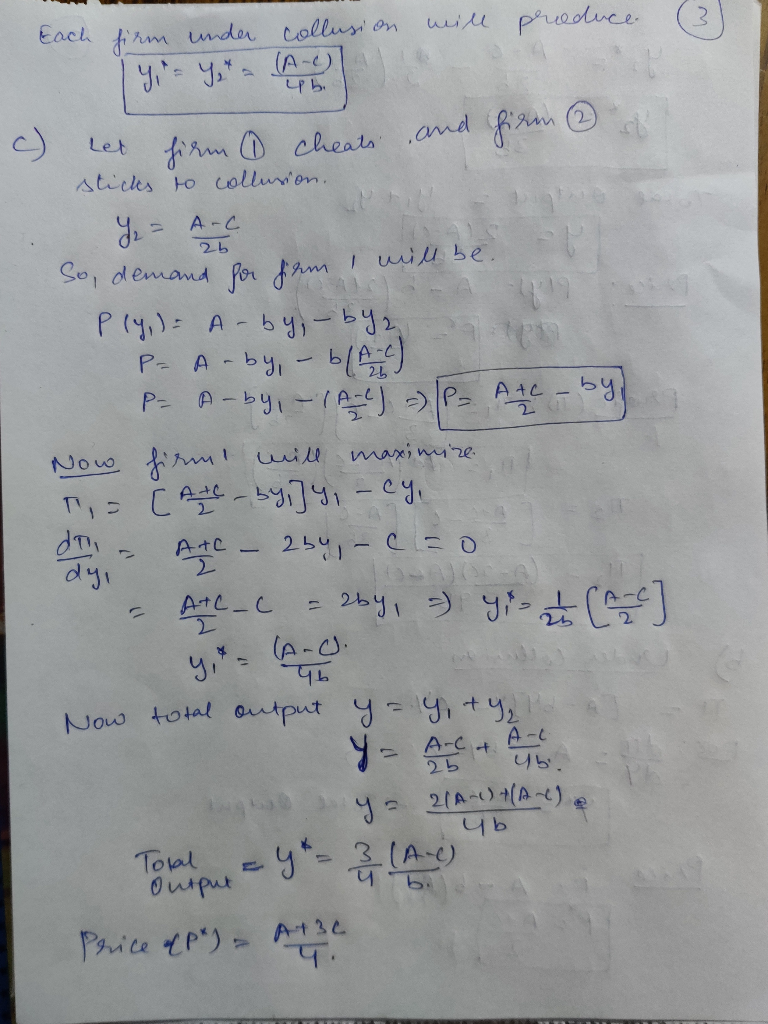
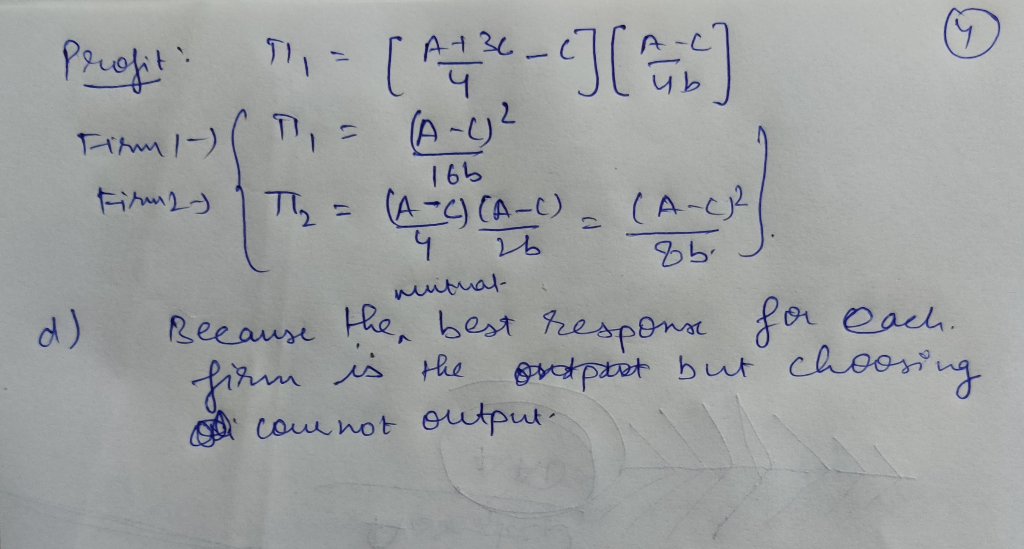
(c) Now suppose that one firm sticks to the collusive quanity,
while the other one cheats. Compute the
profit maximizing output of the cheater, the market price, and the
profit for each firm.
Econ 100A, Fall 2019
Prof: Dan Acland
Problem Set #12
Page 2
(d) Using the results you have computed above, argue that the
collusive agreement is not a Nash equi-
librium. In addition, argue that if firms have common knowledge of
rationality (each knows that the
other is rational, and knows that the other knows they are
rational, etc) the only Nash equilibrium is
for both firms to choose the Cournot equilibrium quantity.
(e) Again, using the results you have computed above, argue that
this situation can be thought of as a
prisoner’s dilemma. (Recall that we characterized a prisoner’s
dilemma as a situation in which agents
are unable to cooperate, even when to do so would maximize their
individual payoffs, because the
private cost of cooperation is greater than the private benefit of
cooperation.)
Solutions
Expert Solution
We are supposed to do only four sub-parts to a question. For solution to other parts of the question please post as separate question.
 Rahul Sunny answered 2 months ago
Related Solutions
Consider the Stackelberg duopoly but with different firms. In particular, the marginal cost of Firm A...
(a) [15 marks] Consider two identical firms with no fixed costs and constant marginal cost c...
Consider a price-setting oligopoly with 4 identical firms, all with constant marginal cost c. The firms...
Two identical firms compete in a Bertrand duopoly. The firms produce identical products at the same...
Problem 1. Consider a Cournot game with n > 2 firms, where all firms are identical....
Suppose that identical duopoly firms have constant marginal costs of $16 per unit. Firm 1 faces...
Consider a Cournot duopoly of two identical cigarette producing firms, Warlboro and Cramel. They produce tobacco...
Consider a Cournot duopoly of two identical cigarette producing firms, Warlboro and Cramel. They produce tobacco...
The Toy business has 4 firms. All firms have an identical marginal cost of MC =...
Problem 1: Consider the following Bertrand duopoly: two firms (A and B) are operating in a...
- 10. What are the three monetary policy tools of the Fed? Briefly describe how each tool...
- In what ways would the role of a manager working in a nonstandard international assignment arrangement...
- Write a Bash script called move that could replace the UNIX command mv. 'move' tries to...
- Write program in C language using Pthreads API to simulate the real problem, the Sleeping Teaching...
- HF(g) + H2O(l) = H3O+(aq) + F-(aq) In the following equilibrium in a closed system, indicate...
- : Write a paragraph to reflect on what you have learned about Microsoft access in terms...
- Consider two markets: the market for cat food and the market for dog food. The initial...