Question
In: Economics
Consider the following economy: Labor supply: Nt= 90 Capital stock: Kt = 90 Government spending: Gt...
Consider the following economy:
Labor supply: Nt= 90
Capital stock: Kt = 90
Government spending: Gt = 20
Tax collections: Tt = 20
Production function: Yt = 2(Kt)0.5 (Nt)0.5
Real money demand Lt = 2Yt - 200rt
Consumption function: Ct = 16 + 0.8(Yd)t
Domestic price level: Pt = 4
Investment function: It = 25 - 50rt
Nominal money supply: Mt = 1296
QUESTIONS:
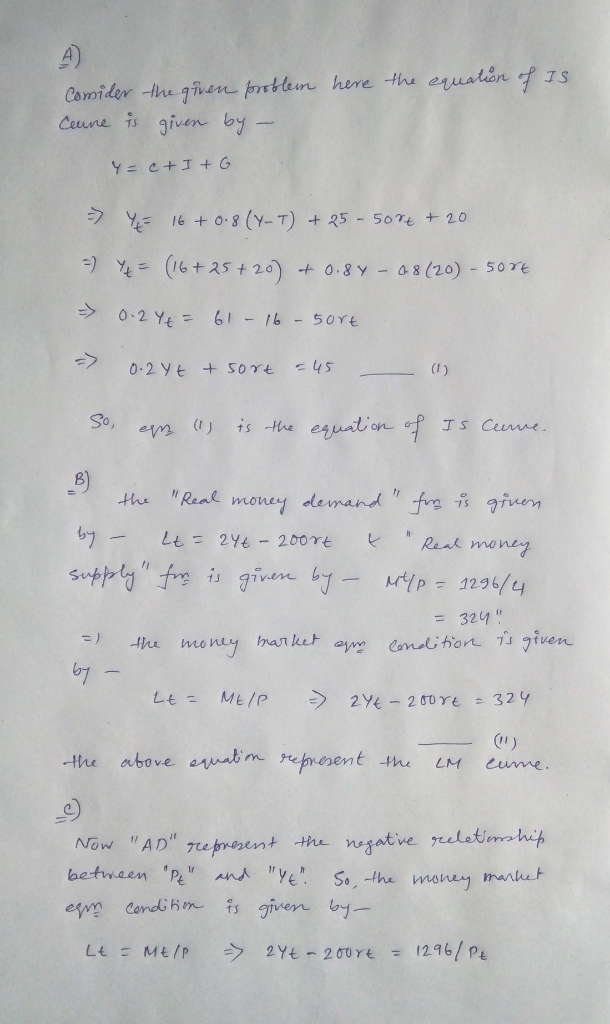
- (7 points) Find an expression for the IS curve.
- (7 points) Find an expression for the LM curve.
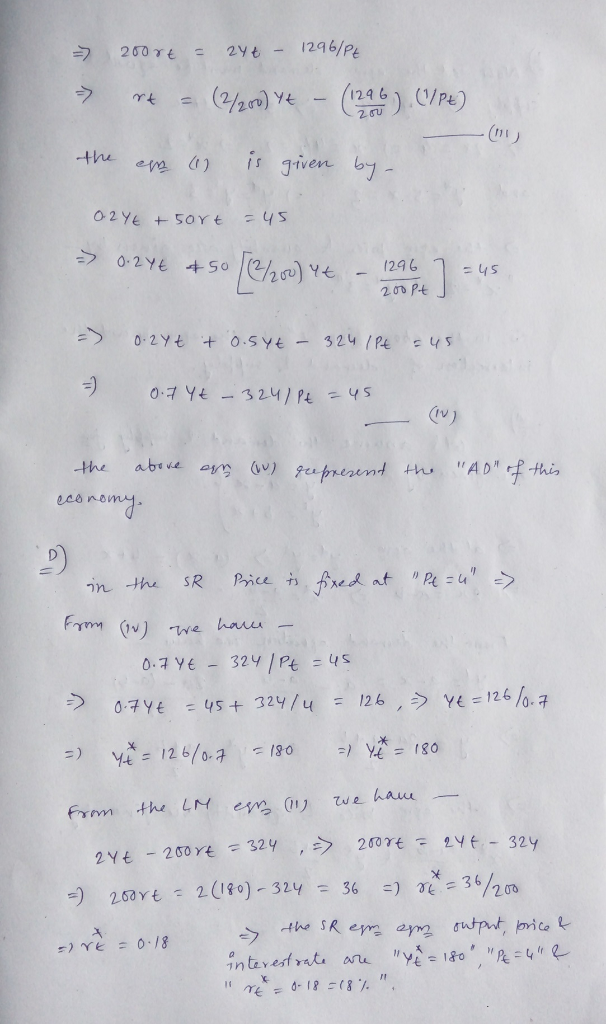
- (7 points) Find an expression for the aggregate demand curve.
- (7 points) What are the short run equilibrium values for output, interest rate and price level?
- (7 points) Plot (a)-(d) on the IS-LM and AD-SRAS-LRAS diagrams. Make sure to label (i) the axes, (ii) the curves and (iii) the initial equilibrium levels.
- (7 points) Is this a short-run level of output also a long-run equilibrium? Explain.
- (7 points). Suppose that the government the Fed increases money supply to Ms=1620. Find the new short-run equilibrium levels of output and interest rate
- (7 points) Find the long-run equilibrium levels of output, interest rates and prices.
- (7 points) Graph this combination of policies both in the short and in the long run.
- (7 points) Explain how the adjustment from the short-run to the long-run occurs.
Solutions
 Rahul Sunny answered 2 months ago
Related Solutions
Consider the following production function: Yt = F( Kt , Nt ) = ( Kt1/2 +...
Consider the following production function: Yt = F(
Kt , Nt ) = ( Kt1/2 +
Nt1/2 )2 Assume that capital
depreciates 5% each year and that households save 5% of their
income. Assume that investment is equal to savings. Finally, assume
that the population is growing 15% each year.
1. Solve for the steady state level of capital per worker as a
function of δ and s.
2. Solve for the steady state level of output per worker as...
Slow model: A flood destroys half population and capital. Draw four graphs plotting Kt, Nt, kt,...
Slow model:
A flood destroys half population and capital. Draw four graphs
plotting Kt, Nt, kt, and Yt against time. Begin at steady state, Be
prepaid with distance, times, and movements, using words to
explain.
For a given economy, investment is 100, government spending is 150 and taxes are 90. the...
For a given economy, investment is 100, government spending is
150 and taxes are 90. the consumption function is C=120+.75 YD
Calculate the government expenditure multiplier and the tax
multiplier.
A. 3, 4
B. -3, 4
C. 4, -3
D. 4, 3
Consider a government that wants to raise investment spending in the economy. Perhaps the government is...
Consider a government that wants to raise investment spending in
the economy. Perhaps the government is concerned about future
economic growth and so wants to promote investment in order to
raise growth. However, the government also does not want to
increase inflation. Inflation could be caused by excessively high
output growth pushing up prices. Therefore, the government does not
want output to increase more than normal. Use the following
questions to think about how the government could raise investment
without...
Question 3- Consider an economy with a shrinking stock of fiat money. Let Nt = N,...
Question 3- Consider an economy with a shrinking stock of fiat
money. Let Nt = N, a constant, and Mt = z Mt-1 for every period t,
where z is positive and less than 1. The government taxes each old
person t goods in each period, payable in fiat money. It destroys
the money it collects.
d. Find and explain the rate of return in a monetary
equilibrium.
e.Prove that the monetary equilibrium does not maximize the
utility of the...
1. Consider an economy with no international trade, no government spending and no taxes, whose consumption...
1. Consider an economy with no international trade, no
government spending and no taxes, whose consumption function and
investment function are given by the following equations: C =
100,000 + .92Y I = 40,000
a. What is the equilibrium level of aggregate output for this
economy?
b. What is the saving function for this economy?
c. Check the solution, as we did in class, by showing that at
the equilibrium level of Y total spending exactly matches the level
of...
1. Consider the annual government budget constraint of a government: Gt + (1 + rt)Bt =...
1. Consider the annual government budget constraint of a
government:
Gt + (1 + rt)Bt = Tt + Bt+1
for t=2019,2020,... Denote GDP by Yt.
(a) Express the budget constraint in terms of variables measured as
a fraction of GDP.
(b) Suppose GDP grows at 4%, the interest rate is 2% and the
primary deficit is 3% of GDP. If debt to GDP is 1
(100%) in 2019, write down the evolution of debt to GDP ratio for
2020, 2021...
24. Consider an economy that implements an expansionary fiscal policy of increased government spending by $X...
24.
Consider an economy that implements an expansionary fiscal
policy of increased government spending by $X amount. Which of the
following by itself would tend to make the change in aggregate
demand different from $X?
a. both the multiplier effect and the crowding-out effect
b. the multiplier effect, but not the crowding-out effect
c. the crowding-out effect, but not the multiplier effect
d. neither the crowding out effect nor the multiplier effect
25.
If the multiplier is 2 and if...
1/ Growth Rates of Capital and Output Consider the following production function: Yt = F(Kt ,...
1/ Growth Rates of Capital and Output Consider the following
production function: Yt = F(Kt , Lt) = K 1 2 t L 1 2 t Assume that
capital depreciates at rate ? and that savings is a constant
proportion s of output: St = sYt Assume that investment is equal to
savings: It = St Finally, assume that the population is constant:
Lt = Lt+1 = L 1. The production function above expresses output as
a function of capital...
Consider an economy in which two factors of production, labor and capital, produce two goods, capital...
Consider an economy in which two factors of production, labor
and capital, produce two goods, capital intensive pharmaceuticals
and labor-intensive clothing. Suppose that both factors of
production are freely mobile across both industries and that all
producers, consumers, capitalists and workers are price-takers.
Suppose that there are currently steep tariffs on all imported
goods, but there is a bill before Parliament to eliminate those
tariffs, and the government has invited citizen representatives of
workers and capitalists to express their opinions...
ADVERTISEMENT
ADVERTISEMENT
Latest Questions
- At a certain temperature, this reaction establishes an equilibrium with the given equilibrium constant, Kc. 3A(g)+2B(g)−⇀↽−4C(g)Kc=2.53×1031...
- Define a class named Payment that contains an instance variable "paymentAmount" (non-static member variable) of type...
- What are the five types of vision impairment and what are the four types of hearing...
- Two train cars are on a straight, horizontal track. One car starts at rest and is...
- 1. Explain the difference between inorganic and organic molecules. 2. Define: a. salt b. ...
- Veldre Company provides the following information about its defined benefit pension plan for the year 2014....
- One of the consequences of the economic meltdown in Great Recession has been a free fall...
ADVERTISEMENT