Question
In: Computer Science
Use python. DO NOT use pres existing libraries. Suppose there exists a text file called "expressions.txt"....
Use python. DO NOT use pres existing libraries. Suppose there exists a text file called "expressions.txt". This file contains simple arithmetic expressions written in infix notation. Using the Stack class, write code to implement the Shunting Yard Algorithm to generate postfix expressions. Each expression in expressions.txt is written on a single line. Moreover, each expression contains only numbers comprising a single digit. Each token is separated by whitespace. Write each postfix expression generated to a file "answers.txt". Only consider the operations +, -, /, *, and ^.
Solutions
Expert Solution
Code screenshots:
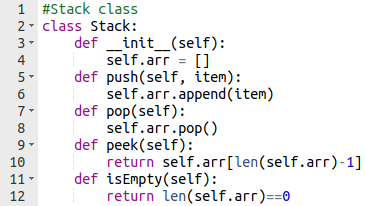
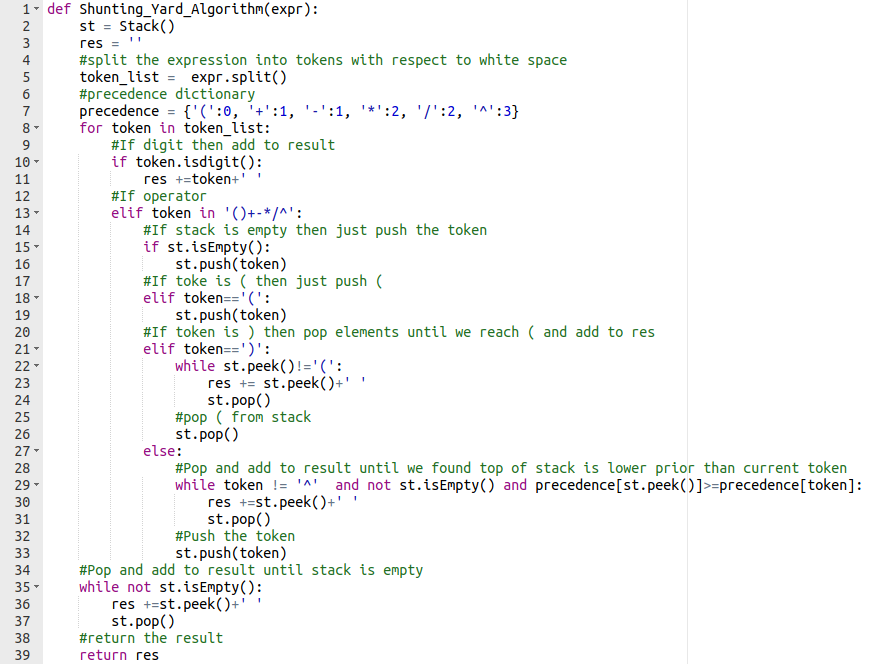
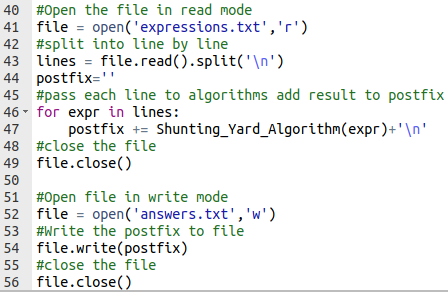
Code to copy:
class Stack:
def __init__(self):
self.arr = []
def push(self, item):
self.arr.append(item)
def pop(self):
self.arr.pop()
def peek(self):
return
self.arr[len(self.arr)-1]
def isEmpty(self):
return len(self.arr)==0
def Shunting_Yard_Algorithm(expr):
st = Stack()
res = ''
#split the expression into tokens with respect to
white space
token_list = expr.split()
#precedence dictionary
precedence = {'(':0, '+':1, '-':1, '*':2, '/':2,
'^':3}
for token in token_list:
#If digit then add to
result
if token.isdigit():
res +=token+'
'
#If operator
elif token in '()+-*/^':
#If stack is
empty then just push the token
if
st.isEmpty():
st.push(token)
#If toke is (
then just push (
elif
token=='(':
st.push(token)
#If token is )
then pop elements until we reach ( and add to res
elif
token==')':
while st.peek()!='(':
res += st.peek()+' '
st.pop()
#pop ( from stack
st.pop()
else:
#Pop and add to result until we found top
of stack is lower prior than current token
while token != '^' and not st.isEmpty() and
precedence[st.peek()]>=precedence[token]:
res +=st.peek()+' '
st.pop()
#Push the token
st.push(token)
#Pop and add to result until stack is empty
while not st.isEmpty():
res +=st.peek()+' '
st.pop()
#return the result
return res
#Open the file in read mode
file = open('expressions.txt','r')
#split into line by line
lines = file.read().split('\n')
postfix=''
#pass each line to algorithms add result to postfix
for expr in lines:
postfix += Shunting_Yard_Algorithm(expr)+'\n'
#close the file
file.close()
#Open file in write mode
file = open('answers.txt','w')
#Write the postfix to file
file.write(postfix)
#close the file
file.close()
expressions.txt
1 + 2 * ( 3 + 4 )
1 * 2 + ( 3 / 4 )
1 - 2 + 3 * ( 4 - 5 * 6 )
1 - 2 + 3
1 * 2 - 3 ^ 4 + 5 / 6
1 * 2 - 3 ^ 4 * 5 / 6
1 ^ 2 ^ 3
1 ^ 2 ^ 3 * 4 / 5 * 6 - 7 * ( 8 + 9 )
( 1 + 2 ) ^ ( 3 - 4 ) * ( 5 * 6 ) / ( 7 / 8 ) + ( 9 ^ 1 )
answers.txt
1 2 3 4 + * +
1 2 * 3 4 / +
1 2 - 3 4 5 6 * - * +
1 2 - 3 +
1 2 * 3 4 ^ - 5 6 / +
1 2 * 3 4 ^ 5 * 6 / -
1 2 3 ^ ^
1 2 3 ^ ^ 4 * 5 / 6 * 7 8 9 + * -
1 2 + 3 4 - ^ 5 6 * * 7 8 / / 9 1 ^ +
 venereology answered 3 months ago
Related Solutions
how can we use cryptography libraries in Python
Python: Word Frequencies (Concordance) 1. Use a text editor to create a text file (ex: myPaper.txt)...
Use Python to Complete the following on a single text file and submit your code and...
In python 1.4. Write To a Text File Create a function that writes to a text...
This is a python file Reads information from a text file into a list of sublists....
Using Python. A file exists on the disk named students.txt. The file contains several records, and...
Write a python program: There is a file called file 2. File2 is a txt file...
Python programming problem! Suppose that there is a json file called data from the desktop. I...
In Python: Assume a file containing a series of integers is named numbers.txt and exists on...
Problem: Write a Python module (a text file containing valid Python code) named p5.py. This file...
- Need solution: HSL Company produces rugs. The following cost information from last year is available: Total...
- You are the network administrator for your organization. Your DHCP server (Server1) has a scope of...
- python3 Let x0,...,xn−1 be n numbers stored in the list x. The median of x, denoted...
- Raintree Cosmetic Company sells its products to customers on a credit basis. An adjusting entry for...
- 1. The larger the calculated χ2 value in a goodness-of-fit test, the _______ likely the data...
- tcp 16115
- #include <iostream> #include <fstream> #include <vector> #include <string> using namespace std; // Define a Person class,...