Question
In: Physics
Two particles each with charge +2.14
Two particles each with charge +2.14
Solutions
Expert Solution
Electric potential for a particle charge, as in this exercise, is given by:
 For this case, there are two charges with equal charge located at
-1 m and 1 m. The question is what will be the electric potential
on a point y = 0.350 m. This electric potential exists because of
the two charges, which will generate an electric field and will
generate an energy by charge. This last thing is what it is about.
So, this magnitude is scalar, which means that we can add them
easily:
For this case, there are two charges with equal charge located at
-1 m and 1 m. The question is what will be the electric potential
on a point y = 0.350 m. This electric potential exists because of
the two charges, which will generate an electric field and will
generate an energy by charge. This last thing is what it is about.
So, this magnitude is scalar, which means that we can add them
easily:
 distances between charges and the point y, are the same:
 .
Replace those values and obtain V, electric potential.
.
Replace those values and obtain V, electric potential.
Now if at a point in space you place a charge, this charge will have electric potential energy, which is diferent from electric potential. This energy can be transformed to kinetic energy, making the charge to move. This is a characteristic of electric forces with stationary charges, energy can be stored as potential energy. This energy can be written for point charges as:
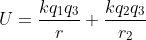
where  ,
,  , and
, and
That's it! ;) I hope it is understandable. Good luck!
 genius_generous answered 3 months ago
Related Solutions
Two charged particles attract each other with a force of magnitude F acting on each. If the charge of one is doubled and the
Consider a system of two particles. One (charge q1) is held at rest at the origin....
Two point particles separated by 0.8 m carry a total charge of 185
Two particles a and b with same charge q and same mass m move uniformly in...
Two point particles separated by 0.7 m carry a total charge of 150 µC. (a) If...
Two particles are fixed on an x axis. Particle 1 of charge 49.0 μC is located...
Two particles are fixed on an x axis. Particle 1 of charge 57.8 μC is located...
Two particles are fixed on an x axis. Particle 1 of charge 51.4 μC is located...
a.) Two identical particles of charge 3 μμC and mass 6 μμg are initially at rest...
5) Two particles are placed on the y-axis. Particle 1, with a charge of -2 C,...
- Dirac's Theorem states that "A simple graph with n vertices (n >= 3) is Hamiltonian if...
- Two 10-cm-diameter charged rings face each other, 15cm apart. The left ring is charged to -29nC...
- Under what conditions would it be possible for an excise tax to have no efficiency cost...
- explain the difference between activities and financial statements of service businesses and merchandising businesses.
- 2. Compare and compare the matrix multiplication algorithm and the Floyd-Warshall algorithm to find all pairs...
- Q: 50.00 ml of 0.5216 M copper(II) nitrate solution is combined with 100.0 ml of 0.5580...
- This is a business law question. Explain how environmental laws regulate the use of toxic substances...