Question
In: Physics
A 12.0m uniform beam is hinged to a vertical wall and held horizontally by a 5.00m...
A 12.0m uniform beam is hinged to a vertical wall and held horizontally by a 5.00m cable attached to the wall 4.00m above the hinge, as shown in the figure below (Figure 1) . The metal of this cable has a test strength of 1.00kN , which means that it will break if the tension in it exceeds that amount.
What is the heaviest beam that the cable can support with the given configuration?
Find the horizontal component of the force the hinge exerts on the beam.
Find the vertical component of the force the hinge exerts on the beam.
Solutions
Expert Solution
Here is what I solved before, please modify the figures as per your question. Please let me know if you have further questions. Ifthis helps then kindly rate 5-stars.
A 11.0m uniform beam is hinged to a
vertical wall and held horizontally by a 5.00m cable attached to
the wall 4.00m above the hinge. The metal of this cable has a test
strength of .800kN, which means that it will break if the tension
in it exceeds that amount. 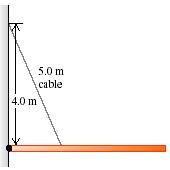 What is the heaviest beam that the cable can support with the
given configuration? Find the horizontal component of the force the
hinge exerts on the beam. Find the vertical component of the force
the hinge exerts on the beam.
What is the heaviest beam that the cable can support with the
given configuration? Find the horizontal component of the force the
hinge exerts on the beam. Find the vertical component of the force
the hinge exerts on the beam.
Answer
The tention in the string is T = 800 N
The length of the beam is L = 11.0m
The length of the cable is x = 5.0m
Theheight is h = 4.00m
---------------------------------------------------------------------------
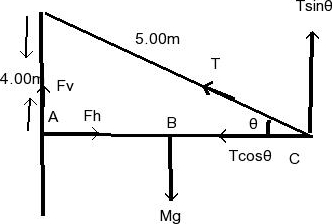
From the figure the angle sin? =4.00m/5.00m
? = sin-1(4.00m/5.00m)
= 53.130
Apply moment of torque at pointA then
Mg*AB - Tsin?*AC = 0
from the given data AB = 3.2 m
AC = 6.4 m
substitude these values in above equation then we get
M=Tsin?*AC /AB*g
= 130.6 Kg
The horizontal component of the force that the string exert on the beam,
Tx = T cos? = 800 * cos53.13 = 480 N
The vertical component of the force that the string exert on the beam,
Ty = T sin? = 800 * sin53.13 = 640 N
 genius_generous answered 4 months ago
Related Solutions
A 1220-N uniform beam is hinged at a vertical wall at one end and is supported...
A 100 kg uniform beam is attached to a vertical wall at one end and is...
A purple beam is hinged to a wall to hold up a blue sign. The beam...
A purple beam is hinged to a wall to hold up a blue sign. The beam...
A purple beam is hinged to a wall to hold up a blue sign. The beam...
A purple beam is hinged to a wall to hold up a blue sign. The beam...
A purple beam is hinged to a wall to hold up a blue sign. The beam...
a uniform 163 kg, 6m beam is held at rest by a vertical post s=2 m...
An 18.4 kg beam is attached to a wall by a hinge and it hangs out horizontally.
one end of a uniform beam of mass 5 kg is mounted at the wall by...
- On January 1, 2018, bonds with a face value of $ 79,000 were sold. The bonds...
- How do I make this sort in true alphabetical order instead of ascii(ABCabc) order? I am...
- As a healthcare provider in physical therapy, athletic training, or as an exercise scientist and personal...
- in the market for makeup artists, what happens after the invention of high-definition tv allowing viewers...
- 10. What are the three monetary policy tools of the Fed? Briefly describe how each tool...
- In what ways would the role of a manager working in a nonstandard international assignment arrangement...
- Write a Bash script called move that could replace the UNIX command mv. 'move' tries to...