Question
In: Computer Science
C++ #include <iostream> using namespace std; struct Node { int data; Node* next; ...
C++
#include <iostream>
using namespace std;
struct Node {
int data;
Node* next;
Node(){
data = 0;
next = NULL;
}
Node(int x){
data = x;
next = NULL;
}
};
struct LinkedList {
Node* head;
LinkedList(){
head = NULL;
}
void append(int value){
if (head == NULL){
head = new Node(value);
}
else{
Node* newNode = new Node(value);
Node* temp = head;
while(temp->next != NULL){
temp = temp->next;
}
temp->next = newNode;
}
}
void insertAt(int index, int value) {
// Provide your code
here
}
int getValue(int index){
// Provide your code
here
}
void setValue(int index, int value){
// Provide your code
here
}
void print (){
Node* temp = head;
while (temp != NULL)
{
cout << temp->data << endl;
temp = temp->next;
}
}
~LinkedList(){
Node* temp = head;
while(temp !=
NULL){
temp = temp->next;
delete head;
head = temp;
}
}
};
int main(int argc, const char * argv[]) {
LinkedList myList;
for (int i = 0; i < 6; i++) {
myList.append(i);
}
myList.insertAt(2, 77);
myList.insertAt(10, 89);
myList.append(101);
myList.setValue(0, 11);
cout << myList.getValue(2) << endl
<< endl;
myList.print();
// Expected output:
// 77
//
// 11
// 1
// 77
// 2
// 3
// 4
// 5
// 0
// 0
// 0
// 89
// 101
return 0;
}
The first function you are being asked to implement is int getValueAt(int index) . This function simply returns the value that appears in the array position specified by index .
The second function is void setValueAt(int index, int value) . Its job is to store value in the array position corresponding to index .
The last function to implement is void insertAt(int index, int value) . As the name suggests, it needs to insert the value at the index. It should not overwrite anything. If there is already a something stored at index , it should be shifted to the right. If index is larger than the current size of the list, then it needs to be resized in order to accomodate. If there is a gap between the old size of the list, and the newly inserted value, that gap should be filled with 0s
Solutions
Expert Solution
#include <iostream>

using namespace std;

struct Node {
    int data;
    Node* next;

    Node(){
        data = 0;
        next = NULL;
    }

    Node(int x){
        data = x;
        next = NULL;
    }
};


struct LinkedList {
    Node* head;

    LinkedList(){
        head = NULL;
    }

    void append(int value){

        if (head == NULL){
            head = new Node(value);
        }
        else{

            Node* newNode = new Node(value);

            Node* temp = head;
            while(temp->next != NULL){
                temp = temp->next;
            }


            temp->next = newNode;
        }
    }

    void insertAt(int index, int value) {
    Node *x = new Node;
    x->data = value;
    x->next = NULL;

    if(index == 0) {
        x->next = head;
        head = x;
    } else {
        index--;
        Node *y = head;
        while(y->next && index != 0) {
            y = y ->next;
            index--;
        }

        if(index == 0) {
            x->next = y->next;
            y->next = x;
        } else {
            // add new nodes.
            while(index != 0) {
                y->next = new Node(0);
                y = y->next;
                index--;
            }
            y->next = new Node(value);

        }

    }
    }

    int getValue(int index){
    Node *y = head;
    while(y && index != 0) {
        y = y ->next;
        index--;
    }

    if(y == NULL) {
        // invalid index
        return -1;
    } else {
        return y->data;
    }
    }

    void setValue(int index, int value){
    Node *y = head;
    while(y && index != 0) {
        y = y ->next;
        index--;
    }

    if(y == NULL) {
        // invalid index
        return;
    } else {
        y->data =value;
    }
    }

    void print (){
        Node* temp = head;

        while (temp != NULL) {
            cout << temp->data << endl;
            temp = temp->next;
        }
    }

    ~LinkedList(){
        Node* temp = head;

        while(temp != NULL){
            temp = temp->next;
            delete head;
            head = temp;
        }
    }
};


int main(int argc, const char * argv[]) {

    LinkedList myList;


    for (int i = 0; i < 6; i++) {
        myList.append(i);
    }

    myList.insertAt(2, 77);

    myList.insertAt(10, 89);

    myList.append(101);

    myList.setValue(0, 11);

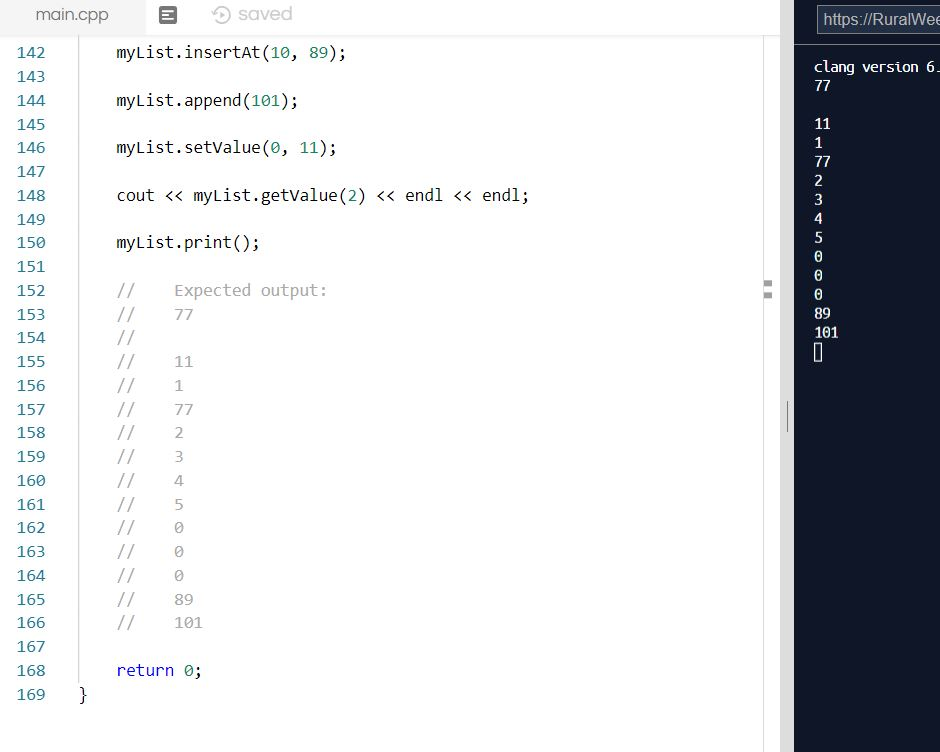
    cout << myList.getValue(2) << endl << endl;

    myList.print();

    //    Expected output:
    //    77
    //
    //    11
    //    1
    //    77
    //    2
    //    3
    //    4
    //    5
    //    0
    //    0
    //    0
    //    89
    //    101

    return 0;
}
Please upvote, as i have given the exact answer as asked in
question. Still in case of any concerns in code, let me know in
comments. Thanks!
 venereology answered 3 months ago
Related Solutions
Flow this Code to answer question below #include <iostream> using std::cout; struct Node { int...
Complete the C++ code #include <iostream> #include <stdlib.h> #include <time.h> using namespace std; struct Cell {...
#include <iostream> #include <fstream> #include <vector> using namespace std; struct Point{ int x, y; bool operator==(const...
#include <cstring> #include <stdio.h> #include <iostream> using namespace std; int main() { const int...
FINISH print and freelist #include<stdio.h> #include <stdlib.h> struct node { int data; struct node *next; }; struct...
in C++, #include<iostream> using namespace std; const int NUM = 10; void prepareArr(int a[]); int countEven...
Given: #include <iostream> using std::cout; template <typename T> struct Node { T data; Node *link; ...
C++ Given Code: #include <iostream> #include <string> using namespace std; int main() { //declare variables to...
#include <iostream> #include <string> #include <iomanip> #include <fstream> using namespace std; struct Product { string...
#include <iostream> using namespace std; int main() { int hour; int min; for (hour = 1;...
- Dirac's Theorem states that "A simple graph with n vertices (n >= 3) is Hamiltonian if...
- Two 10-cm-diameter charged rings face each other, 15cm apart. The left ring is charged to -29nC...
- Under what conditions would it be possible for an excise tax to have no efficiency cost...
- explain the difference between activities and financial statements of service businesses and merchandising businesses.
- 2. Compare and compare the matrix multiplication algorithm and the Floyd-Warshall algorithm to find all pairs...
- Q: 50.00 ml of 0.5216 M copper(II) nitrate solution is combined with 100.0 ml of 0.5580...
- This is a business law question. Explain how environmental laws regulate the use of toxic substances...