Question
In: Physics
In an Ampere
In an Ampere
Solutions
Expert Solution
1) By DEFINITION two parallel wire that carry PARALLEL currents
attract each other. If the currents are ATNTIPARALLEL the two wires
repel each other.
This can be explained with the help of the figure below.
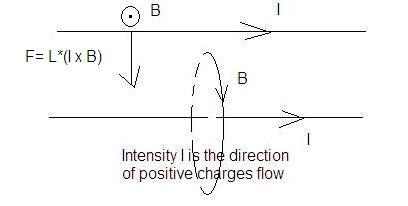
The lower wire creates a field B according to the rotation of a
right screw (screw is advancing in the direction of the current and
its rotation gives the direction of B).
The upper wire feels a magnetic force F = L*(I x B),
where x is the vectorial product. Hence the magnetic force is
attractive.
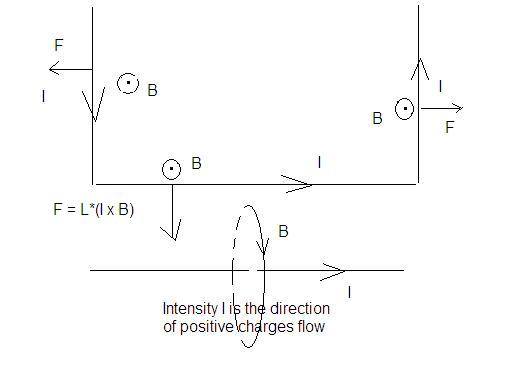
2) Still in the wires N and G the currents are peprendicular to the
field B (so the cross product I x B should be different from zero),
but in this case the currents in the wires N and G are opposing one
to the other so in total the two magnetic forces on the wires N and
G will cancel each other. The figure with this case is below
c) The magnetic field of a current I1 through a wire is given at distance d from the wire by:
B = mu*I1/(2*pi*d)
The magnetic force of field B on current I2 is
F =| L*(I2 x B) |= B*I2*L
since the angle between B and I is 90 degree.
Therefore F = mu*I1*I2*L/(2*pi*d) = mu*I^2*L/(2*pi*d)
where mu is the magnetic permeability of the air mu=4*pi*10^-7 H/m
d) m*g = mu*I^2*L/(2*pi*d)
I = sqrt [mu*L/(2*pi*d*m*g)] =sqrt [4*pi*10^-7*0.26/ (2*pi) / (0.004*2*10^-6*9.81)] =0.814 A
 genius_generous answered 3 months ago
Related Solutions
The unit of current, the ampere, is defined in terms of the force between currents. Two...
The capacities (in ampere-hours) were measured for a sample of 120 batteries. The average was 178...
Imagine you were a physicist in the time of Faraday, Lenz, and Ampere. Why might you...
a. State the ampere circuital law b. Derive expression for inductance of a Toroid? c. Derive...
Show that Maxwell's displacement current must be introduced to satisfy continuity equation using Gauss' Law, Ampere-Maxwell...
DATA: Current in Solenoid l (Ampere(A)) Magnetic Field B (mT) 0.5 0.06050 1.0 0.1500 1.5 0.2048...
- How can the corporate culture coordinate with the company to enhance its competitiveness?(450 words and 1...
- In this exercise, weighed samples of a solid unknown containing NaCl and NaHCO3react with hydrochloric acid....
- strlen(): strlen() counts the number of characters in a cstring. The algorithm works by looking at...
- give short description of each phase of the cardicac cycle where is blood going to and...
- Management Science Bank is the only bank in the small town of Sto Thomas. On a...
- What is the ultimate fate of the digested chicken and rice? What was the initial biological...
- how do corporations benefit from government regulation? *refer to Dean Baker's THE CONSERVATIVE NANNY STATE*