Question

In: Economics

Q.1) Oil-rich countries in the Gulf, already confronted by strong labor protests, are facing renewed pressure...

Q.1) Oil-rich countries in the Gulf, already confronted by strong labor protests, are facing renewed pressure from India to pay minimum wages for unskilled workers. With five million immigrant workers in the region, India is trying to win better conditions for their citizens.

source : International Herbal Tribune, March 27, 2008.

Suppose that the Gulf countries paid a minimum wage above the equilibrium wage to the Indian workers. Answer the following questions assuming that migrants to the Gulf are required to have jobs: that means the number of migrants cannot be larger than the quantity of labor demanded.

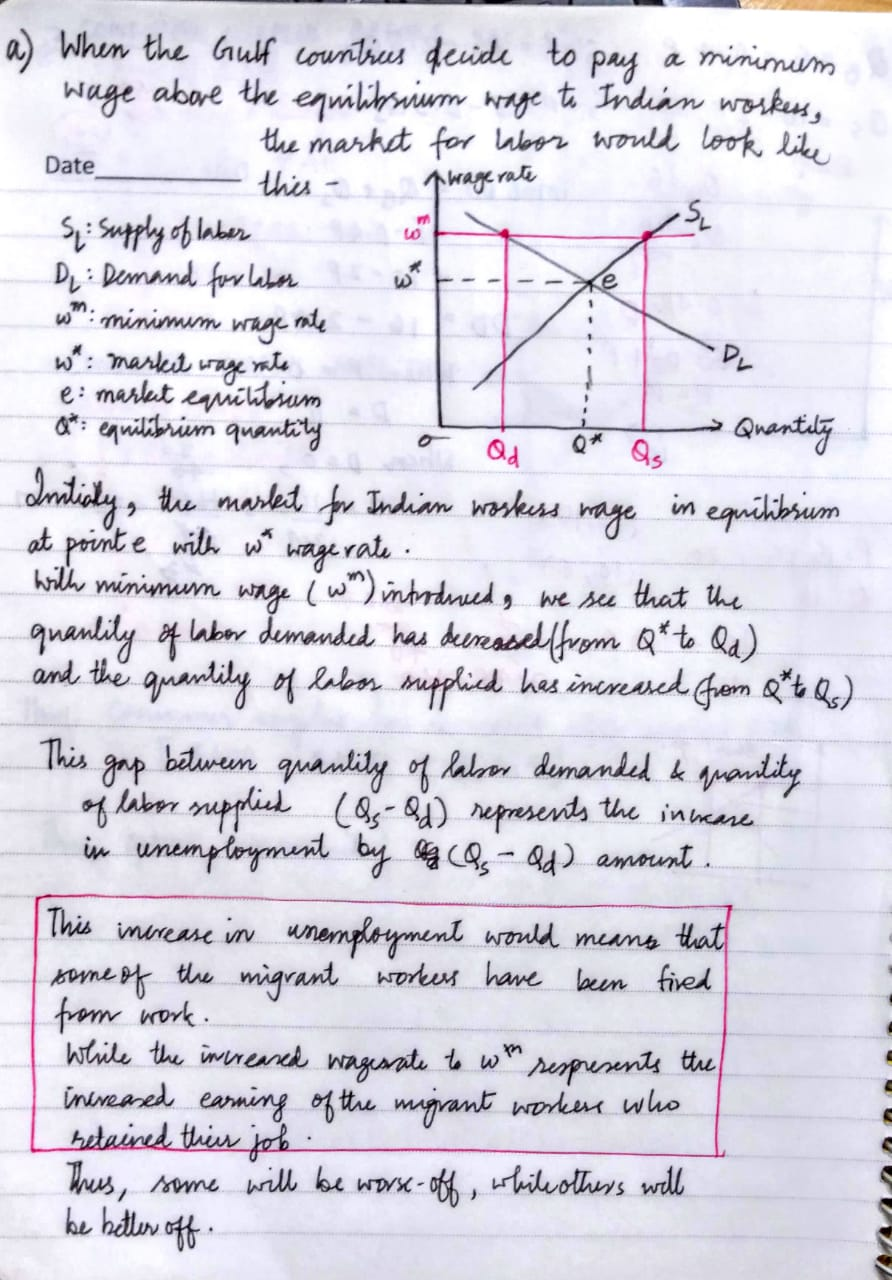
a) How would the market for labor be affected in the Gulf countries? Would migrant Indian workers be better off or worse off or unaffected by this minimum wage? Draw a supply and demand graph to illustrate your answers.

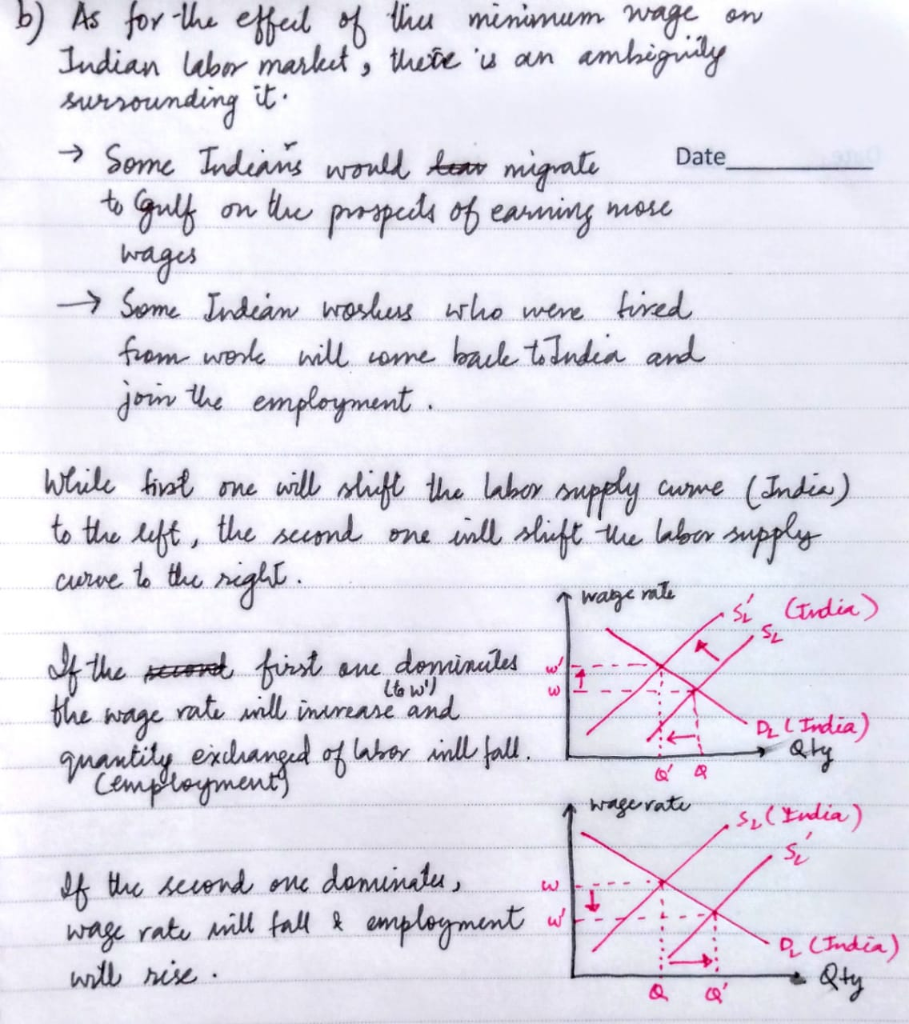
b) How would the market for labor be affected in India? Draw a supply and demand graph to illustrate your answer. Be careful: the minimum wage is in the Gulf countries, not in India.

( Microeconomics )

Solutions
Expert Solution


Related Solutions

Reflective Question # 1: Venezuela is a Latin American country that is rich in oil preserves....
Reflective Question # 1: Venezuela is a Latin American country that is rich in oil preserves. This petroleum sector is mainly owned by the government, in a sense that it controls and prices it. The petroleum sector constitutes around 85% of the exports in the country. In Venezuela, there are very few private sectors. Germany is one of the top 5 richest countries in the world. It provides its citizens varieties in consumer goods and business services. But the government...
Please answer ALL of the following questions! 1. Suppose China is rich in unskilled labor relatively...
Please answer ALL of the following questions! 1. Suppose China is rich in unskilled labor relatively to Japan. Then, according to the Heckscher=Ohlin model, China tends to export (a. high-tech goods/ b. low-tech goods) to Japan and a trade with China benefits (a. unskilled labor/ b. skilled labor/ c. capital owner) of Japan. 2. Wage rates across countries tend (a. to be equalized only if/ b. to be equalized whether or not) trade barriers and technology gaps are absent. When...
A monopolist is facing the following demand schedule P=24-3Q. That is, Q=0 implies P=24, then Q=1...
A monopolist is facing the following demand schedule P=24-3Q. That is, Q=0 implies P=24, then Q=1 implies P=21, and Q=2 implies P=18, and so one. Fixed costs will be neglected in this analysis. The marginal cost is constant and equal to 6 for every unit produced. How do I find the quantity produced and the amount of maximum profits? How do I find the Price and quantity to yield the efficient solution? How do I find what happens if a...
1. Two countries previously classified as Least Industrialized Nations that are building strong competition with Western...
1. Two countries previously classified as Least Industrialized Nations that are building strong competition with Western nations because of cheap telecommunications and outsourced jobs from multinational corporations are ________ and ________. Select one: a. Vietnam; Indonesia b. China; India c. Japan; Brazil d. Indonesia; Taiwan 2.  Global stratification, which of the following best characterize Japan? Select one: a. under developed b. low income c. a monopoly d. High income 3. Who or what are the "Asian Tigers"? Select one: a. the...
1. Consider two firms facing the demand curve P = 50 ? 5Q, where Q =...
1. Consider two firms facing the demand curve P = 50 ? 5Q, where Q = Q1 + Q2. The firms cost functions are C1(Q1) = 20 + 10Q1 and C2(Q2) = 20 + 10Q2. a. Suppose both firms have entered the industry. What is the joint profit-maximizing level of output? How much will each firm produce? How would your answer change if the firms have not yet entered the industry? b. How much should Firm 1 be willing to...
Q. 1 Describe three reasons for an unfavourable direct manufacturing labor efficiency variance. (3 marks) Q....
Q. 1 Describe three reasons for an unfavourable direct manufacturing labor efficiency variance. Q. 2 How does variance analysis help in continuous improvement? Q. 3 Why might an analyst examining variances in the production area look beyond that business function for explanations of those variances? Give two examples to support your response.
Q 1. (25 pts) A constant pressure container is filled with 1 kg of stainless steel...
Q 1. (25 pts) A constant pressure container is filled with 1 kg of stainless steel and 0.5 kg of PVC (polyvinyl chloride) both at 20C and 0.25 kg of hot air at 500 K, 100 kPa. The container is now left alone with no external heat transfer. a. Find the final temperature. b. Find the process work. pls sol 20 minute
1) Explain why oil producing countries have been caught in a prisoner's dilemma situation?
1). Consider the production function Q= L0.4 * K0.1 The price of labor is 8, the...
1). Consider the production function Q= L0.4 * K0.1 The price of labor is 8, the price of capital is 2, and the price of output is 160. The firm incurs $80 in fixed costs. a.) Find the marginal product of labor. b.) Find the marginal product of capital. c.) Find MRTS. d.) find the relationship between optimal level of capital and labor to be used. e.) find the total cost function. f) find the marginal cost. g) what output...
1. Suppose that output q is a function of a single input, labor (L). Describe the...
1. Suppose that output q is a function of a single input, labor (L). Describe the returns to scale associated with each of the following production functions: a. q = 3L. Answer: b. q = L3. Answer:
ADVERTISEMENT
ADVERTISEMENT
ADVERTISEMENT