Question
In: Physics
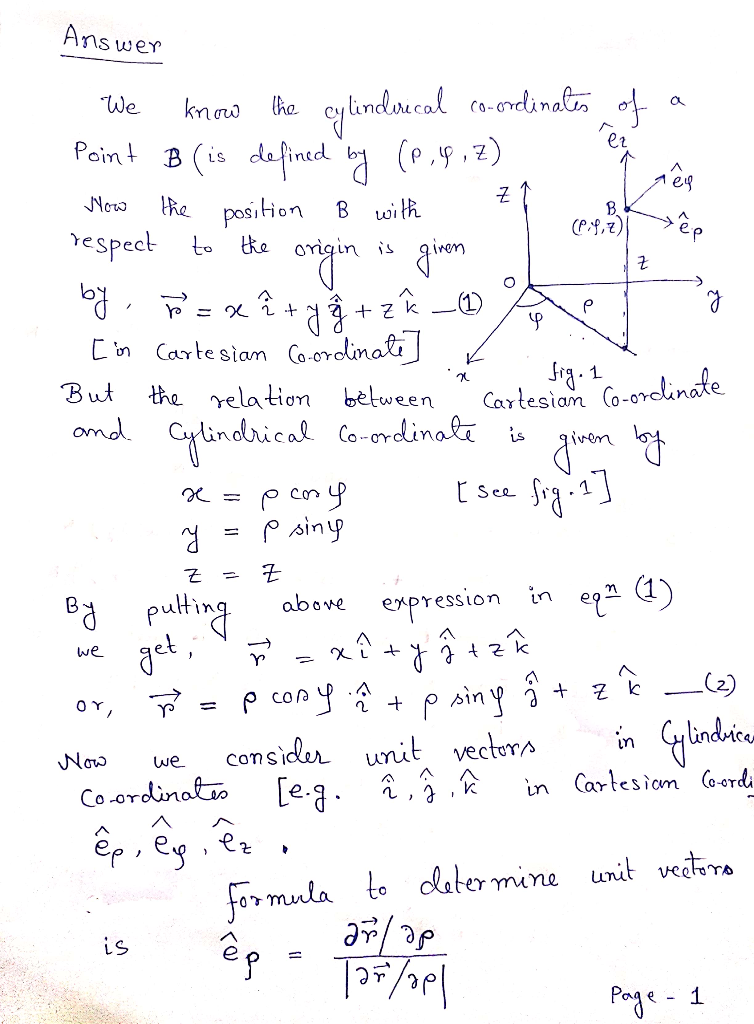
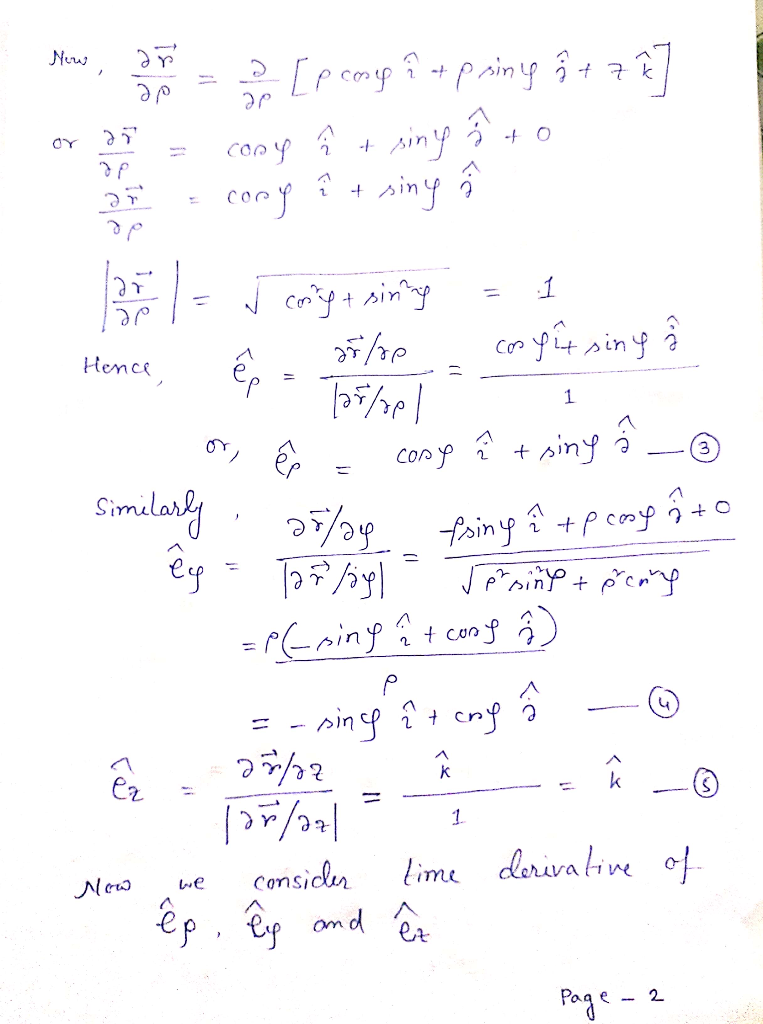
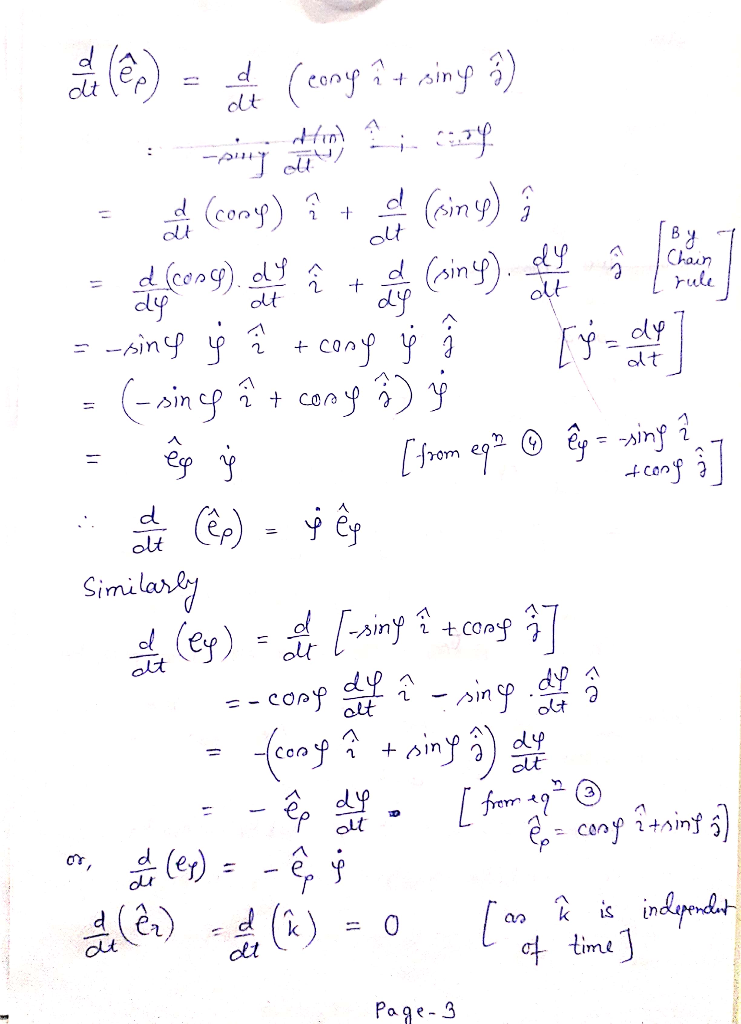
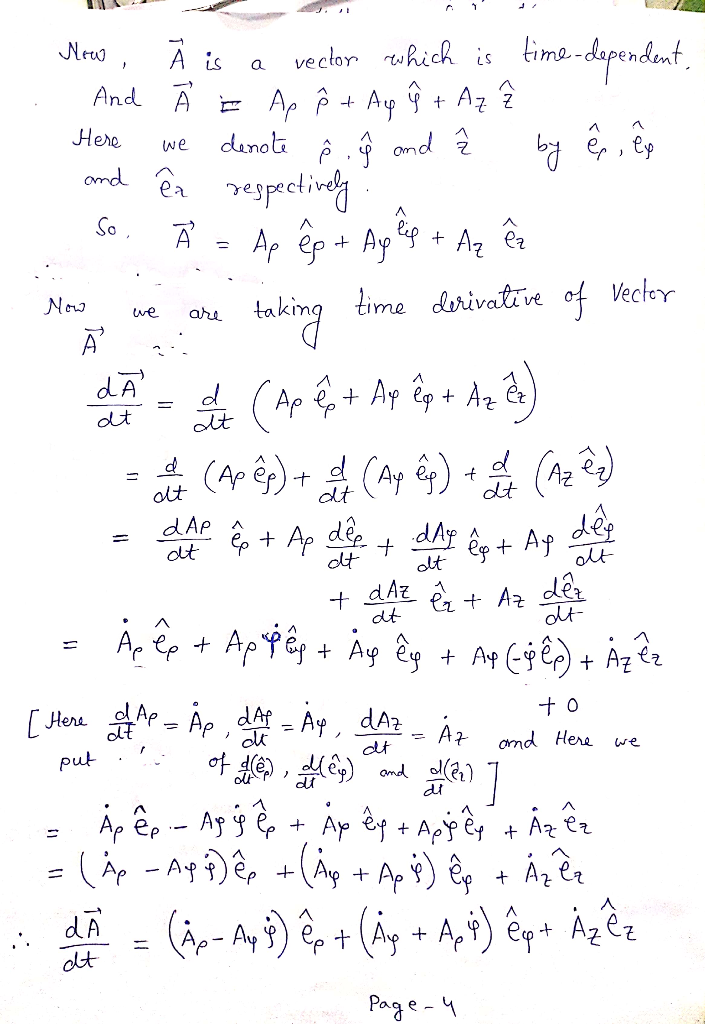
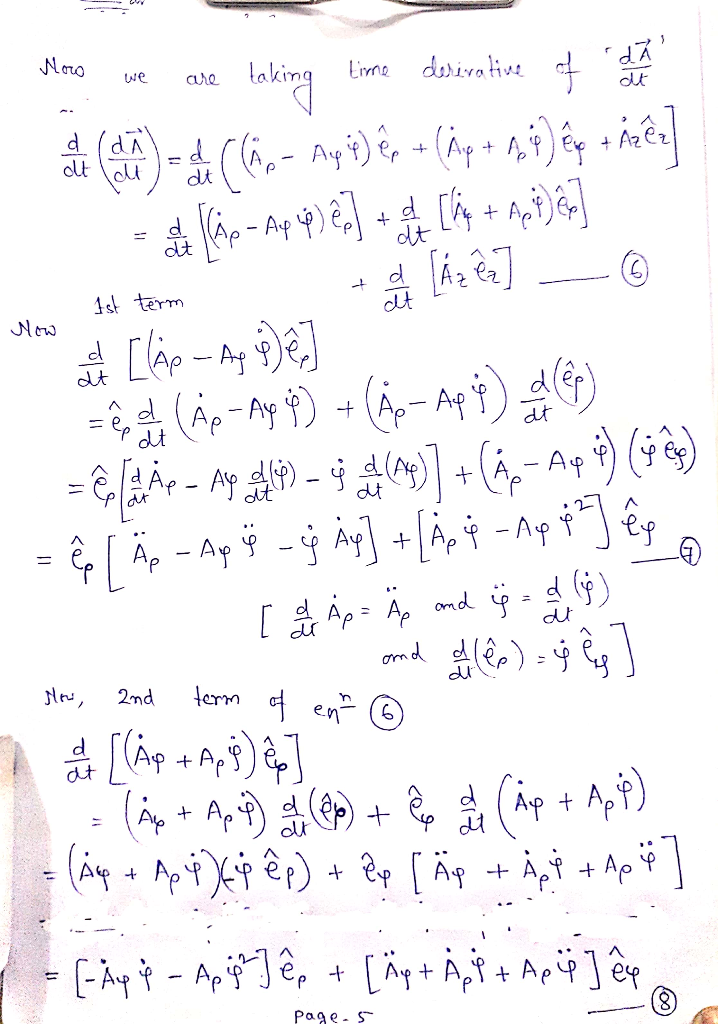
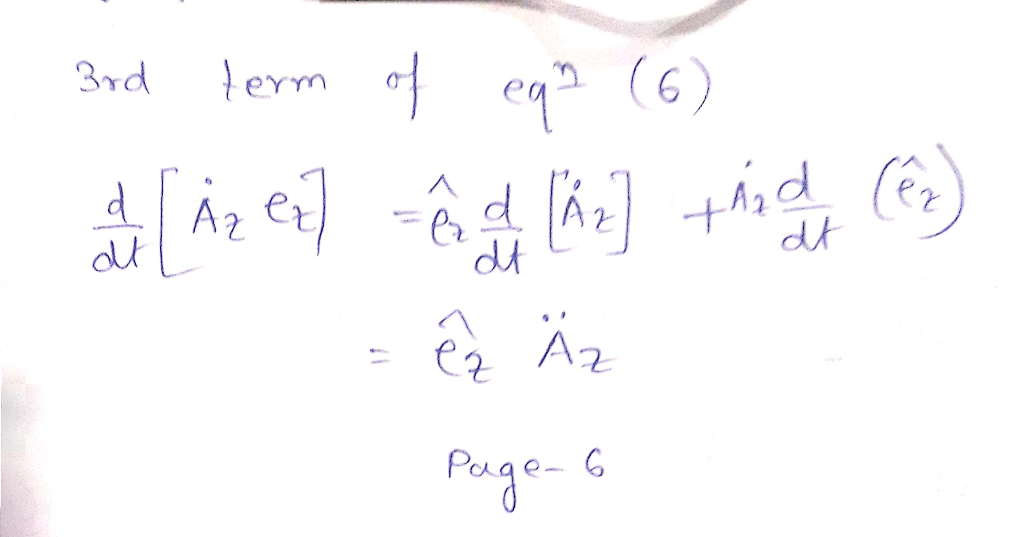
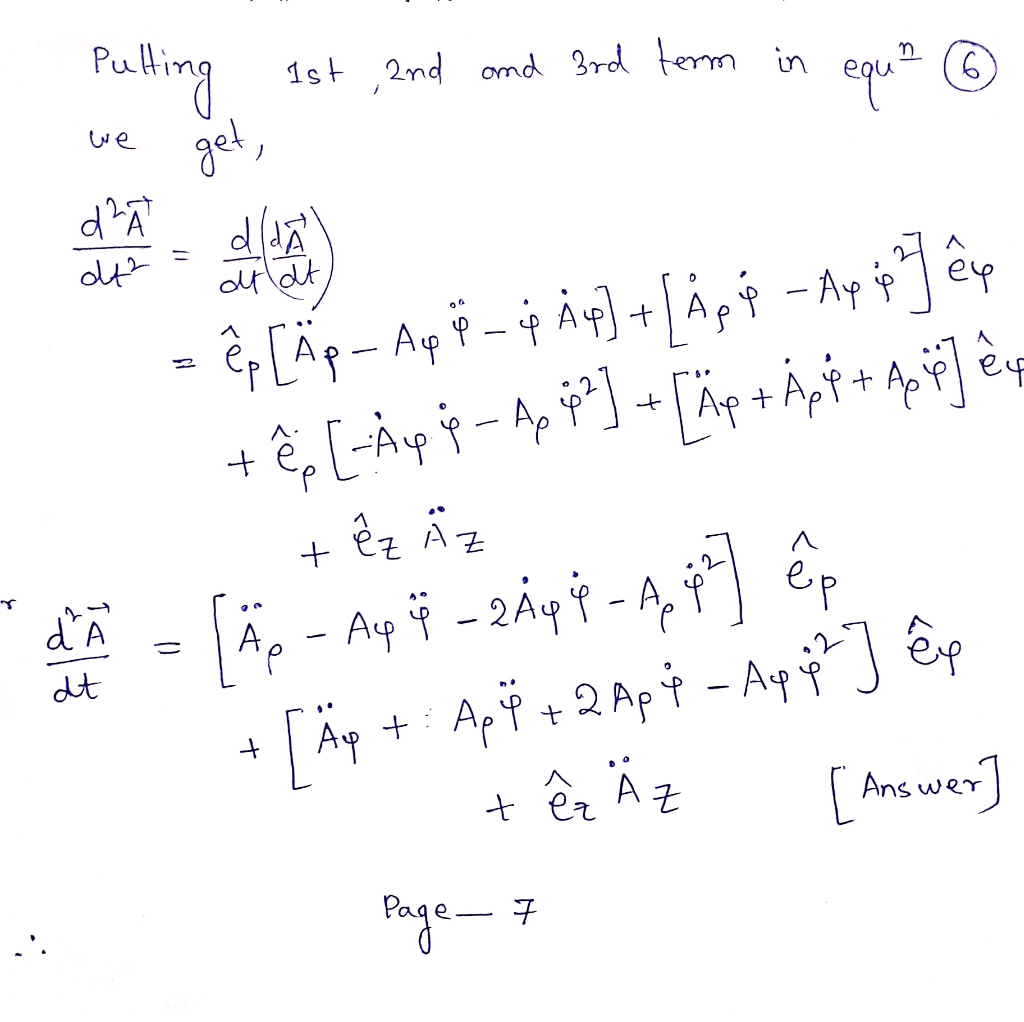
In cylindrical coordinates, vector A is given as; A = Aρρ + Aφφ + Azz ....
In cylindrical coordinates, vector A is given as;
A = Aρρ + Aφφ + Azz .
Vector A is a time-dependent function.
Find the components of d2A / dt2 .
Solutions
 genius_generous answered 4 months ago
Related Solutions
The unit vector (in cylindrical coordinates) parallel to the z-axis at Q (r = 5, θ...
The unit vector (in cylindrical coordinates) parallel to the
z-axis at Q (r = 5, θ = π/2, ϕ =1.5π) is
The stream function in cylindrical coordinates for a two-dimensional flow is given by:  
The stream function in cylindrical
coordinates for a two-dimensional flow is given by:
Ψ = [(a)(r) + (b)/(r)] Sin ϴ
Where “a” and “b” are constants.
a)Does this flow satisfy the continuity?
b)Determine the corresponding velocity
potential in the polar coordinate system.
c) Is this flow irrotational? Why?
Derive the del operator in cylindrical coordinates by converting the del operator in Cartesian coordinates into...
Derive the del operator in cylindrical coordinates by converting
the del operator in Cartesian coordinates into thr del operator in
cylindrical coordinates.
a) Given a vector field à = zỹ +(3y + 2)2 î in cartesian coordinates, determine...
a) Given a vector field à = zỹ +(3y + 2)2 î in cartesian
coordinates, determine whether it is solenoidal (V · À = 0),
conservative (D x X = 0)
I Div x A (Cylinderical Coordinates)
ii) Calculate integral A*dl , where the contour C is the unit
circle (r=1) traversed in anticlockwise direction
1.) Convert the following from rectangular coordinates to cylindrical coordinates. Write your angles in degrees rounded...
1.) Convert the following from rectangular coordinates to
cylindrical coordinates. Write your angles in degrees rounded to
one decimal point
(3, -7, 4)
2.) Convert the following from rectangular coordinates to
spherical coordinates. Write your angles in degrees rounded to one
decimal point
(3, -7, 4)
3.) Convert the following from cylindrical to rectangular
coordinates. Round your answer to one decimal place.
(3, 20o, -4)
4.) Convert the following from sphereical to rectangular
coordinates. Round your answer to one decimal...
Starting from the general expression of the Navier-Stokes equations in cylindrical coordinates, provide the form of...
Starting from the general expression of the Navier-Stokes
equations in cylindrical coordinates, provide the form of the
equations for an axisymmetric, steady flow. Explicitly write down
the continuity equation as well as the momentum equation in all
relevant directions in terms of partial derivatives. (Hint: How
much is uθ for this flow? Explain why. How much is ∂/∂θ ?
IMPORTANT NOTE: Please have the answer complete,
clear and computer generated!!
The following charges exist (given coordinates are (x, y) coordinates in the plane of the page):
The following charges exist (given coordinates are (x, y) coordinates in the plane of the page):
• a −3.0 µC point charge located at (0, 0)
• a −2.0 µC uniform spherical shell of charge of radius 3.0 cm centered at (+4.0 cm, 0)
• a +2.0 µC uniform spherical shell of charge of radius 2.0 cm centered at (0, −4.0 cm)
• a +4.0 µC uniform spherical shell of charge of radius 4.0 cm centered at (−1.0 cm,...
Plot the point whose polar coordinates are given. Then find the Cartesian coordinates of the point...
Plot the point whose polar coordinates are given. Then find the
Cartesian coordinates of the point
b. (2, π/4)
c.(−3, −π/6)
Use cylindrical or spherical coordinates, whichever seems more appropriate. Find the volume of the smaller wedge...
Use cylindrical or spherical coordinates, whichever seems more
appropriate. Find the volume of the smaller wedge cut from a sphere
of radius 2 by two planes that intersect along a diameter at an
angle of ?/2.
Consider an incompressible flow in cylindrical coordinates with velocity field v = Cr^(a) θ^ where C...
Consider an incompressible flow in cylindrical coordinates with
velocity field v = Cr^(a) θ^ where C is a constant (a) Show that
the flow satisfies the Navier-Stokes equations for only two values
of a. (b) Given that p(r; θ; z) = p(r) only, and neglecting
gravity, find the pressure distribution for each case, assuming
that the pressure at r = R is p0
ADVERTISEMENT
ADVERTISEMENT
Latest Questions
- Under what conditions would it be possible for an excise tax to have no efficiency cost...
- explain the difference between activities and financial statements of service businesses and merchandising businesses.
- 2. Compare and compare the matrix multiplication algorithm and the Floyd-Warshall algorithm to find all pairs...
- Q: 50.00 ml of 0.5216 M copper(II) nitrate solution is combined with 100.0 ml of 0.5580...
- This is a business law question. Explain how environmental laws regulate the use of toxic substances...
- A sky diver and her parachute system weigh a total of 800 N. She is falling...
- Need solution: HSL Company produces rugs. The following cost information from last year is available: Total...
ADVERTISEMENT