Question
In: Computer Science
In the game of Lucky Sevens, the player rolls a pair of dice. If the dots...
In the game of Lucky Sevens, the player rolls a pair of dice. If the dots add up to 7, the player wins $4; otherwise, the player loses $1. Suppose that, to entice the gullible, a casino tells players that there are many ways to win: (1, 6), (2, 5), and soon. A little mathematical analysis reveals that there are not enough ways to win to make the game worthwhile; however, because many people's eyes glaze over at the first mention of mathematics “wins $4”.
Your challenge is to write a program that demonstrates the futility of playing the game. Your Python program should take as input the amount of money that the player wants to put into the pot, and play the game until the pot is empty.
The program should have at least TWO functions (Input validation and Sum of the dots of user’s two dice). Like the program 1, your code should be user-friendly and able to handle all possible user input. The game should be able to allow a user to ply as many times as she/he wants.
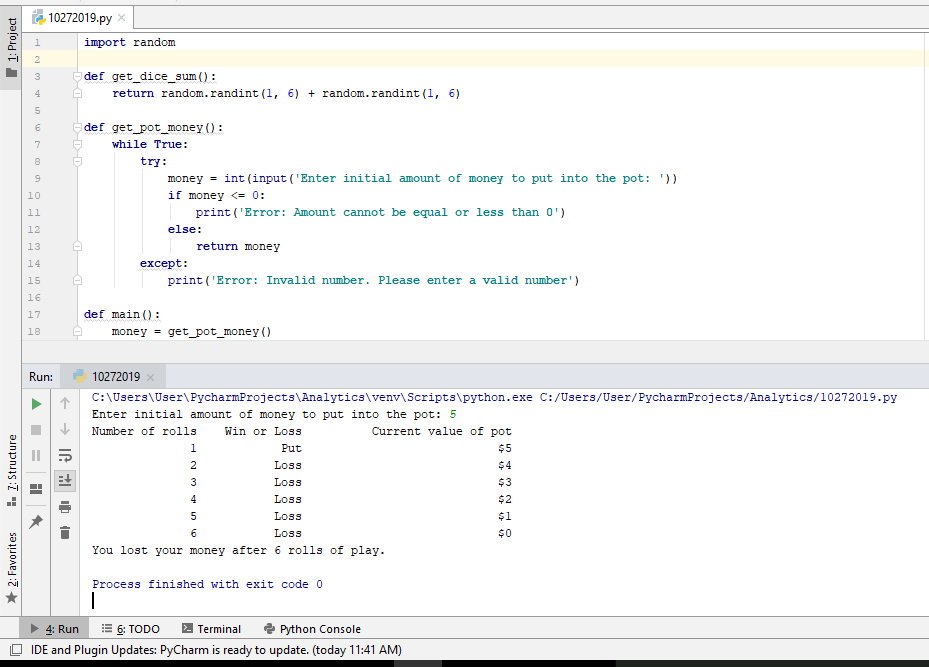
The program should print a table as following:
Number of rolls Win or Loss Current value of the pot
1 Put $10
2 Win $14
3 Loss $11
4
## Loss $0
You lost your money after ## rolls of play.
The maximum amount of money in the pot during the playing is $##.
Do you want to play again?
At that point the player’s pot is empty (the Current value of the pot is zero), the program should display the number of rolls it took to break the player, as well as maximum amount of money in the pot during the playing.
Again, add good comments to your program.
Test your program with $5, $10 and $20.
Solutions
Expert Solution
Thanks for the question.

Below is the code you will be needing  Let me know if you have any doubts or if you need anything to change.

Thank You !!

===========================================================================

import random


def get_dice_sum():
    return random.randint(1, 6) + random.randint(1, 6)


def get_pot_money():
    while True:
        try:
            money = int(input('Enter initial amount of money to put into the pot: '))
            if money <= 0:
                print('Error: Amount cannot be equal or less than 0')
            else:
                return money
        except:
            print('Error: Invalid number. Please enter a valid number')


def main():
    money = get_pot_money()

    print('{0:>15}{1:>15}{2:>30}'.format('Number of rolls', 'Win or Loss', 'Current value of pot'))
    print('{0:>15}{1:>15}{2:>30}'.format(1, 'Put', '${}'.format(money)))
    rolls = 1
    while money != 0:
        dice_sum = get_dice_sum()
        rolls += 1
        if dice_sum == 7:
            money += 4
            print('{0:>15}{1:>15}{2:>30}'.format(rolls, 'Win', '${}'.format(money)))
        else:
            money -= 1
            print('{0:>15}{1:>15}{2:>30}'.format(rolls, 'Loss', '${}'.format(money)))


    print('You lost your money after {} rolls of play.'.format(rolls))

main()
=============================================================================

 venereology answered 3 months ago
Related Solutions
In the game of Lucky Sevens, the player rolls a pair of dice. If the dots...
In the game of Lucky Sevens, the player rolls a pair of dice. If the dots...
Please generate code in PYTHON: In the game of Lucky Sevens, the player rolls a pair...
PLEASE USE PYTHON THANK YOU In the game of Lucky Sevens, the player rolls a pair...
At a charity event, a player rolls a pair of dice. If the player roles a...
In a dice game a player first rolls two dice. If the two numbers are l...
You are rolling a pair of balanced dice in a board game. Rolls are independent. You...
PROGRAMMING IN C-DICE GAME Q1. A player rolls two dice at the same time. Each die...
A game works as follows: the player rolls one dice once (let's call it ''n'') and...
In the game of craps, a player (known as the shooter) rolls two fair six-sided dice....
- Consider the quick sort algorithm. The quick sort algorithm is a divide and conquer approach which...
- Tesla 1. How to make these weaknesses into strengths? Burn through cash, high prices, bottlenecking/product delays,...
- Assignment # 12: Email Presentation Learning Objectives and Outcomes Design a PowerPoint presentation appropriate for middle...
- Identify which of the perspectives you believe is the BEST for accurately explaining human behavior and...
- What trade policies should a country adopt? why? Explain. Also, find some reference materials on this...
- In Java: Suppose you want to implement a Sudoku game that consists of 9x9 rows and...
- What is the percent yield of the solid product when 17.62 g of iron(III) nitrate reacts...