Question
In: Math
Suppose the following data are product weights for the same items produced on two different production...
Suppose the following data are product weights for the same items produced on two different production lines.
| Line 1 | Line 2 |
|---|---|
| 13.9 | 13.5 |
| 13.3 | 14.2 |
| 14.0 | 14.4 |
| 13.6 | 14.0 |
| 13.8 | 14.9 |
| 13.4 | 13.7 |
| 13.1 | 14.8 |
| 13.9 | 14.3 |
| 12.6 | 14.7 |
| 14.8 | 14.1 |
| 15.0 | |
| 14.6 |
Test for a difference between the product weights for the two lines. Use α = 0.05.
State the null and alternative hypotheses.
H0: The two populations of product weights
are identical.
Ha: The two populations of product weights are
not identical.H0: Median for line 1 − Median
for line 2 < 0
Ha: Median for line 1 − Median for line 2 =
0 H0: The two
populations of product weights are not identical.
Ha: The two populations of product weights are
identical.H0: Median for line 1 − Median for
line 2 ≤ 0
Ha: Median for line 1 − Median for line 2 >
0H0: Median for line 1 − Median for line 2 ≥
0
Ha: Median for line 1 − Median for line 2 <
0
Find the value of the test statistic.
W =
Find the p-value. (Round your answer to four decimal places.)
p-value =
State your conclusion.
Reject H0. There is not sufficient evidence to conclude that there is a significant difference between the product weights for the two lines.Reject H0. There is sufficient evidence to conclude that there is a significant difference between the product weights for the two lines. Do not reject H0. There is sufficient evidence to conclude that there is a significant difference between the product weights for the two lines.Do not reject H0. There is not sufficient evidence to conclude that there is a significant difference between the product weights for the two lines.
Solutions
Expert Solution
As distribution of the weights is not specified,We perform Mann Whitney test in minitab for the above non parametric problem.
1. The null and alternative hypotheses.are :
H0: The two populations of product weights
are identical.
Ha: The two populations of product weights are
not identical.
2. steps in minitab : stat, non parametric, Mann Whitney
test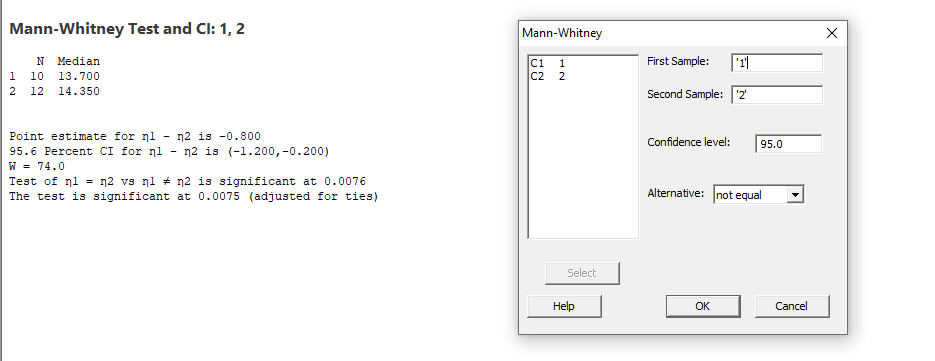
Value of the test statistic.
W =74
3. p-value =0.0075
4. Conclusion : As p-value=0.0075<0.05=alpha , we reject H0 i.e Reject H0. There is sufficient evidence to conclude that there is a significant difference between the product weights for the two lines.
 milcah answered 5 months ago
Related Solutions
Suppose the following data are product weights for the same items produced on two different production...
uppose the following data are product weights for the same items produced on two different production...
The following data are for the two products produced by Tadros Company. Product A Product...
The following data are for the two products produced by Tadros Company. Product A Product...
The following data are for the two products produced by Shakti Company. Product A Product B...
The following data are for the two products produced by Tadros Company. Product A Product B...
The following data are for the two products produced by Tadros Company. Product A Product B...
The following data are for the two products produced by Tadros Company. Product A Product B...
1. The weights of items produced by a company are normally distributed with a mean of...
A monopolist sells the same product at the same price into two different markets. The demand...
- On January 1, 2018, bonds with a face value of $ 79,000 were sold. The bonds...
- How do I make this sort in true alphabetical order instead of ascii(ABCabc) order? I am...
- As a healthcare provider in physical therapy, athletic training, or as an exercise scientist and personal...
- in the market for makeup artists, what happens after the invention of high-definition tv allowing viewers...
- 10. What are the three monetary policy tools of the Fed? Briefly describe how each tool...
- In what ways would the role of a manager working in a nonstandard international assignment arrangement...
- Write a Bash script called move that could replace the UNIX command mv. 'move' tries to...