Question
In: Physics
A 34.8-kg child starting from rest slides down a water slide with a vertical height of...
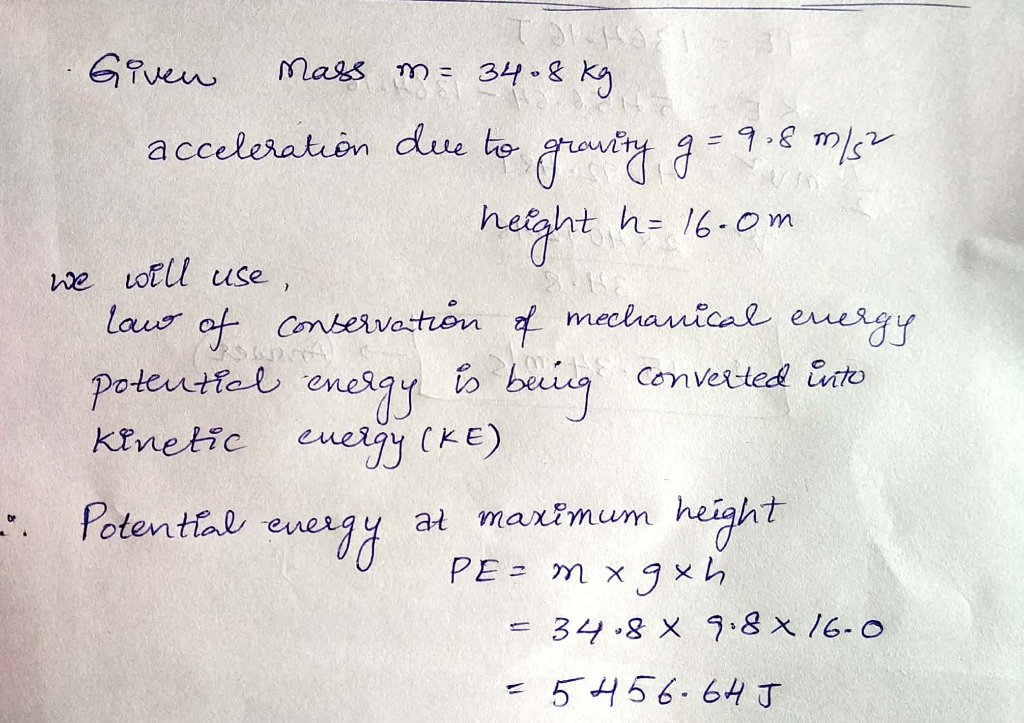
A 34.8-kg child starting from rest slides down a water slide with a vertical height of 16.0 m. (Neglect friction.)
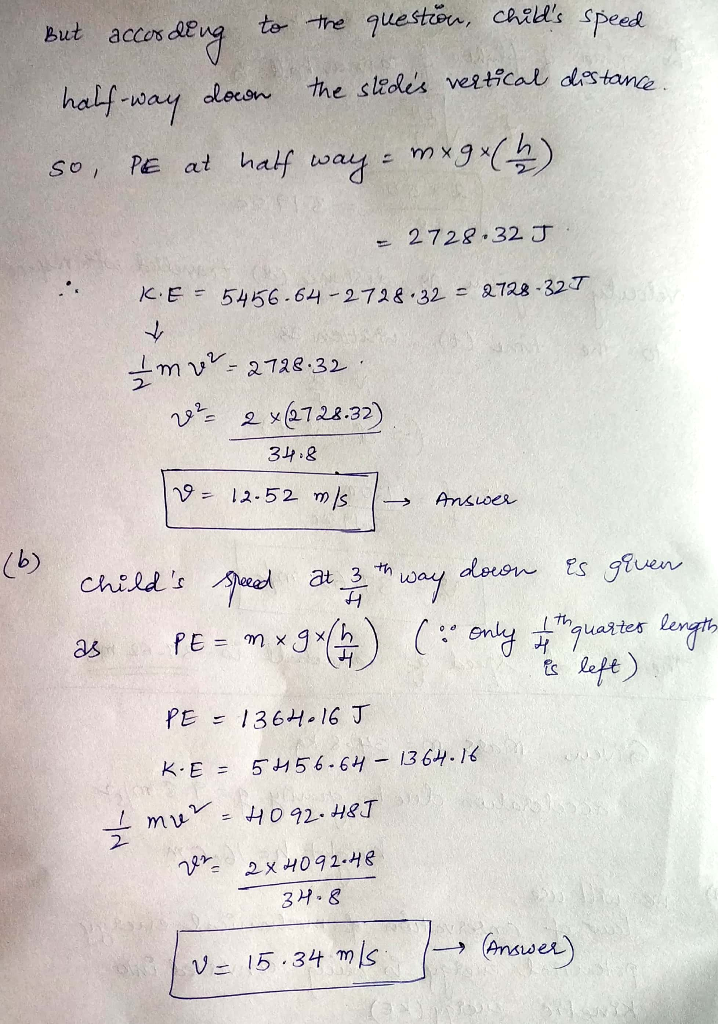
(a) What is the child's speed halfway down the slide's vertical distance?
m/s
(b) What is the child's speed three-fourths of the way down?
m/s
Solutions
Expert Solution
Answer Explanation:
-----------------------------------------------------------------------------------------------------------------------------------
Hope it helps!
Please Upvote..
In case of doubts please comment below..
Thank you.
 genius_generous answered 6 months ago
Related Solutions
A student, starting from rest, slides down a water slide. On the way down, a kinetic...
A student, starting from rest, slides down a water slide. On the
way down, a kinetic frictional force (a nonconservative force) acts
on her. The student has a mass of 62.0 kg, and the height of the
water slide is 12.4 m. If the kinetic frictional force does -5.72 ×
103 J of work, how fast is the student going at the bottom of the
slide?
A student, starting from rest, slides down a water slide. On the way down, a kinetic...
A student, starting from rest, slides down a water slide. On the
way down, a kinetic frictional force (a nonconservative force) acts
on her. The student has a mass of 77 kg, and the height of the
water slide is 12.9 m. If the kinetic frictional force does -7.1 ×
103 J of work, how fast is the student going at the bottom of the
slide?
a) A child slides down a water slide at an amusement park from an initial height...
a) A child slides down a water slide at an amusement park from
an initial height h. The slide can be considered
frictionless because of the water flowing down it. Can the equation
for conservation of mechanical energy be used on the child?
YesNo
(b) Is the mass of the child a factor in determining his speed at
the bottom of the slide?
YesNo
(c) The child drops straight down rather than following the curved
ramp of the slide. In...
A student of mass 65.4 kg, starting at rest, slides down a slide 17.2 m long,...
A student of mass 65.4 kg, starting at rest, slides down a slide
17.2 m long, tilted at an angle of 30.1° with respect to the
horizontal. If the coefficient of kinetic friction between the
student and the slide is 0.118, find the force of kinetic friction,
the acceleration, and the speed she is traveling when she reaches
the bottom of the slide. (Enter the magnitudes.)
HINT
(a)
the force of kinetic friction (in N)
N
(b)
the acceleration (in...
1.A 65.0 kg object slides down a 30o angle slope from rest at a height of...
1.A 65.0 kg object slides down a
30o angle slope from rest at a height of 15.0 m. The
coefficient of kinetic friction between the object and the slope
surface is 0.15. (A) What is the object
A 4.5 kg box slides down a 4.2-m -high frictionless hill, starting from rest, across a...
A 4.5 kg box slides down a 4.2-m -high frictionless hill,
starting from rest, across a 2.3-m -wide horizontal surface, then
hits a horizontal spring with spring constant 480 N/m . The other
end of the spring is anchored against a wall. The ground under the
spring is frictionless, but the 2.3-m-long horizontal surface is
rough. The coefficient of kinetic friction of the box on this
surface is 0.26.
What is the speed of the box just before hitting the...
Starting from rest, a 4.20-kg block slides 2.30 m down a rough 30.0° incline. The coefficient...
Starting from rest, a 4.20-kg block slides 2.30 m down a rough
30.0° incline. The coefficient of kinetic friction between the
block and the incline is μk =
0.436.
(a) Determine the work done by the force of gravity.
J
(b) Determine the work done by the friction force between block and
incline.
J
(c) Determine the work done by the normal force.
J
(d) Qualitatively, how would the answers change if a shorter ramp
at a steeper angle were...
Starting from rest, a 5 kg block slides 2.5 m down a roughly 30 degree incline....
Starting from rest, a 5 kg block slides 2.5 m down a roughly 30
degree incline. the coefficient of kinetic friction between the
block and the incline is uk= .436. Determine a) the work done by
the force of gravity, b) the work done by the friction force
between the rock and the incline and c) the work done by the normal
force. d) qualitatively how would answers change if a shorter ramp
at a steeper angle were used to...
1. Starting from rest, a 20 kg wheel rolls down a hill of height 6 m....
1. Starting from rest, a 20 kg wheel rolls down a hill
of height 6 m. At the bottom of the hill 360 J of of energy is in
its rotation. What is the speed of the wheel's center of
mass?
6 m/s
8 m/s
10 m/s
9 m/s
4 m/s
2. If each of the following objects are rotating with
the same angular velocity, ?, which would be the hardest to stop?
(i.e., require the largest amount of work)....
1. A water slide is constructed so that swimmers, starting from rest at the top of...
1. A water slide is constructed so that swimmers, starting from
rest at the top of the slide, leave the end of the slide traveling
horizontally. As the drawing shows, one person hits the water 5.00
m from the end of the slide in a time of 1.500 s after leaving the
slide. Ignoring friction and air resistance, find the height H in
the drawing. The answer is 11.6 m (please explain)
2. An extreme skier, starting from rest, coasts...
ADVERTISEMENT
ADVERTISEMENT
Latest Questions
- Problem 18-12 Various shareholders' equity topics; comprehensive [LO18-1, 18-4, 18-5, 18-6, 18-7, 18-8] Part A In...
- Hello There, This is discussion Question For Advanced Database Systems Question: (a) Please define what a...
- Physicians at a clinic gave what they thought were drugs to 860860 patients. Although the doctors...
- On January 1, 2018, bonds with a face value of $ 79,000 were sold. The bonds...
- How do I make this sort in true alphabetical order instead of ascii(ABCabc) order? I am...
- As a healthcare provider in physical therapy, athletic training, or as an exercise scientist and personal...
- in the market for makeup artists, what happens after the invention of high-definition tv allowing viewers...
ADVERTISEMENT