Question
In: Physics
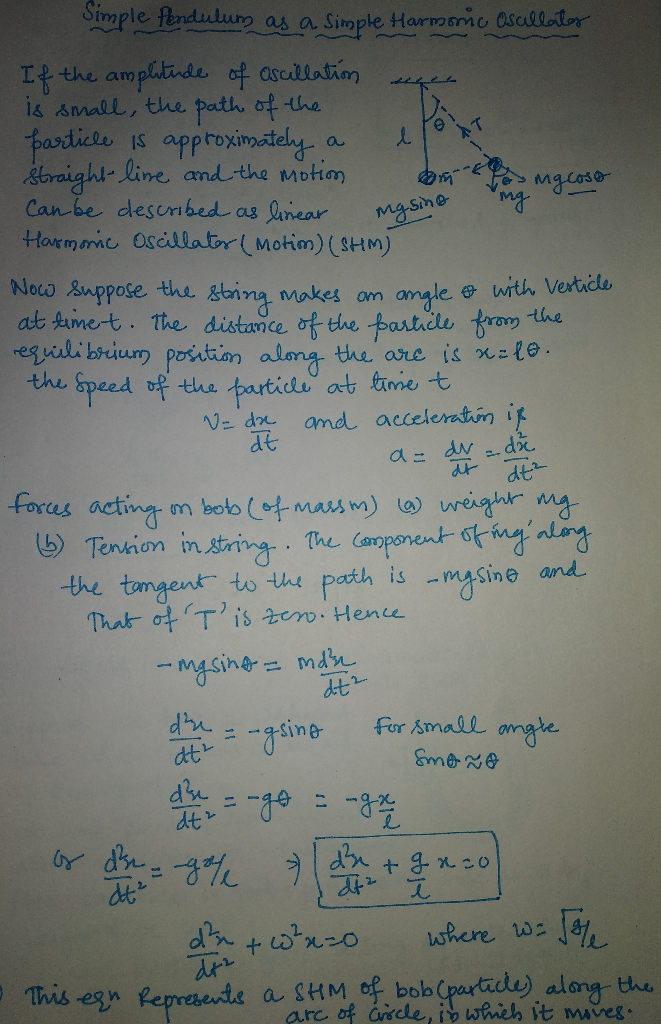
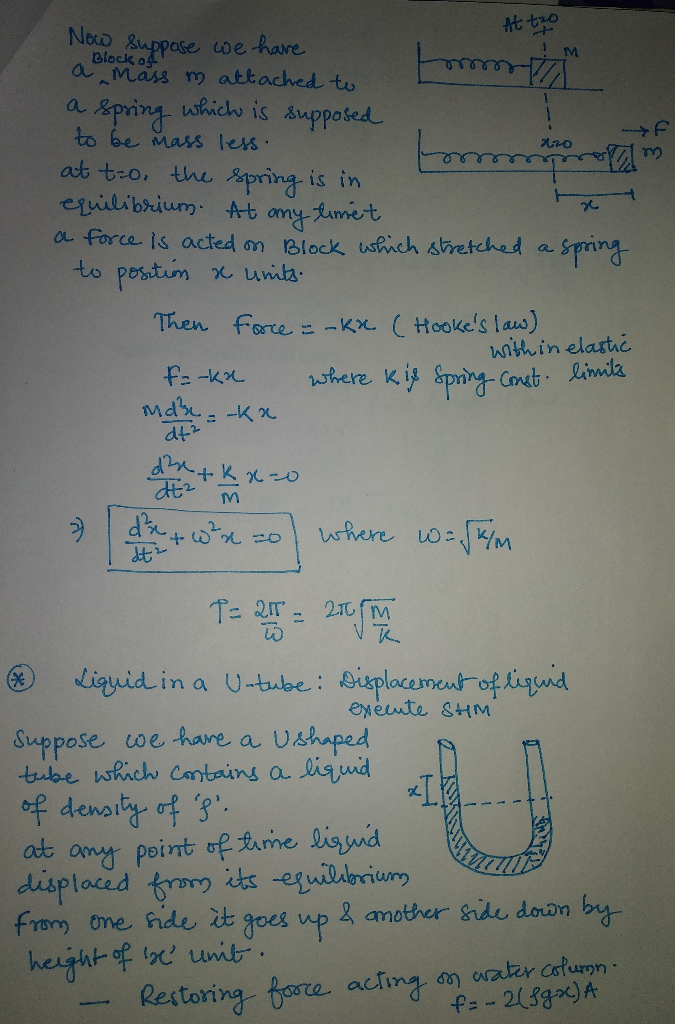
Describe how a pendulum and a mass on a horizontal spring satisfy those conditions (ignore any...
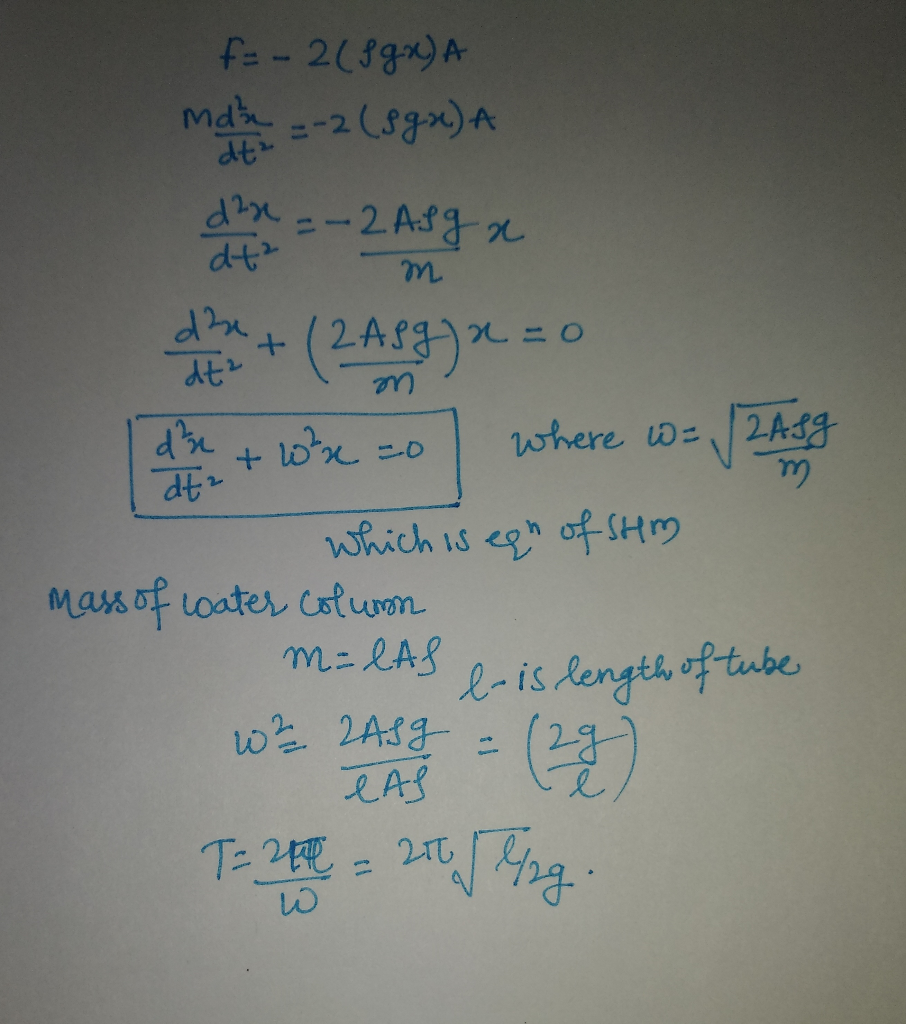
Describe how a pendulum and a mass on a horizontal spring satisfy those conditions (ignore any friction forces); also, include another example of a system that undergoes simple harmonic motion and discuss how it satisfies the conditions mentioned above.
Solutions
 genius_generous answered 6 months ago
Related Solutions
You are bringing a spring pendulum (i.e. a mass attached to a spring) and a regular...
You are bringing a spring pendulum (i.e. a mass attached to a
spring) and a regular pendulum (think ball on a string) to the
International Space Station. Because the ISS is in orbit around the
Earth you (and everything else on board) experience apparent
weightlessness. Under these conditions, which of the following
statements is correct when you displace both pendulums from their
respective equilibrium positions (ie try to make them oscillate):
Group of answer choices
The spring pendulum will oscillate....
There are two correct answers for this question: A simple pendulum and a spring-mass pendulum both...
There are two correct answers for this question:
A simple pendulum and a spring-mass pendulum both have identical
frequencies. Which changes will result in the spring-mass system
having twice the period of the pendulum?
a) Quadruple the mass of the simple pendulum
b) Replace the spring with one half the spring constant and
double the mass
c) Make the string on the pendulum four times smaller and make
the pendulum 4 times more massives
d) Double the mass in the...
Compare and contrast a simple pendulum with a mass/spring pendulum. Be sure to address velocity, acceleration,...
Compare and contrast a simple pendulum with a mass/spring
pendulum. Be sure to address velocity, acceleration, and energy
conversions.
A block with a mass M is attached to a horizontal spring with a spring constant...
A block with a mass M is attached to a horizontal spring with a
spring constant k. Then attached to this block is a pendulum with a
very light string holding a mass m attached to it. What are the two
equations of motion? (b) What would these equations be if we
assumed small x and φ? (Do note that these equations will turn out
a little messy, and in fact, the two equations involve both
variables (i.e. they are...
A mass of 1.20 kg is attached to a horizontal spring with a spring constant of...
A mass of 1.20 kg is attached to a horizontal spring with a
spring constant of 125 N/m. It is stretched to a length of 20.0 cm
and released from rest.
a) Write down an equation for the position and velocity of the
block as a function of time. b) What is the maximum magnitude of
acceleration that the block experiences? Is this consistent with
Hooke’s Law? c) When the block is to the right of the equilibrium
position with...
A vertical spring (ignore its mass), whose spring constant is 825 N/m , is attached to...
A vertical spring (ignore its mass), whose spring constant is
825 N/m , is attached to a table and is compressed down by 0.160
m.
A)What upward speed can it give to a 0.360-kg ball when
released? Express your answer to three significant figures and
include the appropriate units.
B) How high above its original position (spring compressed) will
the ball fly? Express your answer to three significant figures and
include the appropriate units.
A mass-spring system is in SHM in the horizontal direction. PART A If the mass is...
A mass-spring system is in SHM in the horizontal
direction.
PART A
If the mass is 0.35 kg, the spring constant is 11 N/m , and
the amplitude is 16 cm, what is the maximum speed of the
mass?
vmax = _____ m/s
PART B
Where does this occur?
-at a half-amplitude position
-at a third-amplitude position
-at a quarter-amplitude position
-at the equilibrium position
PART C
What is the speed at a half-amplitude position?
v = _____ m/s
In a horizontal spring-mass configuration, the position of the 0.44 kg mass is described by [x...
In a horizontal spring-mass configuration, the position of the
0.44 kg mass is described by [x = (0.49 m) sin(2.39t)]
a) What is in meters the amplitude of these oscillations?
b) What is in m/s the maximum speed of the mass under these
conditions?
c) What is in Joules the spring potential energy stored in this
system when the spring is stretched at a maximum?
d) What is in Joules the kinetic energy of the mass when the
spring is...
A 0.300 kg mass is connected to a horizontal spring, with simple friction between the mass...
A 0.300 kg mass is connected to a horizontal spring, with simple
friction between the mass and the surface having a coefficient of
µk = 0.0800. The force constant of the spring is k = 50.0 N/m. What
distance would the mass travel if it were released 0.150 m from
equilibrium with zero initial velocity?
__________m
A block with a mass of 2.00 kg is attached to a spring, undergoing a horizontal...
A block with a mass of 2.00 kg is attached to a spring,
undergoing a horizontal simple harmonic motion with a period of
1.26 s. The initial speed of the block is 1.20 m/s when the spring
is stretched by 25.0 cm. Let x = 0 at the equilibrium position.
Ignore friction.
a)Find the spring constant.
b)Find the total energy of this object.
c)Find the maximum displacement of the motion.
d)Find the maximum speed.
e)For the block, at what position...
ADVERTISEMENT
ADVERTISEMENT
Latest Questions
- : Write a paragraph to reflect on what you have learned about Microsoft access in terms...
- Consider two markets: the market for cat food and the market for dog food. The initial...
- Why is business ethics unavoidable?
- mr. smith completed 9 years of fixed monthly payments of 3,333.28 on a 30 year loan...
- during the experiment, a student did not follow the procedure exactly as directed how will eact...
- Assume all temperatures to be exact, and neglect significant figures for small changes in dimension. When...
- why is Argentina a developing country ?
ADVERTISEMENT