Question
In: Economics
Suppose that there are four people who enjoy a public good. One person has a willingness...
Suppose that there are four people who enjoy a public good. One person has a willingness to pay for the public good of 20 - Q, while the other three each have a willingness to pay of 10 -Q/3.
a) Derive the aggregate willingness to pay?
b) Suppose that the marginal cost of providing the public good is 10. What is the efficient level of the public good, and how much will be supplied if there is no policy in place?
c) What is the deadweight-loss loss relative to the efficient solution - if there is no policy in place?
Solutions
Expert Solution
There are four people: so the total Market benefit would be the vertical sum of individual willingness to pay.
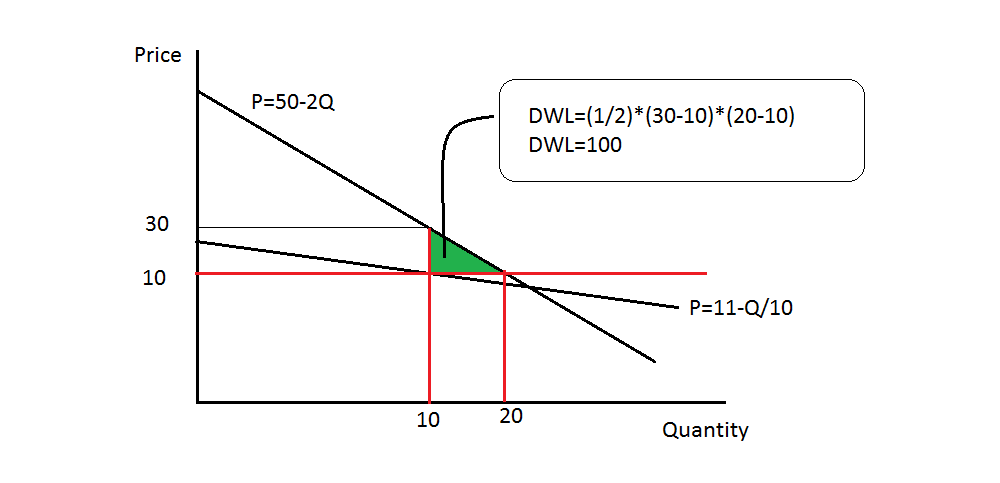
Market demand : 20-Q+3(10-Q/3) = 20-Q+30-Q = 50-2Q
a) Aggregate willingness to pay = 50-2Q
b) Marginal Cost = 10
the efficient level of public good would be at: MC=MSB
50-2Q=10 => 2Q=40 => Q*=20
the efficient level of output would be 20 quantity.
if there is no policy then the market will produce at demanded quantity and supplied quantity.
so the total demand would be Q=Q1+Q2+Q3 = 20-P+90-9P = 110-10P
the inverse demand: P=11-Q/10
so the market quantity would be: 11-Q/10=10 => Q/10 = 11-10 => Q=10
so when no policy is there the quantity produced would be 10.
c)
the Dead weight loss would be the area of the triangle. so at Q=10
the Price charged would be : P=50-2Q = 50-10*2 = 50-20 = 30
and the price corresponds to the inefficient level of output : P1 = 11-10/10 = 10
The dead weight loss : (1/2)(30-10)(20-10) = 100
DWL = 100
___________________
 Rahul Sunny answered 6 months ago
Related Solutions
Suppose seven individuals enjoy going to the comedy club. Their demand is as follows. Person Willingness...
Suppose a monopolist sells its good to three people. Each person can only purchase one good....
4. Suppose that 78% of people enjoy drinking coffee and 44% of people enjoy drinking tea....
For a freely provided public good, a consumer's willingness to pay for a small increase in...
In a four person community, we have elicited each individual’s willingness to pay to build an...
Should people who enjoy the benefits of a union be required to join? Can a union...
3. a) suppose that hedonic wage studies indicate a willingness to pay $60 per person for...
People who plant flowers in their front yard provide a public good. Why don't we subsidize...
Four People (A, B, C, D) are having a conversation. When one person finishes speaking, it...
Four People (A, B, C, D) are having a conversation. When one person finishes speaking, it...
- The half-life of mercury-197 is 64.1 hours. If a patient undergoing a kidney scan is given...
- Double bonds react with Br2 to form a dibromide. Isobutylene undergoes cationic polymerization under conditions where...
- 1. Which sex chromosomes are limited to only one sex? A. X and Z B. X...
- prepare a tecnical report that discuss about "A custom Union (CU) constitute a partial movement towards...
- in your own opinion, It has been said that a smartphone is a computer in your...
- Use the internet to read more about journaling file systems such as NTFS, extfs2, and extfs3....
- Consider the quick sort algorithm. The quick sort algorithm is a divide and conquer approach which...