Question
In: Physics
You are given displacement equation for object in SHM as: x(t)=1.5cos(3.0t) cm. a) The period of...
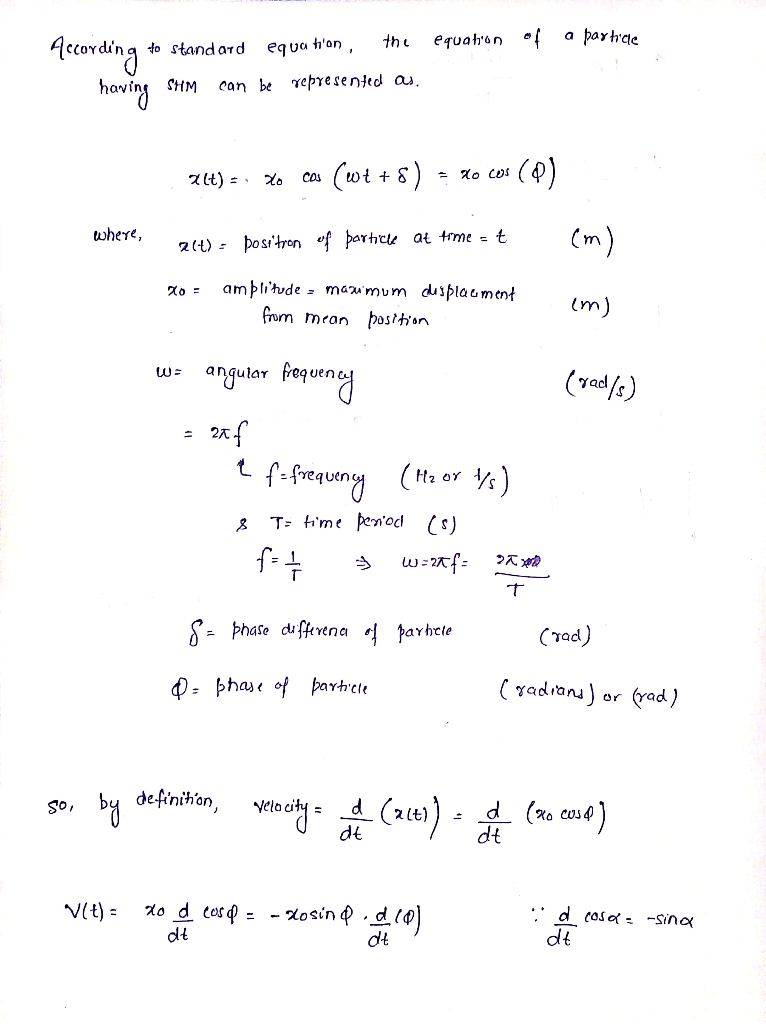
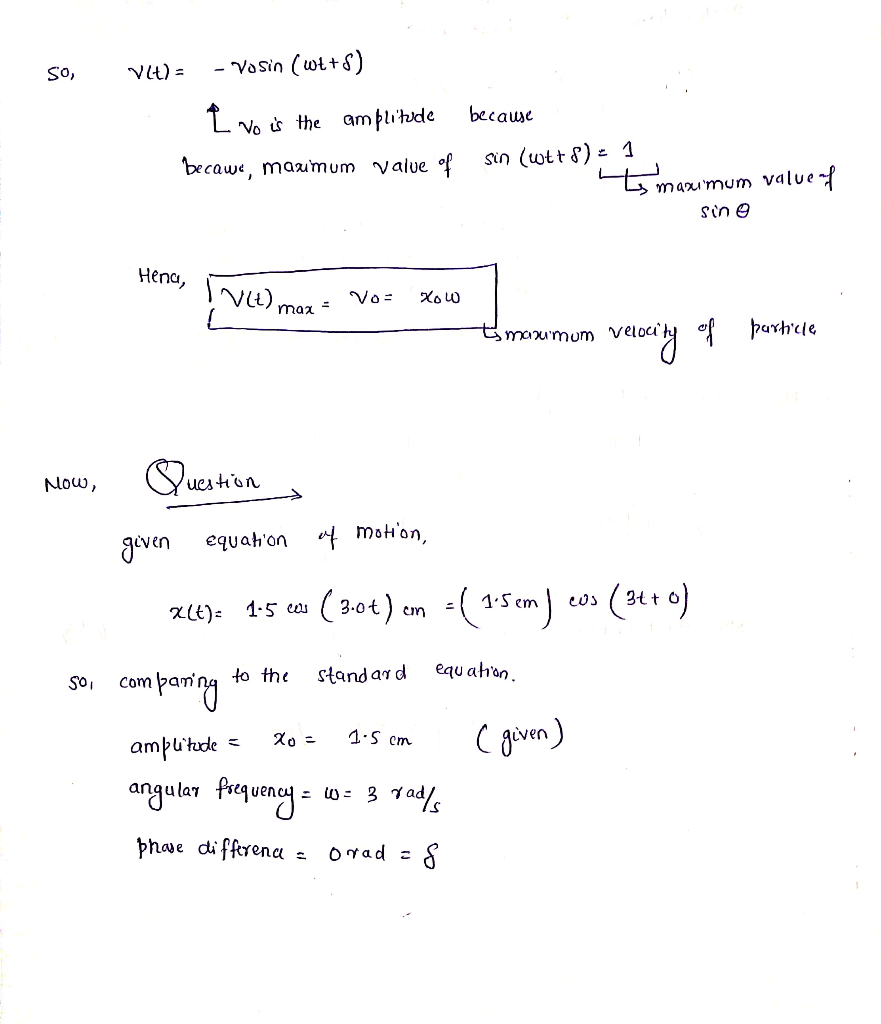
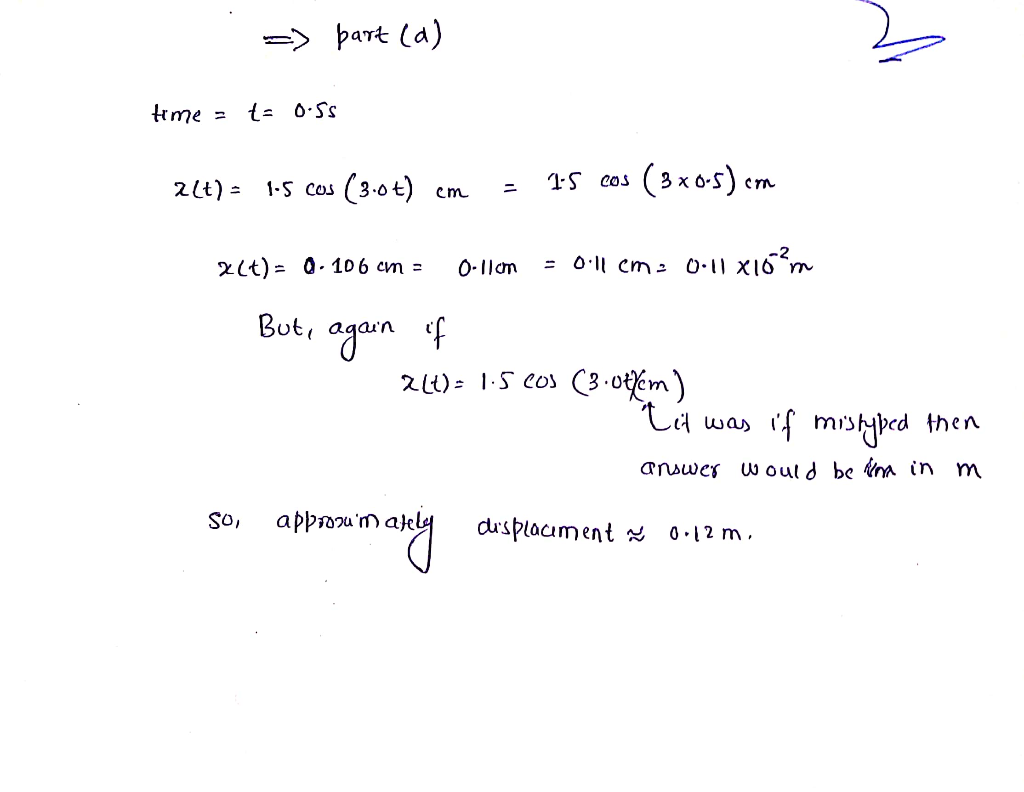
You are given displacement equation for object in SHM as: x(t)=1.5cos(3.0t) cm.
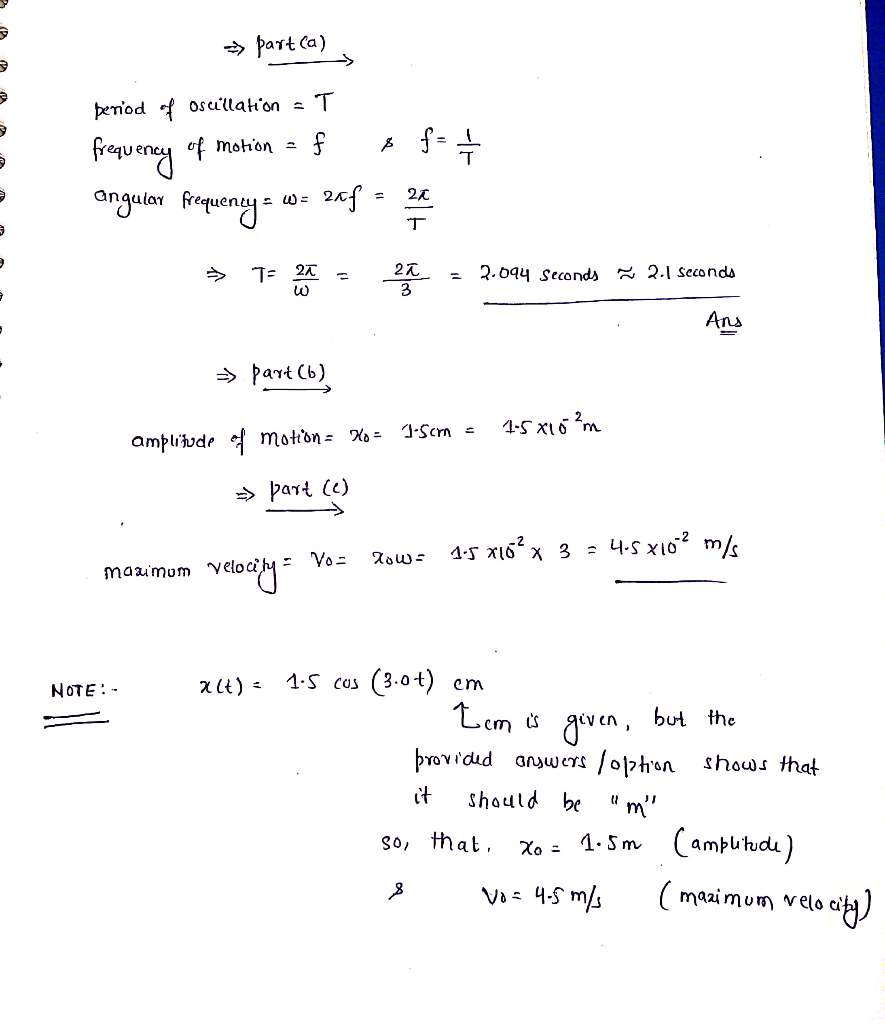
a) The period of this oscillation is: [ Select ] ["2.1 sec", "3 sec", "1.5 sec", "0.48 sec"]
b) The amplitude of the motion is: [ Select] ["0.75 m", "1.5 m", "3.0 m"]
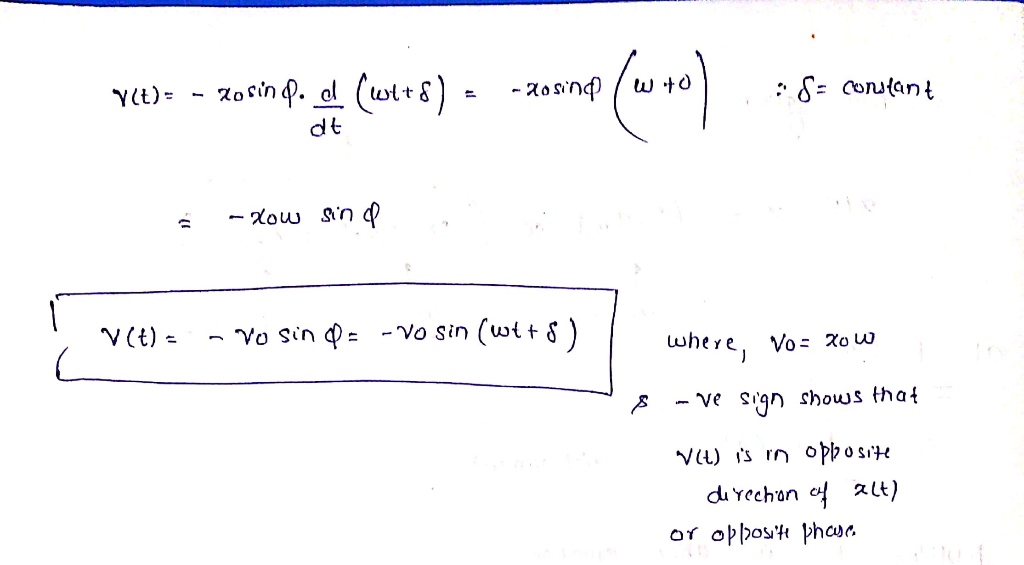
c) The maximum velocity is: [ Select ] ["28 m/s", "4.5 m/s", "0.72 m/s"]
d) The displacement at t = 0.5 s is [ Select ] ["0.12 m", "-0.78 m", "1.5 m"]
Solutions
 genius_generous answered 7 months ago
Related Solutions
An object is undergoing shm with the maximum displacement of 16 cm and an angular frequency...
An object is undergoing shm with the maximum
displacement of 16 cm and an angular frequency of 0.040 s^-1 assume
that at t= 0 it is at its maximum displacement at which of these
times will it have its maximum speed
a) 20 second
b) 39 seconds
C) 56 seconds
D) 78 seconds
e) 157 seconds
PLEASE SHOW WORK CLEARLY
An object is undergoing SHM with period 0.960 s and amplitude 0.320 m. At t= 0,...
An object is undergoing SHM with period 0.960 s and amplitude 0.320 m. At t= 0, the object is at x = 0.320 and is instantaneously at rest.
A) Calculate the time it takes the object to go from x = 0.320 m, to x = 0.160 m.
B) Calculate the time it takes the object to go from x= 0.160 m, to x = 0 m.
The displacement of a wave traveling in the negative x-direction is y(x,t)= ( 5.2 cm )cos(...
The displacement of a wave traveling in the negative x-direction
is y(x,t)= ( 5.2 cm )cos( 6.0 x+ 73 t), where x is in m and t is in
s. What is the frequency of this wave? What is the wavelength of
this wave? What is the speed of this wave?
The displacement of an object in simple harmonic motion is described by the equation 0.40m*sin(8.9rad/s(t)) +...
The displacement of an object in simple harmonic motion is
described by the equation 0.40m*sin(8.9rad/s(t)) +
0.61m*cos(8.9rad/s(t)).
A) Determine the position and velocity when t = 0 seconds.
B) Determine the maximum displacement of the system.
C) Determine the maximum acceleration of the system.
D) Determine the velocity of the system at t = 6 seconds.
An object on a single oscillating string may be modelled by differential equation x"(t)=-x(t) x(t) is...
An object on a single oscillating string may be
modelled by differential equation x"(t)=-x(t)
x(t) is the signed length of the string at time t.
a) the trivial solution x(t) =0 satisfies the
differential equation. describe what physical scenario this
solution represents.
b) find at least three other solutions to the differential
equation
c) describe what it means for this differential equation to have
multiple solutions. what do the solutions represent.
d) suppose a string is damped by friction. propose...
You are watching an object that is moving in SHM. When the object is displaced 0.600...
You are watching an object that is moving in SHM. When the object is displaced 0.600 m to the right of its equilibrium position, it has a velocity of 2.20m/s to the right and an acceleration of 8.40m/s2 to the left.
How much farther from this point will the object move before it stops momentarily and then starts to move back to the left?
The vertical displacement y (x,t) of a horizontal string aligned along the x-axis is given by...
The vertical displacement y (x,t) of a horizontal string aligned
along the x-axis is given by the equation y (x,t) =(5.25 mm) cos
[(4.70 m -1) x (14.1 s -1) t]. What are the (a) speed, (b) period,
and (c) wavelength of this wave?
find an equation for the range (defined as the x displacement of the projectile when it...
find an equation for the range (defined as the x
displacement of the projectile when it reaches y = 0) for a cannon
firing from y = 0. Leave everything as variables, such as
vi for the initial velocity, and θ for
the launch angle.
After you are confident in your equation you must be
able to predict where the projectile will land on the first
try.
Write out an equation that gives the horizontal
position of the object as...
An object moves along the x-axis according to the equation x = 3t ^ 3 - 2t ^ 2 + t along the x-axis.
An object moves along the x-axis according to the
equation x = 3t ^ 3 - 2t ^ 2 + t along the x-axis. Find the
instantaneous velocity at t = 2 s.A) 29 B) 18 C) 48 D) 43
The position of a particle in cm is given by x = (3) cos 9?t, where...
The position of a particle in cm is given by x = (3)
cos 9?t, where t is in seconds.
ADVERTISEMENT
ADVERTISEMENT
Latest Questions
- Python previous function: wrtie a function that takes one argument. The function returns True if the...
- A professional couple wishes to purchase a new home costing $750,000, make a 20 percent down...
- Padre holds 100 percent of the outstanding shares of Sonora. On January 1, 2016, Padre transferred...
- Question: Use backtracking algorithm design to write Java code to solve the subset problem: given a...
- Patsy Ltd. produces ice-cream and would like to accurately forecast sales so that it can meet...
- Power Music owns five music stores, where it sells music, instruments, and supplies. In addition, it...
- 4) A client wants to finance the purchase of a house costing $50,000 over a period...
ADVERTISEMENT