Question
In: Economics
Suppose Joe has preferences over income given by U(I) = ln(I). Furthermore, suppose there are two...
Suppose Joe has preferences over income given by U(I) = ln(I).
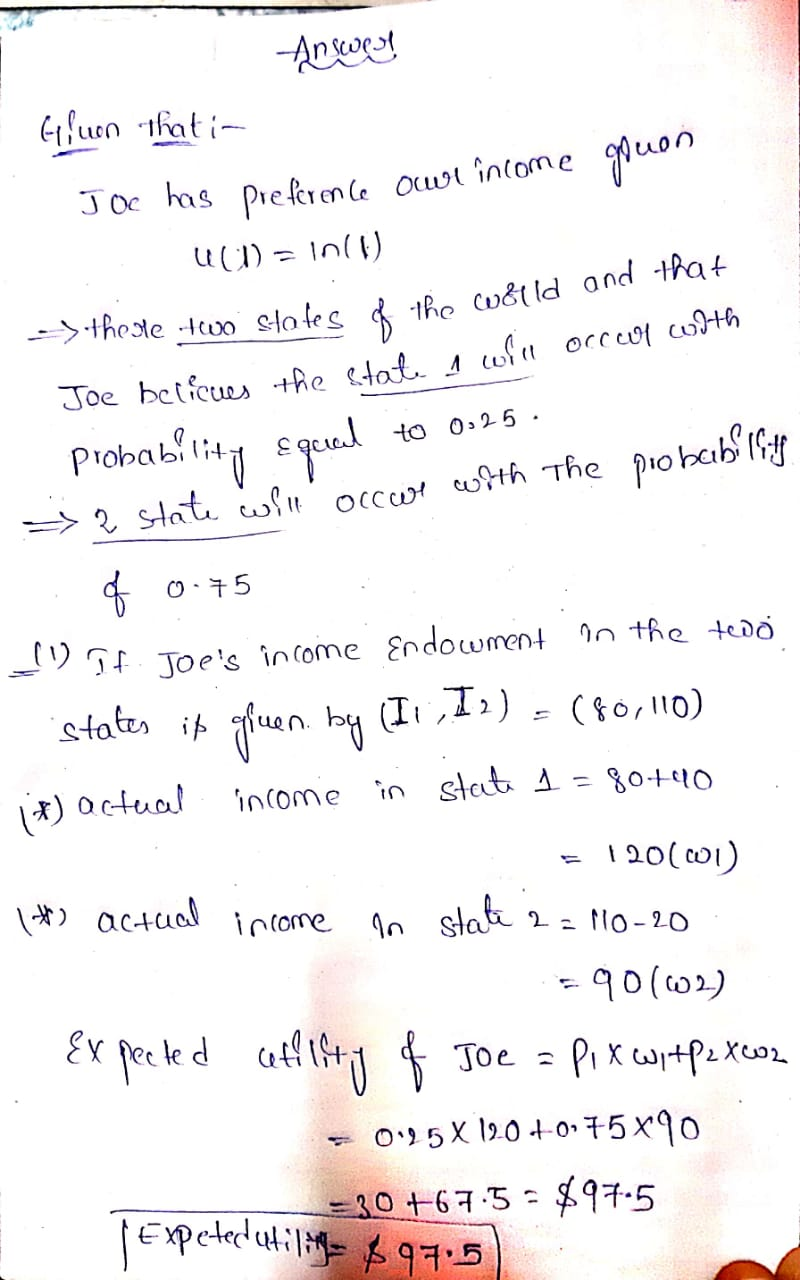
Furthermore, suppose there are two states of the world and that Joe believes the state 1 will occur with probability equal to 0.25 and state 2 will occur with probability 0.75.
1. If Joe's income endowment in the two states is given by (I1, I2) = (80, 110) and he is able buy z1 = 40 extra income in state 1 by selling z2 = -20 income in state 2, what is his expected utility?
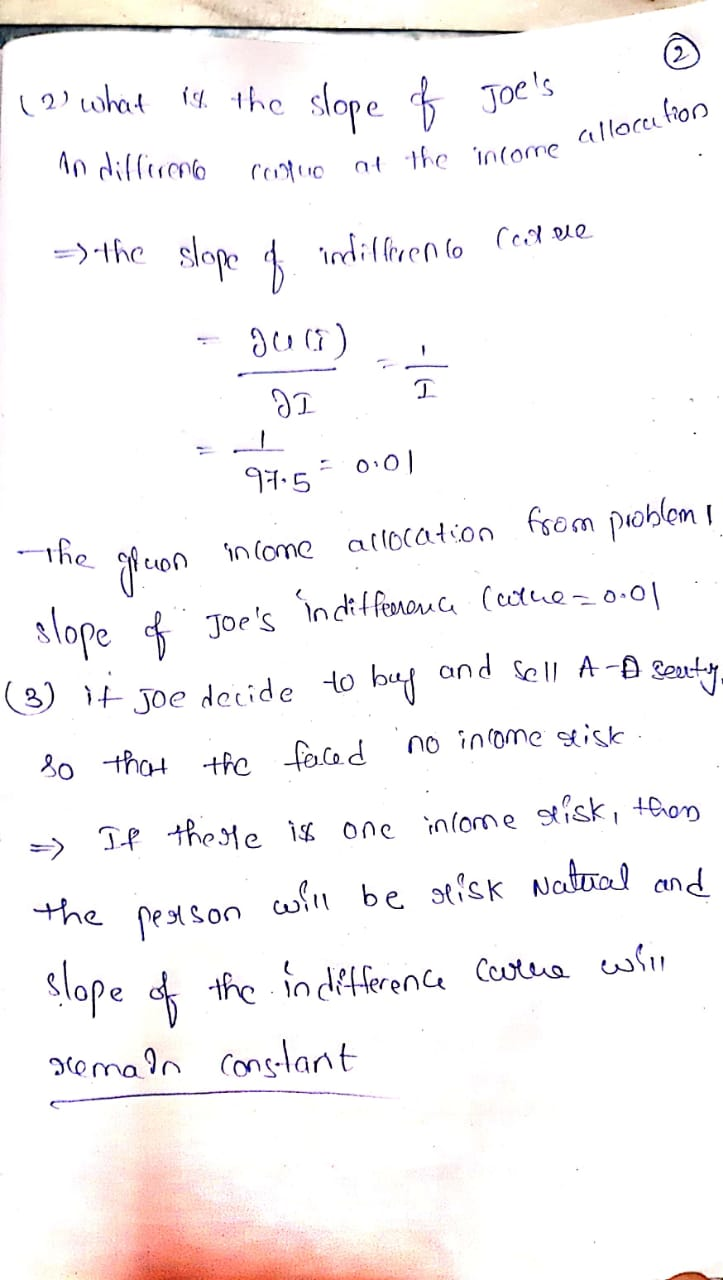
2. What is the |slope| of Joe's indifference curve at the income allocation from problem #1?
3. If Joe decided to buy and sell A-D securities so that he faced no income risk at all in the future, what would be the |slope| of his indifference curve at that point?
Solutions
 Rahul Sunny answered 2 weeks ago
Related Solutions
Suppose preferences for consumption and leisure are: u(c, l) = ln(c) + θ ln(l) and households...
Suppose preferences for consumption and leisure are: u(c, l) =
ln(c) + θ ln(l)
and households solve:
maxc,l u(c, l)
s.t. c=w(1−τ)(1−l)+T
Now suppose that in both Europe and the US we have:
θ = 1.54
w=1
but in the US we have:
τ = 0.34
T = 0.102
while in Europe we have:
τ = 0.53
T = 0.124
The values for τ and T above are not arbitrary. If you did the
calculations correctly, you should find that...
Suppose an agent has preferences represented by the utility function: U(x1, x2) =1/5 ln (x1) +...
Suppose an agent has preferences represented by the utility
function:
U(x1, x2) =1/5 ln (x1) + 4/5 ln
(x2)
The price of x1 is 6 and the price of x2
is 12, and income is 100.
a) What is the consumer’s optimal consumption bundle?
b) Suppose the price of x2 is now 4, what is the
consumer’s new best feasible bundle?
Suppose a person has utility function, prices, and income: U(a,B) = 2 ln(A) + ln(B), Pb=1...
Suppose a person has utility function, prices, and income:
U(a,B) = 2 ln(A) + ln(B), Pb=1 and m=12. Draw her price offer curve
and explain. Hint: it may be useful to think about the number of
B's she purchases as Pa changes.
Consider a consumer with preferences over two goods (good x and good y) given by u...
Consider a consumer with preferences over two goods (good x and
good y) given by
u ( x , y ) = x ⋅ y.
Given income of I and price of good yas $ P yper pound and price
of good xgiven as $ P xper pound, the consumer chooses the optimal
consumption bundle given as
x ∗ = I 2 P x
and
y ∗ = I 2 P y .
Given P x = $ 1per pound...
Suppose an agent has preferences represented by the following utility function: u(x1, x2) = 1/4 ln(x1)...
Suppose an agent has preferences represented by the following
utility function: u(x1, x2) = 1/4 ln(x1) + 3/4 ln(x2) The price of
good x1 is 2, the price of good x2 is 6, and income is 40.
a) What is the consumers best feasible bundle (ie, his optimal
consumption bundle)?
b) Interpret the consumer’s marginal rate of substitution at the
best feasible bundle found in part a).
Priya has preferences over consumption and leisure given by U(C,L) = CL. Her total number of...
Priya has preferences over consumption and leisure
given by U(C,L) = CL. Her total number of available hours in a
given week is 100. Her non-labour income is £800. If she chooses to
work, she earns w = £20 per hour. If the government starts a
welfare policy that pays an amount of £B to all non-workers and
pays 0 to all workers, at what value of B will Priya opt out of the
labour force in order to go...
Suppose a consumer has preferences given by U(X,Y) = MIN[2X,Y]. Suppose PX = 1 and PY...
Suppose a consumer has preferences given by U(X,Y) = MIN[2X,Y].
Suppose PX = 1 and PY = 2. Draw the Income Consumption Curve for
this consumer for income values
• M = 100
• M = 200
• M = 300
To do this, carefully draw the budget constraints associated
with each of the prices for good X, and indicate the bundle that
the consumer chooses in each case. Also, be sure to label your
graph accurately.
A worker has a utility function over income U(I) = √ I. She is picking between...
A worker has a utility function over income U(I) = √ I. She is
picking between two jobs for the following year. Job X pays
$40,000; she can get this job for sure. She is also considering Job
Y; there are other candidates for this job, and the probability of
not getting it during the hiring process is 0.2 (she would get no
income at all if that happened, and the process concludes after Job
X’s deadline). If she gets...
Let's say that my utility function over wealth is LaTeX: U=\ln\left(W\right) U = ln (...
Let's say that my utility function over wealth is LaTeX:
U=\ln\left(W\right) U = ln ( W ) where W is my wealth in dollars.
Suppose I currently have $1,000,000 in wealth (oh ye-ah), but my
friend Rob offers me an opportunity to invest in his new start-up
creating autonomous window-washing robots. [Note: the robots part
is a kinda-true story. Ask me sometime!] If the start-up is
successful—and we estimate it has a 10 percent chance of
success—Rob will pay...
Suppose that an individual has wealth of $20,000 and utility function U(W) = ln(W), where ln(W)...
Suppose that an individual has wealth of $20,000 and utility
function U(W) = ln(W), where ln(W) indicates the natural logarithm
of wealth. What is the maximum amount this individual would pay for
full insurance to cover a loss of $5,000 with probability 0.10?
ADVERTISEMENT
ADVERTISEMENT
Latest Questions
- These two waves travel along the same string: y1 = (3.52 mm) sin(1.75?x - 470?t) y2...
- An analyte has been discovered ( so it's new) in the Tobago population. Define the term...
- A freestyle skier is training for the Olympics. In this sport the skier starts at the...
- 16. When demand decreases in a competitive market, a. Supply rises. b. Actual price rises. c....
- Draw a picture that shows FA oxidation vs. FA synthesis Color-code each pathway Include: All steps...
- In IRAC Form Clifford Aymes was hired by Jonathan Bonelli of Sun Island Sales, Inc., to...
- 1.Describe the log-linear regression model and how it is used to measure the elasticity of the...
ADVERTISEMENT