Question

In: Physics

A ball is thrown straight up from the edge of the roof of a building. A...

A ball is thrown straight up from the edge of the roof of a building. A second ball is dropped from the roof a time of 1.16 s later. You may ignore air resistance.

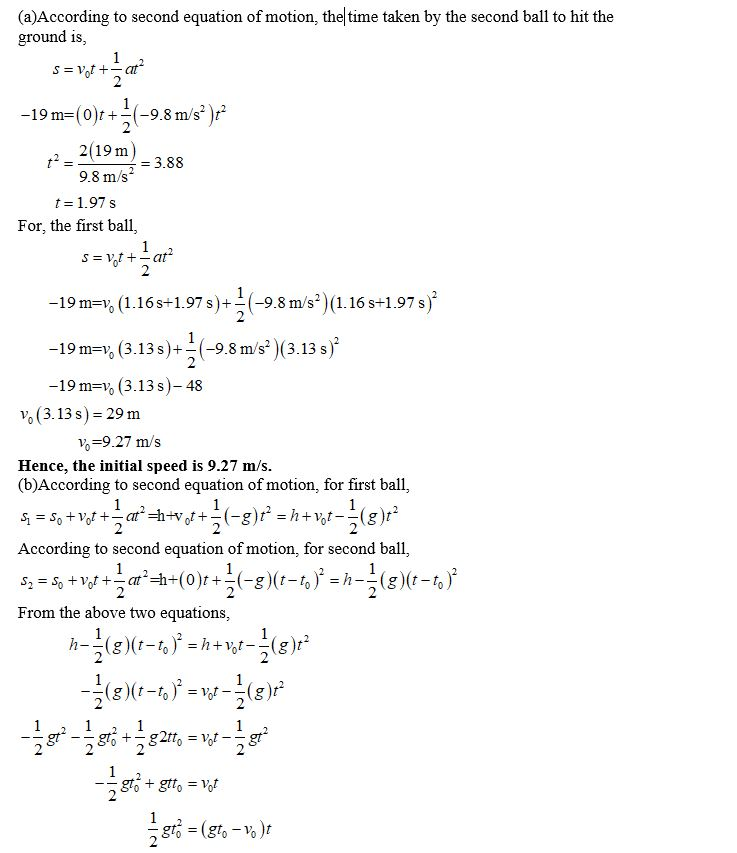
a. If the height of the building is 19.0 m , what must the initial speed be of the first ball if both are to hit the ground at the same time?

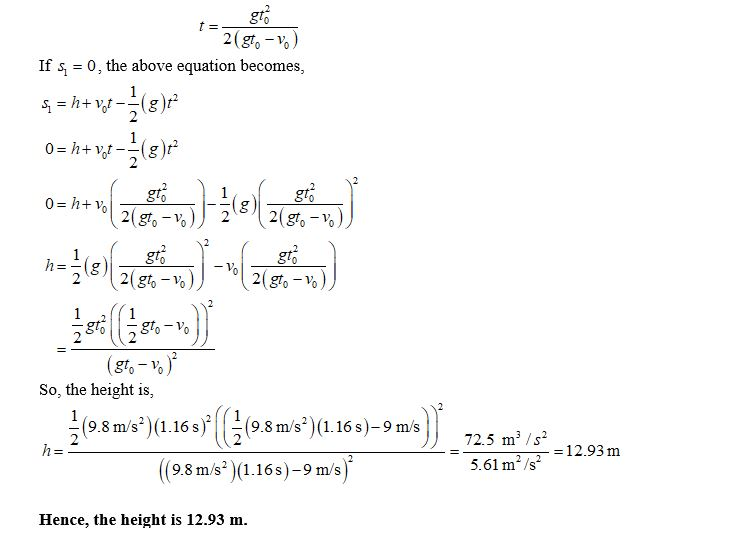
b. Consider the same situation, but now let the initial speed v0 of the first ball be given and treat the height h of the building as an unknown. What must the height of the building be for both balls to reach the ground at the same time for v0 = 9.00 m/s .

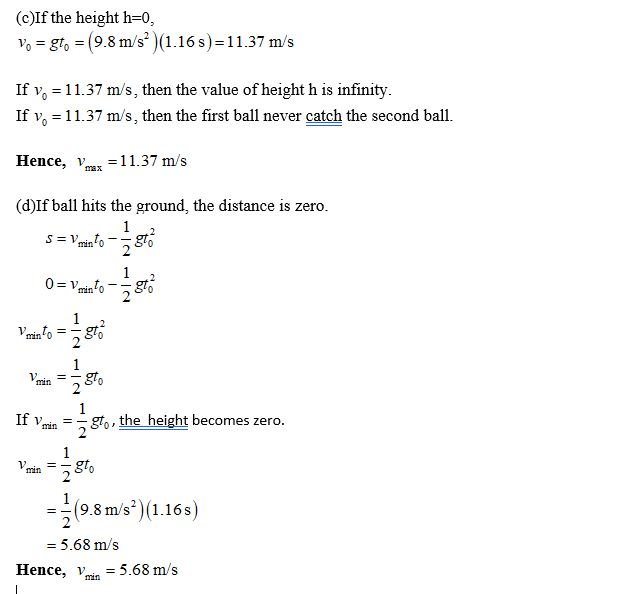
c. If v0 is greater than some value vmax, a value of h does not exist that allows both balls to hit the ground at the same time. Solve for vmax.

d. If v0 is less than some value vmin, a value of h does not exist that allows both balls to hit the ground at the same time. Solve for vmin.

Solutions
Expert Solution


Related Solutions

A ball is thrown straight up from the edge of the roof of a building. A...
A ball is thrown straight up from the edge of the roof of a building. A second ball is dropped from the roof a time of 1.20 s later. You may ignore air resistance. A) If the height of the building is 20.7 m , what must the initial speed be of the first ball if both are to hit the ground at the same time? B) Consider the same situation, but now let the initial speed v0 of the...
Part I A ball is thrown straight up from the top of a building that is...
Part I A ball is thrown straight up from the top of a building that is 185ft high with an initial velocity of 64ft/s. The height of the object can be modeled by the equation s(t) = -16t 2 + 64t + 185. In two or more complete sentences explain how to determine the time(s) the ball is higher than the building in interval notation. Part II In two or more complete sentences, describe the transformation(s) that take place on...
a ball was thrown straight upward from the top of a building 120 ft high at...
a ball was thrown straight upward from the top of a building 120 ft high at a rate of 24 ft/s. answer the following questions (acceleration is -32 ft/s^2 ) a. at what time t does the ball reach its maximum height? b. what is the velocity of the ball at 3 seconds? c. how long does it take for the ball to hit the ground? d. what is the velocity of the ball when it hits the ground?
A ball is thrown straight up with an initial speed of 19 m/s. The ball was...
A ball is thrown straight up with an initial speed of 19 m/s. The ball was released 6.3 m above the ground, but when it returns back down, it falls into a hole d m deep. If the ball’s speed is 35.7 m/s at the bottom of the hole, how deep is the hole (in m)?
A ball is thrown upwards from the roof of a house that is 20m tall. The...
A ball is thrown upwards from the roof of a house that is 20m tall. The initial velocity V0 is 10m/s, and the acceleration due to gravity g is 10m/s2. Find: a) The maximum height that the ball reaches in the air. b) The total time of flight. c) The hitting velocity (the velocity right before the ball hits the ground). d) Its velocity at t=2s.
1) A ball is thrown from the top of a roof at an angle of 20...
1) A ball is thrown from the top of a roof at an angle of 20 o with respect to the vertical. 1 s later a ball is dropped from the top of the roof a) If the height of the roof is 20 m, determine the velocity with which the first ball must be thrown in order for both balls to land at exactly the same time. b) Imagine the velocity of the first ball is now known, and...
A tennis ball is hit straight up at 27.0 m/s from the edge of a sheer...
A tennis ball is hit straight up at 27.0 m/s from the edge of a sheer cliff. Sometime later, the ball passes the original height from which it was hit. 1)How fast is the ball moving at that time? (Express your answer to three significant figures.) 2)If the cliff is 36.0 m high, how long will it take the ball to reach the ground level? (Express your answer to three significant figures.) 3)What total distance did the ball travel? (Express...
a ball is thrown up onto a roof, landing 3.60 s later at height h =...
a ball is thrown up onto a roof, landing 3.60 s later at height h = 25.0 m above the release level. The ball's path just before landing is angled at ? = 64.0?with the roof. (a) Find the horizontal distance d it travels. (Hint: One way is to reverse the motion, as if it is on a video.) What are the (b) magnitude and (c) angle (relative to the horizontal) of the ball's initial velocity?
a ball is thrown up onto a roof, landing 3.60 s later at height h =...
a ball is thrown up onto a roof, landing 3.60 s later at height h = 25.0 m above the release level. The ball's path just before landing is angled at ? = 64.0?with the roof. (a) Find the horizontal distance d it travels. (Hint: One way is to reverse the motion, as if it is on a video.) What are the (b) magnitude and (c) angle (relative to the horizontal) of the ball's initial velocity?
A ball thrown straight up into the air is found to be moving at 7.24 m/s...
A ball thrown straight up into the air is found to be moving at 7.24 m/s after falling 2.27 m below its release point. Find the ball's initial speed. Thank you.
ADVERTISEMENT
ADVERTISEMENT
ADVERTISEMENT