Question
In: Economics
Suppose there is an individual with “well behaved preferences” who consumes bundles of two goods, (X,Y)...
Suppose there is an individual with “well behaved preferences” who consumes bundles of two goods, (X,Y) and this individual is indifferent between bundle 1, (15,3) and bundle 2, (6,12). There is also bundle 3, (10.5, 7.5).
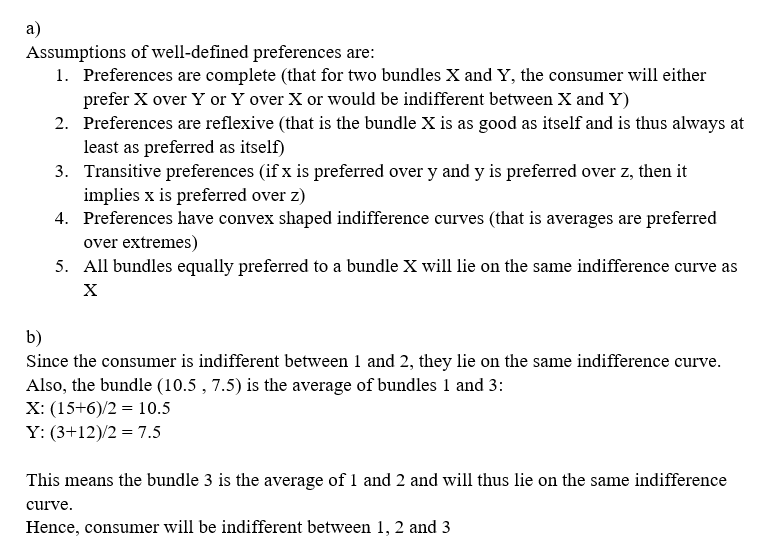
a) List and briefly define the 5 assumptions that define “Well behaved preferences”
b) Between bundles 1 and 3, does the consumer prefer one bundle over the other, or is he indifferent? What about between 2 and 3? Justify your answer mathematically.
Solutions
 Rahul Sunny answered 1 month ago
Related Solutions
Randy consumes two goods: X and Y. Randy’s preferences over consumption bundles (X,Y) are summarized by the...
Randy consumes two goods: X and Y. Randy’s
preferences over consumption bundles (X,Y) are summarized by the
utility function:
u (X,Y) = X3Y.
Write algebraic expressions for Randy’s demand functions for
goods X and Y to be
If PX= 1, PY= 1, and m = 100, what would
be Randy’s optimal consumption of goods X and Y?
Suppose now that the price of X rises to 3, while the price of
Y and income remain unchanged. What is Randy’s new
optimal consumption...
Consider an economy with two goods, x and y. Explain why if a consumer has well-behaved...
Consider an economy with two goods, x and y. Explain why if a
consumer has well-behaved preferences over bundles of x and y then
the two goods cannot both be inferior goods. (Please answer that
easy to understand)
1. Consider the preferences of an individual over two goods, x and y, with prices px...
1. Consider the preferences of an individual over two goods, x
and y, with prices px and py and income
I.
(a) If the individual's preferences can be represented by the
utility function u(x,y) =2x1/2 + y, what is the
marginal rate of substitution? What does this MRS imply about how
this consumer would trade y for x? Are the underlying preferences
homothetic (explain)? Graphically illustrate a typical indifference
curve and explain how you know the shape.
(b) If the...
Kevin has well-behaved preferences and currently has a bundle with positive amounts of two goods. Let...
Kevin has well-behaved preferences and currently has a bundle
with positive amounts of two goods. Let x1 and x2 denote the
quantities of goods 1 and 2, respectively. Thinking in terms of x1
on the horizontal axis, the absolute value of Kevin’s marginal rate
of substitution between the two goods at his current consumption
bundle is greater than 3. Using this information, can the theory we
have developed so far predict Kevin’s reaction to the following
propositions? (Please show all...
An Individual consumes commodity bundles including two goods: P and Q. The satisfaction/value/utility obtained for the...
An Individual consumes commodity bundles including two goods: P
and Q. The satisfaction/value/utility obtained for the individual
is provided by the following equation – 3*(units of P)^2 + 2*(units
of Q). Now answer the following questions
a. Compute the utility got the following bundles – (12, 5),
(2,7) and (8,5)
b. Considering a utility level of 75 units; identify one
consumption bundle that provided that level of utility
c. Now draw an indifference curve for the individual with an
utility...
2. Suppose an individual has quasi-linear preferences goods forxandydescribed by U (x, y) = 4√x+y. Recall...
2. Suppose an individual has quasi-linear preferences goods
forxandydescribed by U (x, y) = 4√x+y. Recall this means that
MUx=2√x and MU y= 1. Suppose that Px=1,Py= 2 and I= 24.
(a) Plot the income consumption curve associated with a change
in income from I= 24 to I= 34.(To do this problem, you would need
to calculate the optimal consumption associated with eachof these
incomes. Or you could look at the solutions to HW #3.)
(b) What shape would the...
Mark faces a labor supply decision. His well-behaved preferences over the two goods ‘hours of leisure’...
Mark faces a labor supply decision. His well-behaved preferences
over the two goods ‘hours of leisure’ L and ‘consumption’ c can be
represented by u = 4 L + c. He has no non-labor income and can
choose how many hours to work at the wage rate w per hour. The
price per unit of consumption is p, and his available free time is
T hours.
a) Sketch Mark’s budget set, with axes, intercepts, and slope
labeled (these will depend...
A consumes two goods, x and y. A ’s utility function is given by u(x, y)...
A consumes two goods, x and y. A ’s utility function is given
by u(x, y) = x 1/2y 1/2
The price of x is p and the price of y is 1. A has an income
of M.
(a) Derive A ’s demand functions for x and y.
(b) Suppose M = 72 and p falls from 9 to 4. Calculate the
income and substitution effects of the price change.
(c) Calculate the compensating variation of the price
change....
You are a consumer who consumes goods X (education) and goods Y (recreation), where the price...
You are a consumer who consumes goods X (education) and goods Y
(recreation), where the price of good X is PX and the price of Y is
Py. Your income that can be allocated to purchase these two items
is M.
Questions
a. What happens if the price of education rises? Describe the
substitution effect and the income effect.
b. Derive the demand curve for education.
You are a consumer who consumes goods X (education) and goods Y (recreation), where the price...
You are a consumer who consumes goods X (education) and goods Y
(recreation), where the price of good X is PX and the price of Y is
Py. Your income that can be allocated to purchase these two items
is M.
Question
a. What happens if the price of education rises? Describe the
substitution effect and the income effect.
b. Derive the demand curve for education.
ADVERTISEMENT
ADVERTISEMENT
Latest Questions
- how do corporations benefit from government regulation? *refer to Dean Baker's THE CONSERVATIVE NANNY STATE*
- ##Notice: write in HLA code . . Create an HLA Assembly language program that prompts for...
- The water used in this experiment is sparged with nitrogen to remove any dissolved oxygen. The...
- Topic: Schizophrenia 1. Review the readings on schizophrenia, DSM-V criteria and briefly describe schizophrenia, and current...
- Calculate the frequency in Hz of a typical green photon emitted by the Sun. What is...
- In the previous question, you designed a simple algorithm to create a class list application. In...
- Create a directory called CIS153 Create new files based on each line from mydata.txt. Each new...
ADVERTISEMENT