Question
In: Economics
How equitable is the distribution of income in the G7, Brazil, China, India, and other countries?...
How equitable is the distribution of income in the G7, Brazil, China, India, and other countries? How do we measure that???
Solutions
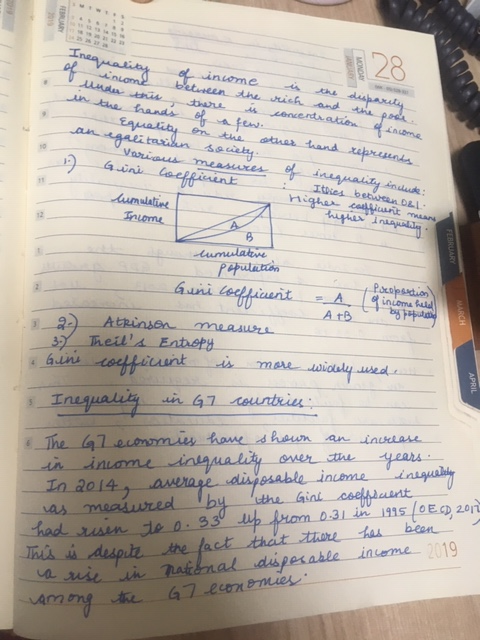
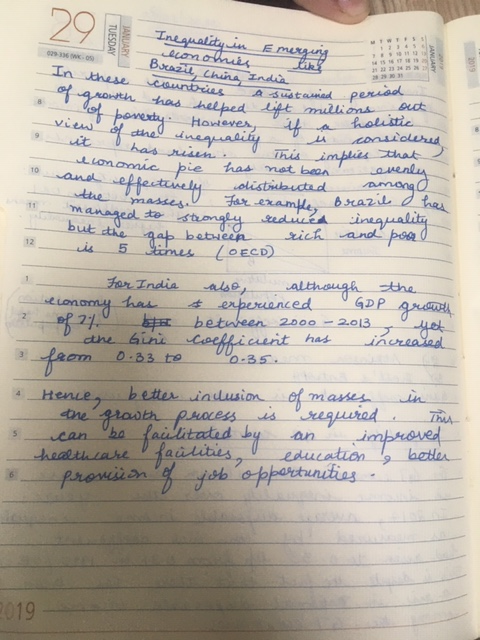
 Rahul Sunny answered 2 months ago
Related Solutions
How likely is it that BRIC (Brazil, Russia, India, and China) countries, and companies based there,...
How
likely is it that BRIC (Brazil, Russia, India, and China)
countries, and companies based there, will eventually experience
what happened to Japan?
How will COVID 19 effect Brazil, Russia, India and China? Also, what measures can they take...
How will COVID 19 effect Brazil, Russia, India and China?
Also, what measures can they take to improve the current
situation and look to financial stability?
a. How will you classify the following countries; Australia, China, US, India based on the definitions...
a. How will you classify the following countries; Australia,
China, US, India based on the definitions of a small and large open
economies and why?
Focusing on either China, Japan, or India, explain how Asian countries responded to the challenges of...
Focusing on either China, Japan, or India, explain how Asian
countries responded to the challenges of modernization and the
growing power of Europe during the 19th century.
Assess the impact on international trade of emerging economies like those of Europe, India, China, Brazil,...
Assess the impact on international trade of emerging economies
like those of Europe, India, China, Brazil, Russia, and other
countries of your choice. What can we expect from them in the next
20 to 50 years.
Didi is based in China and looking to expand to Brazil; China and Brazil are BRICS...
Didi is based in China and looking to expand to Brazil; China
and Brazil are BRICS nations. Why is this significant?
How does the income distribution in the United States compare with the income distribution in other...
How does the income distribution in the United States compare
with the income distribution in other nations? 9b. Examine, the
degree of income inequality in our nation. 9c. Explain, why the gap
in earnings between skilled and unskilled workers is growing in the
United States.
Present the economy of one of the following countries: India Vietnam Canada France South Africa Brazil...
Present the economy of one of the following countries:
India
Vietnam
Canada
France
South Africa
Brazil
US
UAE
Topics discussed in the project should including all of the
following points and any additional information that sparks your
interest:
GDP & Growth Rate
Main industries that contribute to the GDP
Employment and Unemployment rate, Labour Force Participation
Rate
Inflation or Deflation rate - is it a healthy rate?
Fiscal Policy
Monetary Policy
With India and China as the top business process outsourcing countries in the world, what can...
With India and China as the top business process outsourcing
countries in the world, what can you do to prepare yourself for
competing in a flat world? Be specific.
In a debate one person argued that the more equitable is the distribution of income among...
In a debate one person argued that the more equitable is the
distribution of income among consumers, the more efficient is the
economy in terms of Pareto Optimum (PO).
a. Define and explain “Pareto Optimum”
b. How PO relates to the distribution of income?
c. Explain, how PO can be used to determine misallocation of
resources?
d. in a free market, what is the role of the price system in
achieving PO solution?
ADVERTISEMENT
ADVERTISEMENT
Latest Questions
- Suppose Elon Musk is spectacularly successful, and electric vehicle technology follows the technology diffusion model we’ve...
- Starting from rest, a basketball rolls from the top to the bottom of a hill, reaching...
- Ray Company provided the following excerpts from its Production Department’s flexible budget performance report. (Round "rate...
- Give an examples of Altruism on a macro level, and micro level, and how the concept...
- QUESTION In process improvement efforts, quality costs or cost of quality is a means to quantify...
- Lightning is a great illustration from nature of the stunning application of statics and electric fields....
- Example: We are looking at the cholesterol levels of population of 200 healthy individuals. Cholesterol of...
ADVERTISEMENT