Question
In: Economics
Question 2: Application of Basic AD/AS Model to Fiscal Policy. [Suggested writing time: 17 minutes] Suppose...
Question 2: Application of Basic AD/AS Model to Fiscal Policy. [Suggested writing time: 17 minutes] Suppose due to an impeachment you are the newly elected President of the United States (US). You, with your prudent set of economic advisors, are reviewing the following hypothetical economic data in 2019 to 2020:
Real GDP per capita growth rate = -0.2%
Unemployment rate = 6.8%
Inflation rate = -1.0%
a. Determine what phase of the business cycle the US economy is likely to be experiencing in 2019 to 2020. Provide specific reasons for your answer. b. Use a well-labelled AD/AS diagram to show the position of this economy in 2020. Explain how the US government, using appropriate fiscal policy, might boost the economy back to the long run, full-employment GDP equilibrium. Draw the AD curve shift(s) associated with this policy on your diagram.
Solutions
Expert Solution
a.) The phase of the business cycle the US economy will be in is in recessionary phase or in the business cycle. Factors that influence this reasoning are, firstly, the per capita growth rate of real GDP is negative, which could be corresponded to an overall negative growth rate of real GDP, and a negative growth rate of real GDP in two consecutive quarters is considered a recession. Secondly, the rate of unemployment is 6.8% which is higher than the natural rate of 4.7%. Thirdly, the inflation rate is negative, which means the prices are falling, and this tends to happen in recessions.
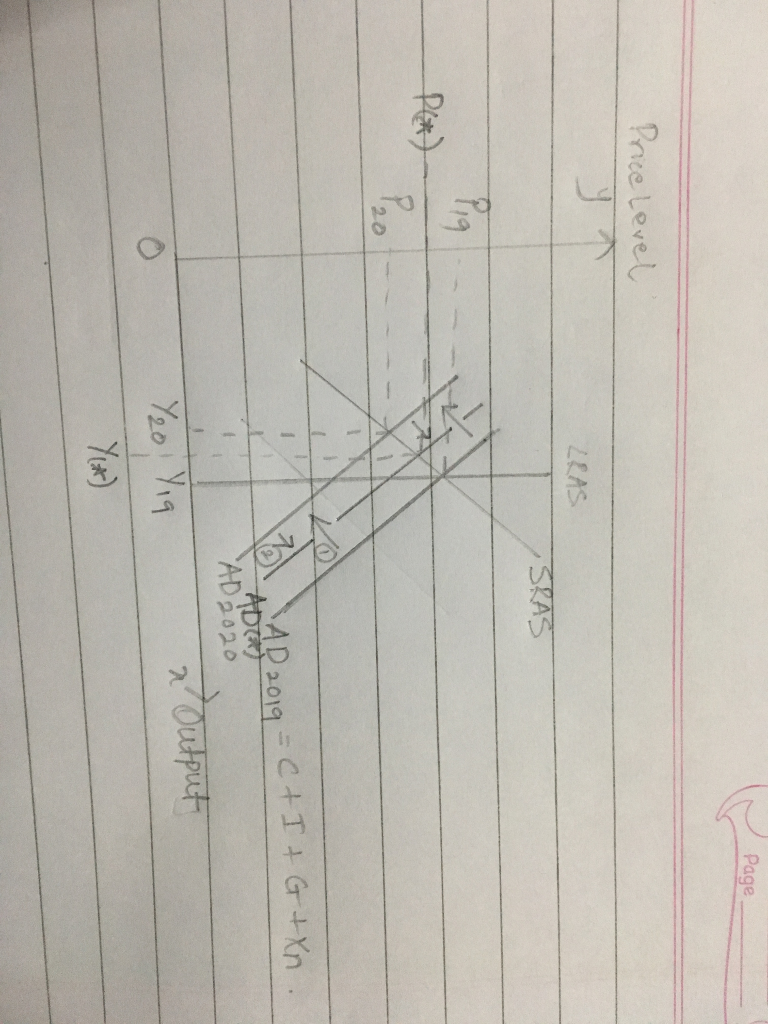
b.) Please refer to the diagram above. The aggregate demand curve will shift to the left from AD(2019) to AD(2020). This could be a result of the impeachment as the investment component could take a substantial hit due to the pessimistic sentiment in the market.
c.) The fiscal policy that needs to be employed in a recessionary environment is an expansionary fiscal policy. In an expansionary fiscal policy, the government will either cut taxes, increase government spending or both. Due to the direct and linear relationship shared by AD and its components, namely, consumption, investment, government spending and net exports any increase in any of these components will cause the AD to increase and shift to the right. Therefore a decrease in taxes will cause the consumption component of the AD to increase as disposable income increases. If the government increases spending, the government spending component of the AD increases causing the AD shift to the right. Therefore the government could use this policy to bolster the economy if the economy falls to output levels of Y20 at AD2020, and shift the curve to the right to AD* and output level Y*, this would push the economy towards full-employment GDP equilibrium.
 Rahul Sunny answered 2 months ago
Related Solutions
Use the AD/AS model to show an economy in recession. Explain how fiscal policy can be...
For this question, please consider monetary and fiscal policy. According to our description of AD and...
Question 1 (10 Marks - Suggested time approx. 23 minutes) Northern Lights Company is considering the...
Using AD/AS model, explain and show using graphs how fiscal policy overshooting can cause consequences in...
Question 1: The AD-AS Model Suppose the economy is initially in long-run equilibrium, and there is...
You will be responsible for writing a paper (2 pages, double-spaced) regarding Fiscal Policy (government spending...
Question 1: Fiscal Policy Suppose the economy is in a recessionary gap, and the government reponds...
2. Fiscal Policy options to address a recessionary gap: Suppose the economy’s MPC is .75 or...
2. Fiscal policy Suppose a hypothetical economy is currently in a situation of deficient aggregate demand...
2. IS-MP-AD-IA model. Suppose that the Federal Reserve becomes more worried about the possibility of future...
- Dirac's Theorem states that "A simple graph with n vertices (n >= 3) is Hamiltonian if...
- Two 10-cm-diameter charged rings face each other, 15cm apart. The left ring is charged to -29nC...
- Under what conditions would it be possible for an excise tax to have no efficiency cost...
- explain the difference between activities and financial statements of service businesses and merchandising businesses.
- 2. Compare and compare the matrix multiplication algorithm and the Floyd-Warshall algorithm to find all pairs...
- Q: 50.00 ml of 0.5216 M copper(II) nitrate solution is combined with 100.0 ml of 0.5580...
- This is a business law question. Explain how environmental laws regulate the use of toxic substances...