Question
In: Economics
The United Kingdom has a drinking problem. British per-capita consumption of alcohol rose 19% between 1980...
The United Kingdom has a drinking problem. British per-capita consumption of alcohol rose 19% between 1980 and 2007, compared with a 13% decline in other developed countries. Worried about excessive drinking among young people, the British government increased the tax on beer by 42% between 2008 and 2012. Under what circumstances will this beer tax substantially reduce the market equilibrium quantity of beer? [Hint: answer in terms of both elasticity of demand and elasticity of supply]
Solutions
Expert Solution
When the other things remain stable, the amount of supply shifts reacts because of the changes in the price level and the sum of demand changes are due to changes in price levels.
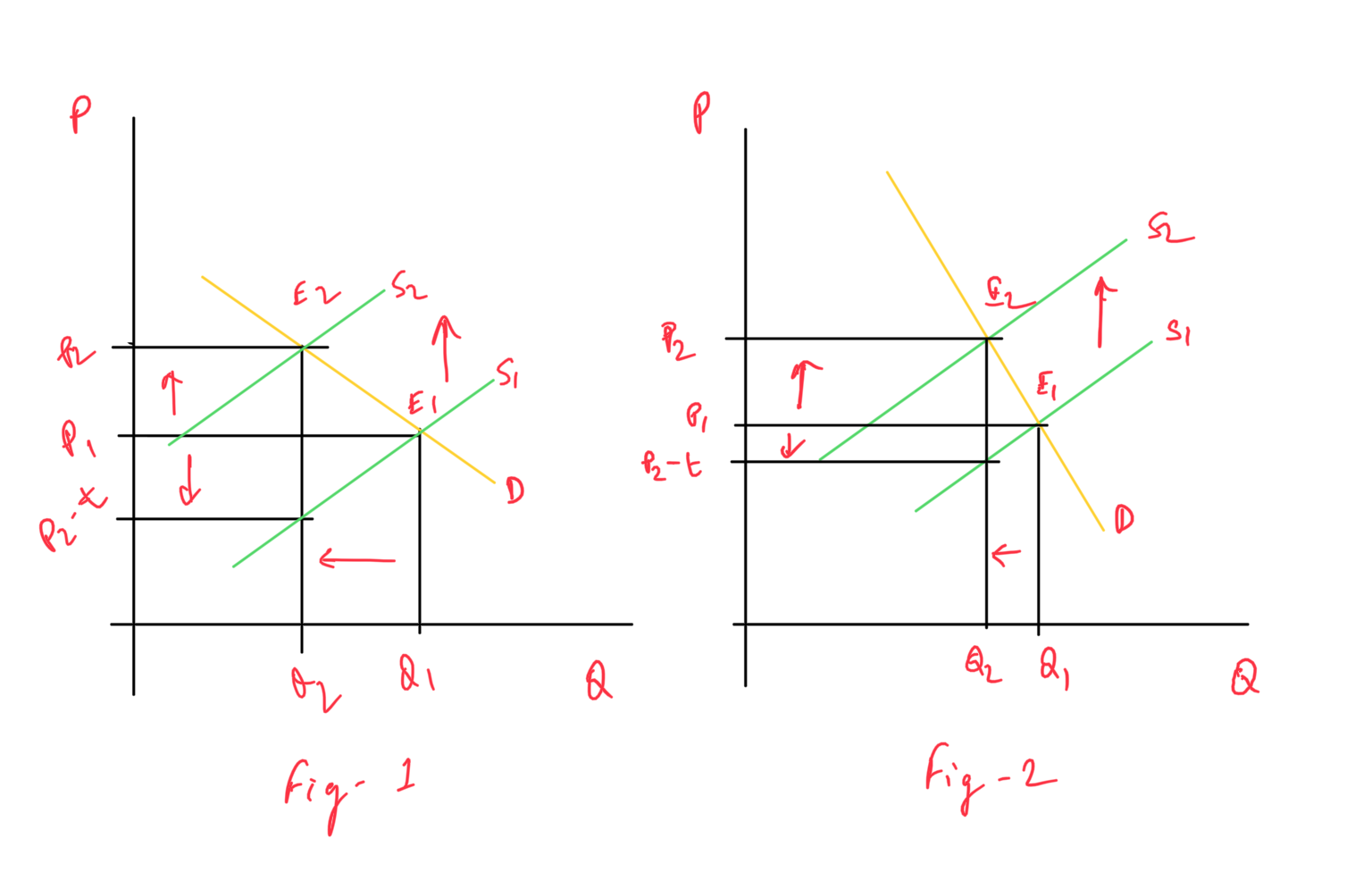
Fig-1 estimates the value of the vertical axis and tests the sum of the horizontal axis. The increase in the tax rate increases the price level as demand is more elastic, meaning that a small price change is causing a significant change in demand for quantities. Therefore, the supply curve changes from S1 to S2 because the tax rate rises caused by a change in price level P1 to P2 and the demand for quantity falls from Q1 to Q2, with a new balance at E2.
Fig-2 shows the effect of a balancing tax, where the price elasticity of the market is greater than 1. Fig-2 includes value calculation of the vertical axis and quantity measurement of the horizontal axis. An rise in the tax rate leads to an increase in prices as demand is inelastic, which means that a large exchange rates increase the demand for goods in a small amount. As such, the supply curve changes from S1 to S2 due to a higher tax level, which induces a change in prices from P1 to P2 and reduces demand for quantities from Q1 to Q2 and a new balance is formed at E2.
Fig-1 shows the effects of the supplier's tax consumed and Fig-2 shows the consumer's cost. Thus the customer lowers the intake of balance quantities of alcohol when the supply curve becomes ideally elastic when the specific tax burden shifts are changed.
 Rahul Sunny answered 3 months ago
Related Solutions
Consider the relationship between yearly wine consumption (liters of alcohol from drinking wine, per person) and...
According to a recent study annual per capita consumption of milk in the United States is...
According to a recent study annual per capita consumption of milk in the United States is...
According to a recent study annual per capita consumption of milk in the United States is...
According to a recent study annual per capita consumption of milk in the United States is...
The annual per capita consumption of fresh bananas (in pounds) in the United States can be...
According to a recent study annual per capita consumption of milk in the United States is...
According to a recent study annual per capita consumption of milk in the United States is...
According to a recent study annual per capita consumption of milk in the United States is...
The annual per capita (average per person) chewing gum consumption in the United States is 200...
- Two 10-cm-diameter charged rings face each other, 15cm apart. The left ring is charged to -29nC...
- Under what conditions would it be possible for an excise tax to have no efficiency cost...
- explain the difference between activities and financial statements of service businesses and merchandising businesses.
- 2. Compare and compare the matrix multiplication algorithm and the Floyd-Warshall algorithm to find all pairs...
- Q: 50.00 ml of 0.5216 M copper(II) nitrate solution is combined with 100.0 ml of 0.5580...
- This is a business law question. Explain how environmental laws regulate the use of toxic substances...
- A sky diver and her parachute system weigh a total of 800 N. She is falling...