Question
In: Economics
From a position of potential GDP and zero inflation, the government increases defense spending (an increase...
From a position of potential GDP and zero inflation, the government increases defense spending (an increase in G). Describe qualitatively, using words and graphs but no algebra, what happens to GDP, the price level, interest rates, consumption, investment, and net exports. Assume at first that expectations of inflation remain at zero. Then describe how your answers change if expectations of inflation depend on last year’s inflation.
Solutions
Expert Solution
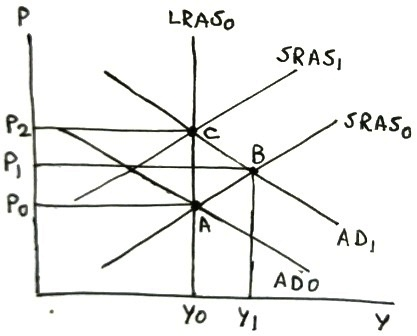
An increase in G increases aggregate demand. AD curve shifts rightward, increasing price level and real GDP, causing an inflationary gap in short run. Higher real GDP and output increases consumption, investment and net exports, and increases interest rate in short run. In long run, higher price level increases production cost, so firms decrease output. Aggregate supply decreases, and SRAS curve shifts leftward, further increasing price level but restoring real GDP to potential GDP level.
In following graph, when money supply increases, AD curve will shift rightward from AD1 to AD2, intersecting SRAS1 at point E2 with higher price level P2 and higher real GDP Y2, with inflationary gap being equal to (Y2 - Y1) in short run. In long run, SRAS1 shifts left to SRAS2, intersecting AD2 at point E3 with further higher price level P3 and restoring real GDP to potential GDP level Y1, removing the short-run inflationary gap.
 Rahul Sunny answered 3 months ago
Related Solutions
a) Real GDP is currently $4,500 billion, and potential GDP is $4,600 billion. If government spending...
problems 20-9 the federal government increases spending on national defense on the golliwing graph indicate the...
When potential GDP increases, is it necessarily the case that real GDP increases as well? Explain
Consider an increase in government spending on roads. 1. Explain which expenditure component of GDP would...
The economy is in a recession. The government increases spending in an effort to move the...
1.If the government spending multiplier is 1 then a $1 increase in deficit-financed government spending will...
What is the impact on GDP if consumer spending increases? Would the answer be different if...
What is the impact on GDP if consumer spending increases? Would the answer be different if...
An increase in government spending initially and primarily shifts
An increase in government spending initially and primarily shifts
- Two 10-cm-diameter charged rings face each other, 15cm apart. The left ring is charged to -29nC...
- Under what conditions would it be possible for an excise tax to have no efficiency cost...
- explain the difference between activities and financial statements of service businesses and merchandising businesses.
- 2. Compare and compare the matrix multiplication algorithm and the Floyd-Warshall algorithm to find all pairs...
- Q: 50.00 ml of 0.5216 M copper(II) nitrate solution is combined with 100.0 ml of 0.5580...
- This is a business law question. Explain how environmental laws regulate the use of toxic substances...
- A sky diver and her parachute system weigh a total of 800 N. She is falling...