Question
In: Economics
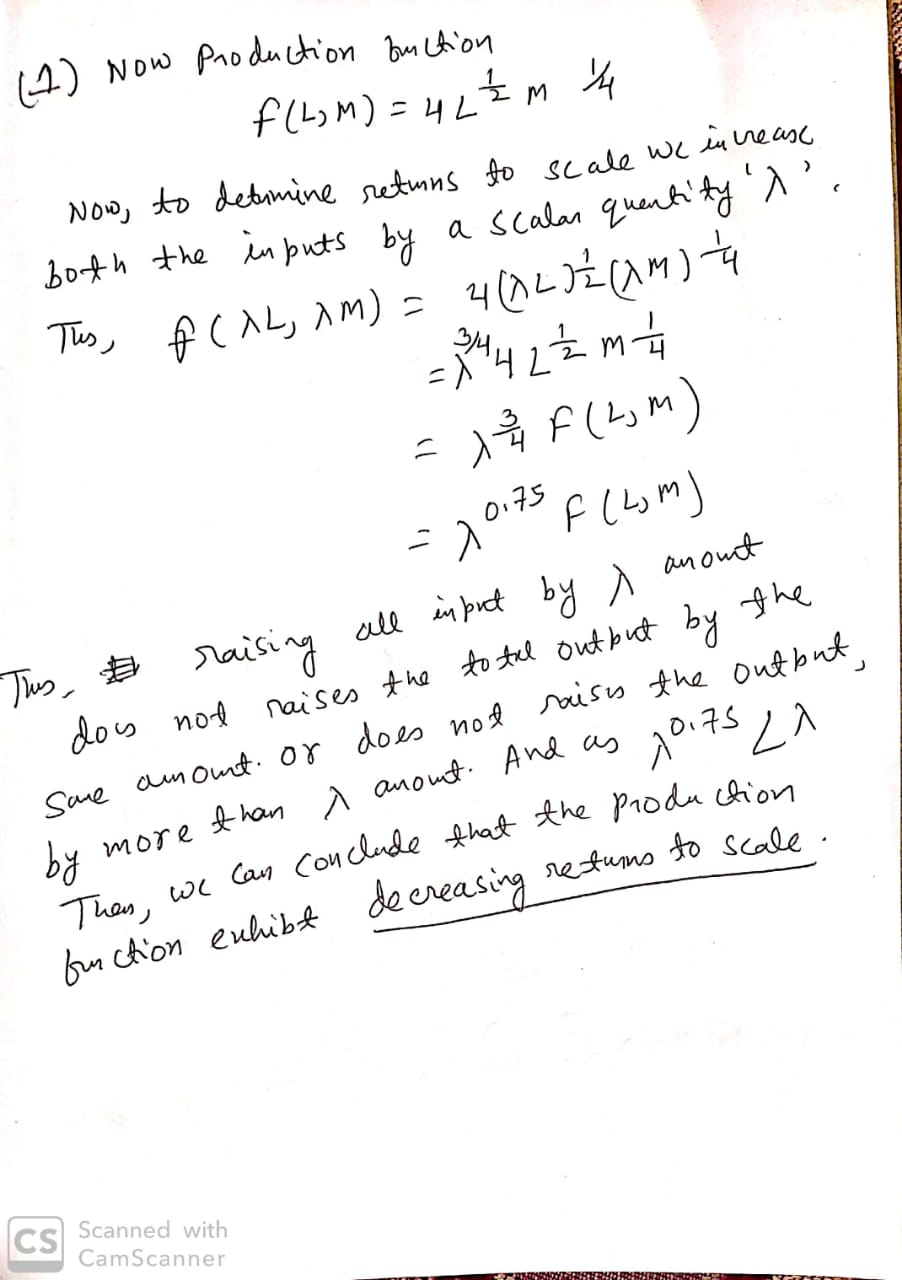
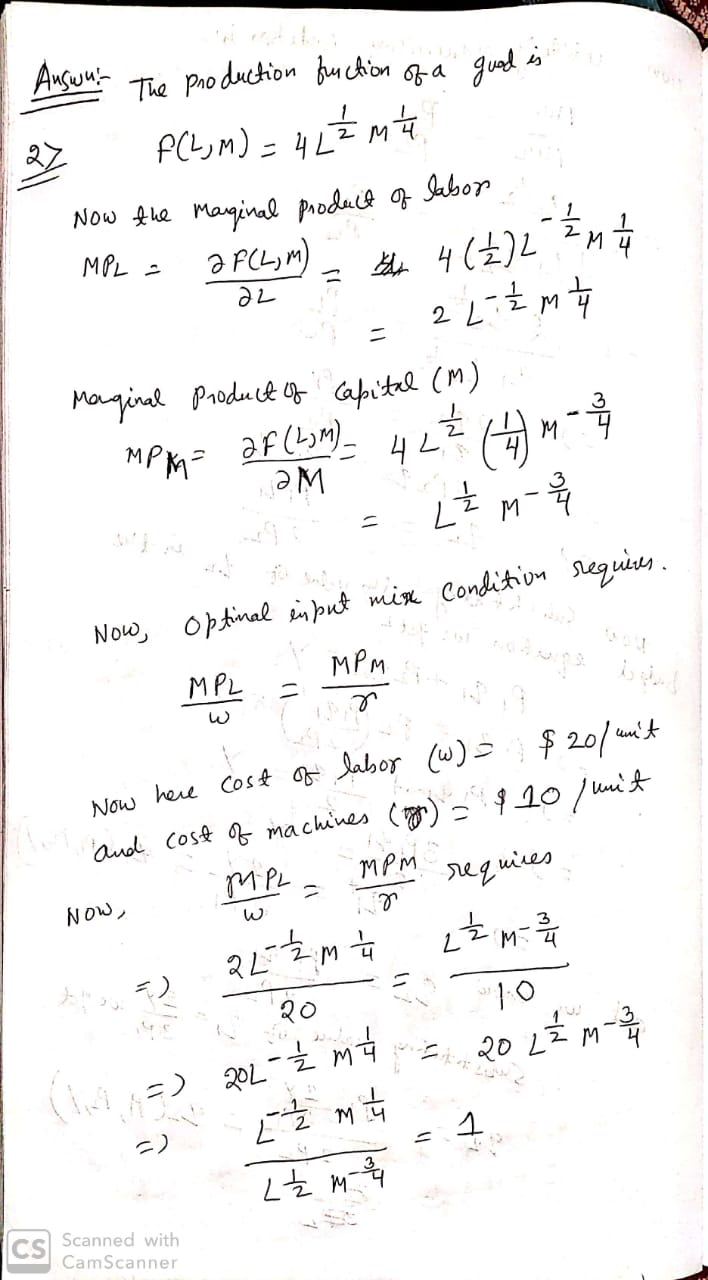
The production function of a good is f(L,M)=4L1/2 M1/4, where L is the number of units...
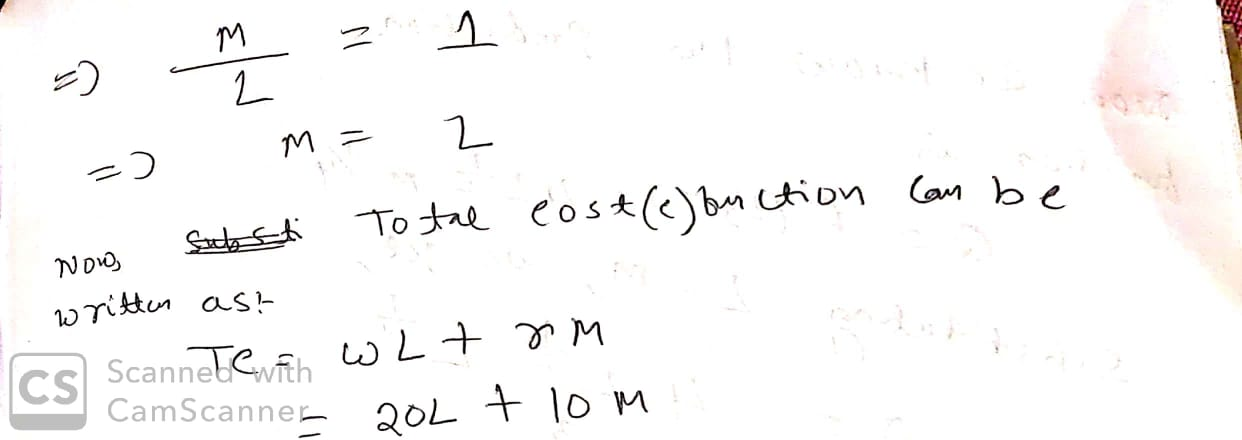
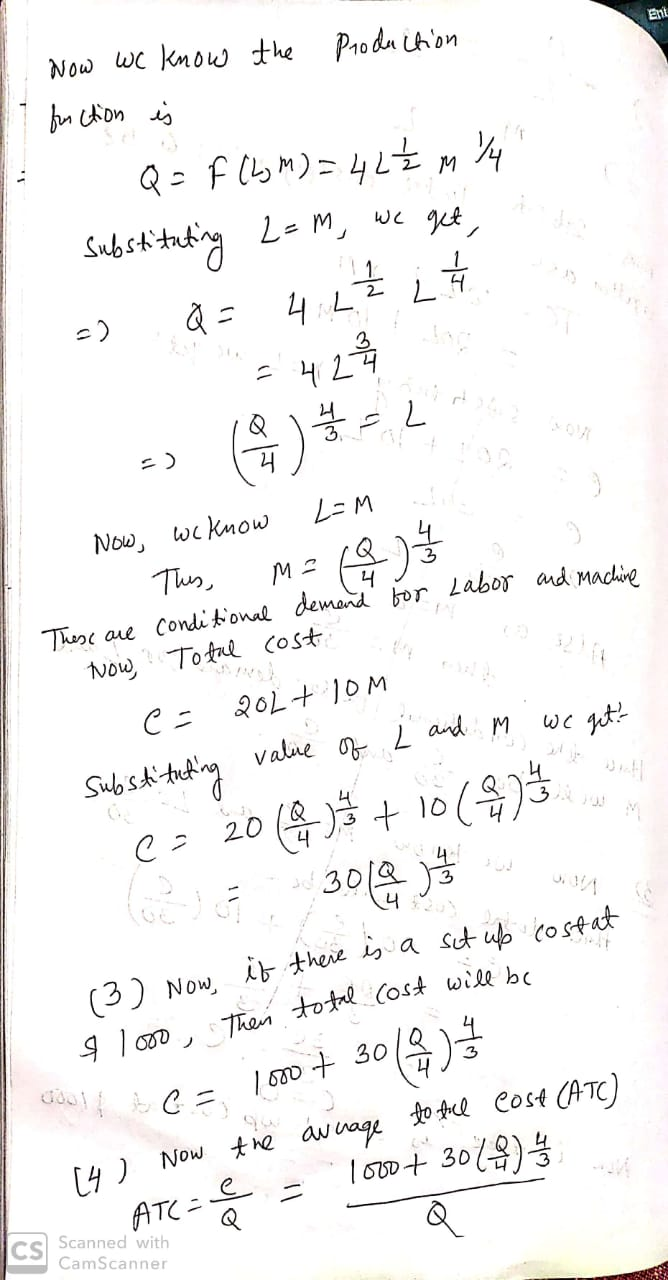
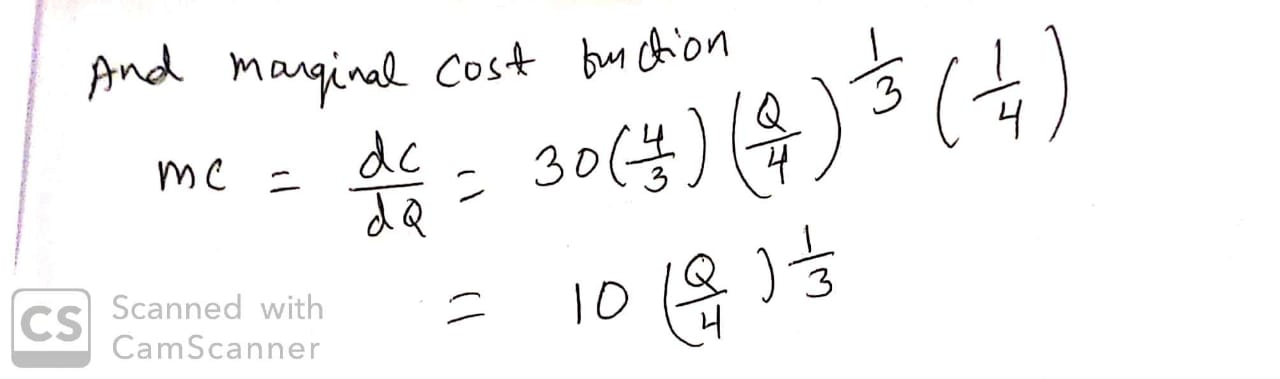
The production function of a good is f(L,M)=4L1/2 M1/4, where L is the number of units of labor and M is the number of machines used. The cost of labor is $20 per unit and the cost of machines is $10 per unit. If the firm decides to produce Q units of output, (1) Does the production function exhibit increasing returns to scale? Why? (2) Get the conditional factor demand for L and M. (3) If there is a set-up cost at $1000. Find the total cost of producing Q units of output using the answer from (2). (4) Find the average total costs function and marginal costs function?
Solutions
 Rahul Sunny answered 3 months ago
Related Solutions
3. the production function is f(L, M)=4*(L^1/2) (M^1/2), where L is the number of units of...
3. the production function is f(L, M)=4*(L^1/2) (M^1/2), where L
is the number of units of labor and M is the number of machines
used. If the cost of labor is $49 per unit and the cost of machines
is $25 per unit, then how much will be the total cost of producing
7 units of output ?
Consider the production function F(L,K) = L^2/3 K^2/3 . (f) Does this production function exhibit increasing,...
Consider the production function F(L,K) = L^2/3 K^2/3 .
(f) Does this production function exhibit increasing, decreasing
or constant returns to scale? Explain.
(g) Find the total cost, average cost and marginal cost of
producing y units of output. Is the average cost increasing or
decreasing in y? Is the marginal cost higher or lower than the
average cost?
Question 2 The production of magic chairs requires only two
inputs: seats (S) and legs (L) (no other inputs are required...
The production function of an economy is F(K,L) = 20(K0.5L0.5), where L is labour and K...
The production function of an economy is F(K,L) =
20(K0.5L0.5), where L is labour and K is
capital with L = 400 and K = 400.
What type of returns to scale does this production function
exhibit?
Suppose a production function is given by F ( K , L ) = K^(1/2) L^(1/2), the...
Suppose a production function is given by F ( K , L )
= K^(1/2) L^(1/2), the price of capital “r” is $16, and the price
of labor “w” is $16.
a. (5) What combination of labor and capital minimizes the cost of
producing 100 units of output in the long run?
b. (5) When r falls to $1, what is the minimum cost of producing
100 pounds of pretzels in the short run? In the long run?
c. (5) When...
Suppose a production function is given by F ( K , L ) = K 1 2...
Suppose a production function is given by F ( K , L )
= K 1 2 L 1 2, the price of capital “r” is $16, and the price of
labor “w” is $16.
a. (5) What combination of labor and capital minimizes the cost of
producing 100 units of output in the long run?
b. (5) When r falls to $1, what is the minimum cost of producing
100 pounds of pretzels in the short run? In the long...
2. Suppose a production function is given by F ( K , L ) = K 1...
2. Suppose a production function is given by F ( K ,
L ) = K 1 2 L 1 2, the price of capital “r” is $16, and the price
of labor “w” is $16.
a. (5) What combination of labor and capital minimizes the cost of
producing 100 units of output in the long run?
b. (5) When r falls to $1, what is the minimum cost of producing
100 pounds of pretzels in the short run? In the...
Suppose that output Q is produced with the production function Q = f(K;L), where K is...
Suppose that output Q is produced with the production function Q
= f(K;L), where K is the number of machines used, and L the number
of workers used. Assuming that the price of output p and the wage w
and rental rate of capital r are all constant, what would the prot
maximizing rules be for the hiring of L and K? (b) What is
theMRTSK;L for the following production function: Q = 10K4L2? Is
this technology CRS, IRS or...
Suppose that output Q is produced with the production function Q = f(K,L), where K is...
Suppose that output Q is produced with the production function Q
= f(K,L), where K is the number of machines used, and L the number
of workers used. Assuming that the price of output p and the wage w
and rental rate of capital r are all constant, what would the profit
maximizing rules be for the hiring of L and K?
(b) What is the MRTSK,L for the following production function: Q =
10K4L2? Is this technology CRS, IRS...
The technology available allows to produce a good according to the production function F(L,K)=[(L-3)K]1/3 if L≥3...
The technology available allows to produce a good according to
the production function F(L,K)=[(L-3)K]1/3 if L≥3 and
K≥0, and F(L,K)=0 if L<3. The market demand for this good is
D(p)=90/p. The prices of labor and capital are w=1 and r=9,
respectively.
A. (12 points) Describe the cost minimization problem of a firm
with this technology, and calculate its conditional factor demands.
Also, calculate the firm's total, average and marginal cost
functions.
B. (10 points) Calculate la supply of a competitive...
Suppose Noah and Naomi's short-run weekly production function for garden benches is F(L)=min{0,L−3},F(L)=min{0,L−3}, where L...
Suppose Noah and Naomi's short-run weekly production function
for garden benches is
F(L)=min{0,L−3},F(L)=min{0,L−3},
where L represents the number of hours of labor employed.
The wage rate is $12 an hour. For non-negative amounts of output,
what is their short-run cost function?
C = 36 + 12Q.
C =12 +36Q.
C =12Q.
C = 36Q.
C =36 - 12Q.
ADVERTISEMENT
ADVERTISEMENT
Latest Questions
- An experiment to measure the value of g is constructed using a tall tower outfitted with...
- Discuss the two estimation methods of classification-type data mining models while considering ANN as a classifier.
- For the equilibrium: CO2(g) + H2(g) ⇌ CO(g) + H2O(g), Kp = 10-5 at 25°C and...
- Sanyu Sony started a new business and completed these transactions during December. Dec. 1 Sanyu Sony...
- A crate rests on a frictionless incline, and is attached to a bucket of nails through...
- e) LIST the three effects that account for the downward slope of the AD curve.
- Complete a 1- to 2-page table using the template provided comparing your opinion of the rights...
ADVERTISEMENT