Question
In: Finance
We are evaluating a project that costs $839014, has an eight-year life, and has no salvage...
We are evaluating a project that costs $839014, has an eight-year life, and has no salvage value. Assume that depreciation is straight-line to zero over the life of the project. Sales are projected at 63074 units per year. Price per unit is $37, variable cost per unit is $18, and fixed costs are $415935 per year. The tax rate is 35%, and we require a return of 21% on this project. What is the NPV of this base-case?
Solutions
Expert Solution
The question clearly states that,
1. Cost of project = $839014
2. Economic Life = 8 years
So, the depreciation (straight line method) after deducting which the value of project becomes zero is,
Depreciation = 839014 / 8 = $104876.75
Assuming we are incurring a fixed cost of $ 415935 per year.
To Calculate the Net Present Value of this project, we’ll employ the following detailed steps.
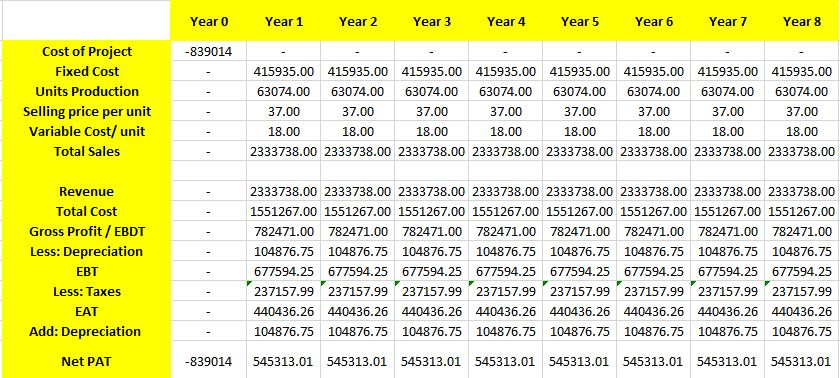
1. Cost of Project: It is $839014 in year 0, as stated in the question.
2. Fixed Cost: It is $415935 each year from year 1-8, as stated in the question.
3. Units produced: It is 63074 units each year from year 1-8, as stated in the question.
4. Selling Price per unit: It is $37 each year from year 1-8, as stated in the question.
5. Variable cost per unit: It is $18 each year from year 1-8, as stated in the question.
6. Total Sales/ Revenue: It is $2333738 each year from year 1-8, as stated in the question. It is computed by multiplying the selling price per unit by units produced and sold.
7. Total cost: It is computed by the formula,
Total cost = Fixed cost + (Units produced x Variable cost)
8. Gross Profit: Also known as EBDT (Earnings before depreciation and taxes), it is computed by subtracting the total cost from total sales.
9. Earnings Before Taxes (EBT): It is computed by subtracting depreciation per year from gross profit.
10. Earnings After Taxes (EAT): It is computed by subtracting taxes (@35%) per year from EBT profit.
11. Net Profit after taxes (PAT): It is computed by adding depreciation per year to EAT. We add depreciation per year as it is a non-cash expense.
All the values described above as shown in the table as below.
Now we have the cash flows for each year (year 0-8).
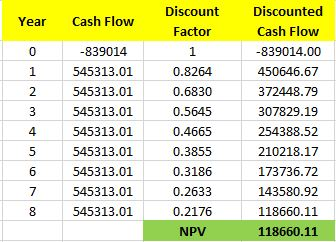
Now, to calculate the Net Present value, we employ the following steps:
1. Write the cash flows for years 0-8.
2. Compute discount factor for each year. This done by the formula 1/(1+r)n where r is the rate of interest and n is the year.
3. Calculate the Discounted cash flow by finding the product of each cash flow and its corresponding discount factor.
4. Add all the discounted cash flows to calculate Net Present Value.
All the values described above as shown in the table as below.
 jeff jeffy answered 3 months ago
Related Solutions
We are evaluating a project that costs $500,000, has an eight-year life, and has no salvage...
We are evaluating a project that costs $841,992, has an eight-year life, and has no salvage...
We are evaluating a project that costs $936,000, has an eight-year life, and has no salvage...
We are evaluating a project that costs $500,000, has an eight-year life, and has no salvage...
We are evaluating a project that costs $892,000, has an eight-year life, and has no salvage...
We are evaluating a project that costs $800,000, has an eight-year life, and has no salvage...
We are evaluating a project that costs $892,000, has an eight-year life, and has no salvage...
We are evaluating a project that costs $500,000, has an eight-year life, and has no salvage...
We are evaluating a project that costs $832,000, has an eight-year life, and has no salvage...
We are evaluating a project that costs $800,000, has an eight-year life, and has no salvage...
- On January 1, 2018, bonds with a face value of $ 79,000 were sold. The bonds...
- How do I make this sort in true alphabetical order instead of ascii(ABCabc) order? I am...
- As a healthcare provider in physical therapy, athletic training, or as an exercise scientist and personal...
- in the market for makeup artists, what happens after the invention of high-definition tv allowing viewers...
- 10. What are the three monetary policy tools of the Fed? Briefly describe how each tool...
- In what ways would the role of a manager working in a nonstandard international assignment arrangement...
- Write a Bash script called move that could replace the UNIX command mv. 'move' tries to...