Question
In: Computer Science
Write the code of: – an abstract class called Creature – classes Player and Monster (derived...
Write the code of:
– an abstract class called Creature
– classes Player and Monster (derived from Creature)
– classes WildPig and Dragon (derived from Monster)
In the Creature class
– Define a string member, Creature Name, to store the class
Creature’s name.(name should be dynamically allocated)
– Define Two virtual pure functions
• void DoAction() : Print the action of the object, and the actions
have to be different from different classes.
• void DrawOnScreen() : Print the object’s name and call DoAction()
belonging to the same class.
The class definition of Creature is:
Question: Implement the class Player, Monster, Dragon and Wildpig
so that when execution the following code, the counsel shows the
execution result as the following:
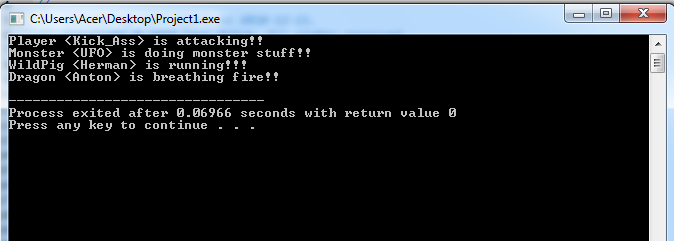
Counsel output:
Player <Kick_Ass> is attacking!!
Monster<UFO> is doing monster stuff!!
WildPig <I'm_Hungry> is Running!!
Dragon<I'm_the_Boss> is breathing Fire!!
Main function:
//==================================================
int main(){
Player hero("Kick_Ass");
Monster mon("UFO");
WildPig pig("I'm_Hungry");
Dragon drag("I'm_the_Boss");
Creature* object[4];
object[0]=&hero;
object[1]=&mon;
object[2]=&pig;
object[3]=&drag;
object[0]->DrawOnScreen();
object[1]->DrawOnScreen();
object[2]->DrawOnScreen();
object[3]->DrawOnScreen();
return0;
}
c++
Solutions
Expert Solution
main.cpp
//
// main.cpp
#include <iostream>
#include "Header.h"
#include <string>
using namespace std;
int main(){
Player hero("Kick_Ass");
Monster mon("UFO");
WildPig pig("Herman");
Dragon drag("Anton");
Creature* object[4];
object[0]=&hero;
object[1]=&mon;
object[2]=&pig;
object[3]=&drag;
object[0]->DrawOnScreen();
object[1]->DrawOnScreen();
object[2]->DrawOnScreen();
object[3]->DrawOnScreen();
return 0;
}
Header.h
#ifndef Header_h
#define Header_h
#include <string>
using namespace std;
class Creature{
public:
Creature() {}
Creature(string name);
virtual void DoAction()=0;
virtual void DrawOnScreen()=0;
protected:
string CreatureName;
};
class Player: public Creature {
public:
Player(string name);
void DoAction() override;
void DrawOnScreen() override;
};
class Monster: public Creature {
public:
Monster() {}
Monster(string name);
void DoAction();
void DrawOnScreen();
};
class WildPig: public Monster {
public:
WildPig(string name);
void DoAction();
void DrawOnScreen();
};
class Dragon: public Monster {
public:
Dragon(string name);
void DoAction();
void DrawOnScreen();
};
#endif /* Header_h */
Creature.cpp
#include "Header.h"
#include <iostream>
#include <string>
using namespace std;
Creature::Creature(string name) {
CreatureName = name;
}
Player::Player(string name){
CreatureName = name;
}
Monster::Monster(string name) {
CreatureName = name;
}
WildPig::WildPig(string name) {
CreatureName = name;
}
Dragon::Dragon(string name) {
CreatureName = name;
}
void Player::DoAction(){
cout << "is attacking!!";
}
void Monster::DoAction(){
cout << "is doing monster stuff!!";
}
void WildPig::DoAction(){
cout << "is running!!!";
}
void Dragon::DoAction(){
cout << "is breathing fire!!";
}
void Player::DrawOnScreen(){
cout << "Player <" <<
CreatureName << "> ";
DoAction();
cout << endl;
}
void Monster::DrawOnScreen(){
cout << "Monster <" <<
CreatureName << "> ";
DoAction();
cout << endl;
}
void WildPig::DrawOnScreen(){
cout << "WildPig <" <<
CreatureName << "> ";
DoAction();
cout << endl;
}
void Dragon::DrawOnScreen(){
cout << "Dragon <" <<
CreatureName << "> ";
DoAction();
cout << endl;
}
 venereology answered 3 months ago
Related Solutions
Refactor the following classes so they are both derived from a base class called Person. Write...
Write in C++ Abstract/Virtual Rock Paper Scissors Create an abstract Player class that consists of private...
3. write a program that uses a class called "garment" that is derived from the class...
Java - Write an abstract class called Shape with a string data field called colour. Write...
This is in JAVA Shapes2D Write the following four classes to practice using an abstract class...
JAVA A simple Class in a file called Account.java is given below. Create two Derived Classes...
Base class: Polygon Derived classes: Rectangle, Triangle Make Square a derived class of Rectangle. There can...
Write a java program with the following classes: Class Player Method Explanation: play : will use...
Shapes2D Write the following four classes to practice using an abstract class and polymorphism. Submit all...
Shapes2D Write the following four classes to practice using an abstract class and polymorphism. Submit all...
- Dirac's Theorem states that "A simple graph with n vertices (n >= 3) is Hamiltonian if...
- Two 10-cm-diameter charged rings face each other, 15cm apart. The left ring is charged to -29nC...
- Under what conditions would it be possible for an excise tax to have no efficiency cost...
- explain the difference between activities and financial statements of service businesses and merchandising businesses.
- 2. Compare and compare the matrix multiplication algorithm and the Floyd-Warshall algorithm to find all pairs...
- Q: 50.00 ml of 0.5216 M copper(II) nitrate solution is combined with 100.0 ml of 0.5580...
- This is a business law question. Explain how environmental laws regulate the use of toxic substances...