Question
In: Economics
8. The reserve requirement, open market operations, and the moneysupply Assume that banks do not hold...
8. The reserve requirement, open market operations, and the moneysupply
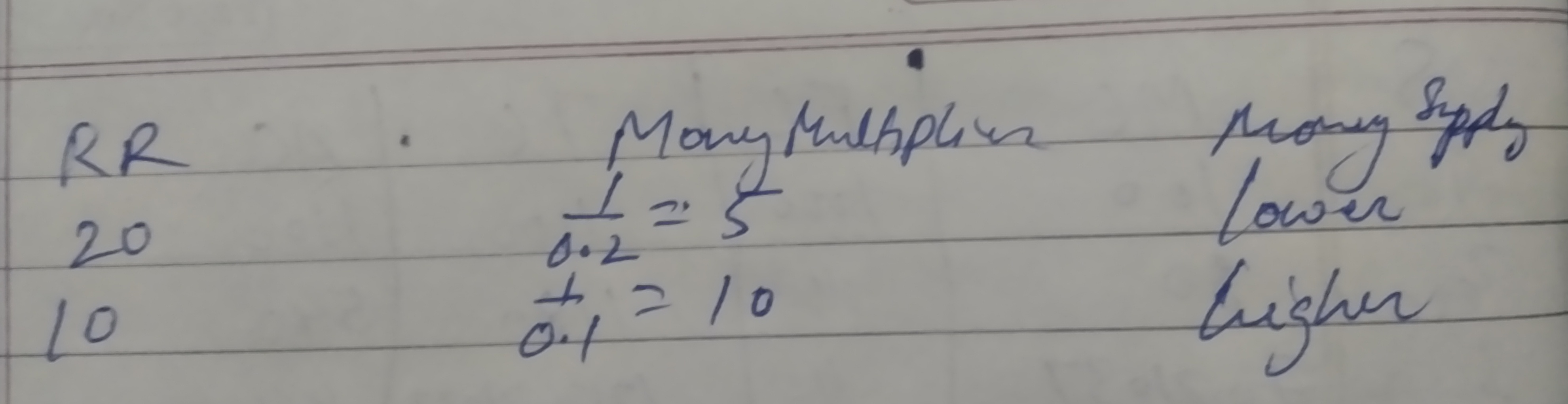
Assume that banks do not hold excess reserves and that households do not hold currency, so the only form of money is demand deposits. To simplify the analysis, suppose the banking system has total reserves of $400. Determine the money multiplier and the money supply for each reserve requirement listed in the following table.
(CHART GOES RIGHT HERE INSTEAD OF THE Bottom)
A higher reserve requirement is associated with a (smaller/ larger) money supply.
Suppose the Federal Reserve wants to increase the money supply by $200. Again, you can assume that banks do not hold excess reserves and that households do not hold currency. If the reserve requirement is 10%, the Fed will use open-market operations to (buy/SEll). _______$ worth of U.S. government bonds.
Now, suppose that, rather than immediately lending out all excess reserves, banks begin holding some excess reserves due to uncertain economic conditions. Specifically, banks increase the percentage of deposits held as reserves from 10% to 25%. This increase in the reserve ratio causes the money multiplier to(FALL/RISE) to( 1, 2.5, 4,5,10) . Under these conditions, the Fed would need to (BUY/SELL) _________ $ worth of U.S. government bonds in order to increase the money supply by $200.
Which of the following statements help to explain why, in the real world, the Fed cannot precisely control the money supply? Check all that apply.
-The Fed cannot control whether and to what extent banks hold excess reserves.
-The Fed cannot control the amount of money that households choose to hold as currency.
-The Fed cannot prevent banks from lending out required reserves.
|
Reserve Requirement |
Simple Money Multiplier |
Money Supply |
|---|---|---|
|
(Percent) |
(Dollars) |
|
| 20 | ||
| 10 |
Solutions
Expert Solution
A higher reserve requirement is associated with a smaller money supply.
Suppose the Federal Reserve wants to increase the money supply by $200. Again, you can assume that banks do not hold excess reserves and that households do not hold currency. If the reserve requirement is 10%, the Fed will use open-market operations to buy 20$ worth of U.S. government bonds.
Now, suppose that, rather than immediately lending out all excess reserves, banks begin holding some excess reserves due to uncertain economic conditions. Specifically, banks increase the percentage of deposits held as reserves from 10% to 25%. This increase in the reserve ratio causes the money multiplier to FALL to 4. Under these conditions, the Fed would need to BUY 50 $ worth of U.S. government bonds in order to increase the money supply by $200.
Explanation:Money multiplier=1/(reserve ratio ( required+ excess). If required reserve ratio will be higher than money Multiplier will lower ,so money supply will be lower.
If RR=10, then money multiplier=1/0.1=10,
So fed needs to increase Monetary base by buying bonds of 20$ ,so Increase in money supply=20*10=200.
The correct options;,
The Fed cannot control whether and to what extent banks hold excess reserves.
-The Fed cannot control the amount of money that households choose to hold as currency.
Note: central bank can prevent banks banks lending out required reserve.
Money supply=Monetary base* money multiplier
 Rahul Sunny answered 4 months ago
Related Solutions
The reserve requirement, open market operations, and the moneysupply Assume that banks do not hold excess...
8. The reserve requirement, open market operations, and the money supply Assume that banks do not...
8. The reserve requirement, open market operations, and the money supply Assume that banks do not...
5. The reserve requirement, open market operations, and the money supply Assume that banks do not...
Suppose the Federal Reserve sets the reserve requirement at 10 percent, banks hold no excess reserves,...
Suppose the Federal Reserve sets the reserve requirement at 10 percent, banks hold no excess reserves,...
Assume that banks do not hold excess reserves and that households do not hold currency, so...
Assume that banks do not hold excess reserves and that households do not hold currency, so...
Assume that banks do not hold excess reserves and that households do not hold currency, so...
What are open market operations? Explain. How can the Federal Reserve use its open market operations...
- sort_employees(Employee emps[], int size) (40 pts) This function should sort the input array based on each...
- Write the program in JAVA. Make an undirected, but disconnected graph of at least 15 vertices...
- Teen Smoking Project CHAPTER 0. Preliminary Discussion Question: 1. What conjectures (educated guesses) could be made...
- In reviewing firm liquidity situations, lenders often count on the Quick Ratio (or Acid-Test ratio). Why...
- code a Java program that: Requests from the user for a text filename to read the...
- Discuss how the ARIES algorithm must operate under the circumstances that the system crashes during recovery
- (a) Based on the information in the above table, what is the unemployment rate? What is...