Question
In: Economics
Suppose the demand functions facing a wireless telephone monopolist are QdL=100−200P for each low-demand consumer and...
Suppose the demand functions facing a wireless telephone monopolist are QdL=100−200P for each low-demand consumer and QdH=120−200P for each high-demand consumer, where P is the per-minute price in dollars. The marginal cost is $0.02 per minute. Suppose the monopolist offers a menu of two-part tariff plans, with one plan intended for each type of consumer. Suppose too that for any per-minute price PL in the low-demand plan, the fixed fee in the low-demand plan leaves a low-demand consumer with zero surplus; that the number of minutes in the low-demand plan is capped at the number of minutes desired by a low-demand consumer at that plan's per-minute price; and that the high-demand plan has a per-minute price of $0.02 per minute and a fixed fee that leaves the high-demand consumer approximately indifferent between the low- and high-demand plans. Suppose that there are 100 high-demand consumers and 400 low-demand consumers. Will the monopolist's profit be higher when the per-minute price in the low-demand plan is $0.07 or $0.12? Instructions: Round your answers to 2 decimal places as needed.
a. Suppose the monopolist's per-minute price in the low-demand plan is $0.07.
Profit = $.
b. Now suppose the monopolist's per-minute price in the low-demand plan is $0.12.
Profit = $.
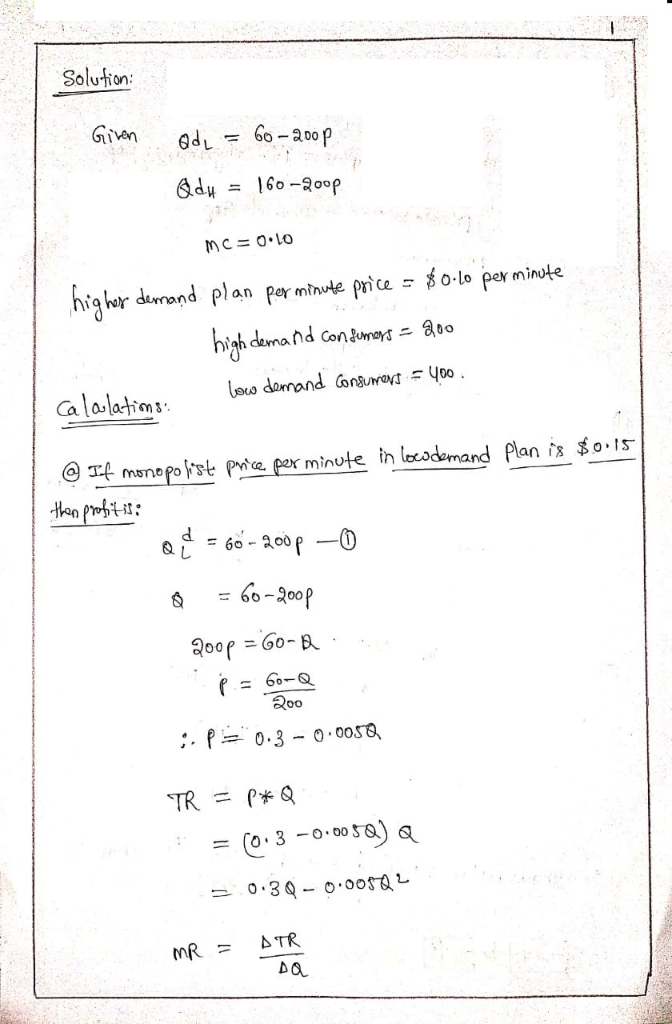
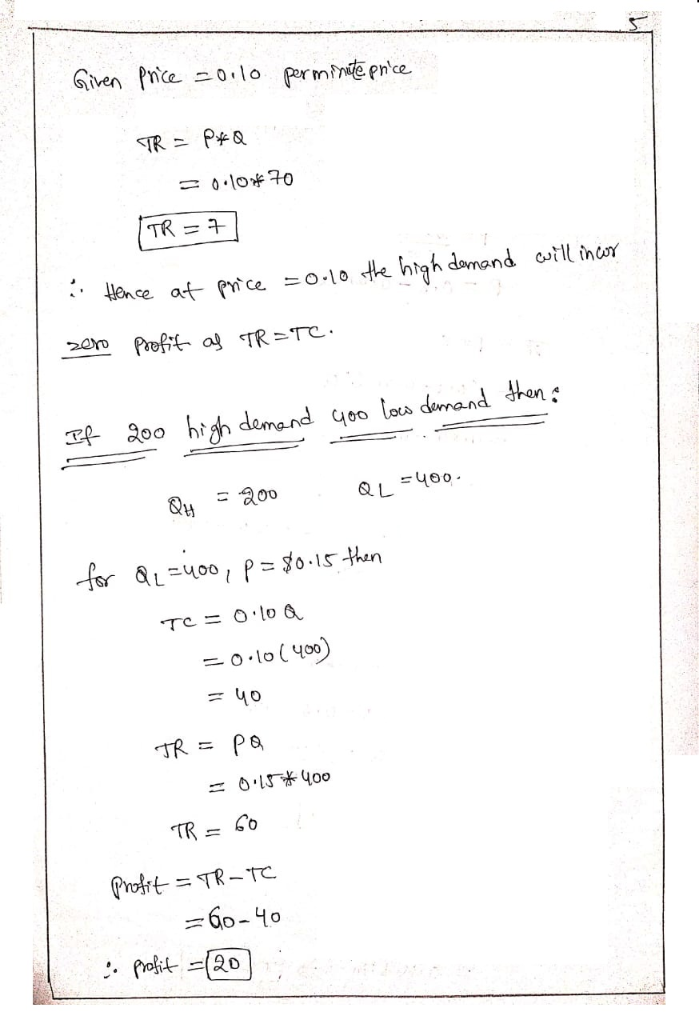
Suppose the demand functions facing a wireless telephone
monopolist are
QdL=60−200P
for each low-demand consumer and
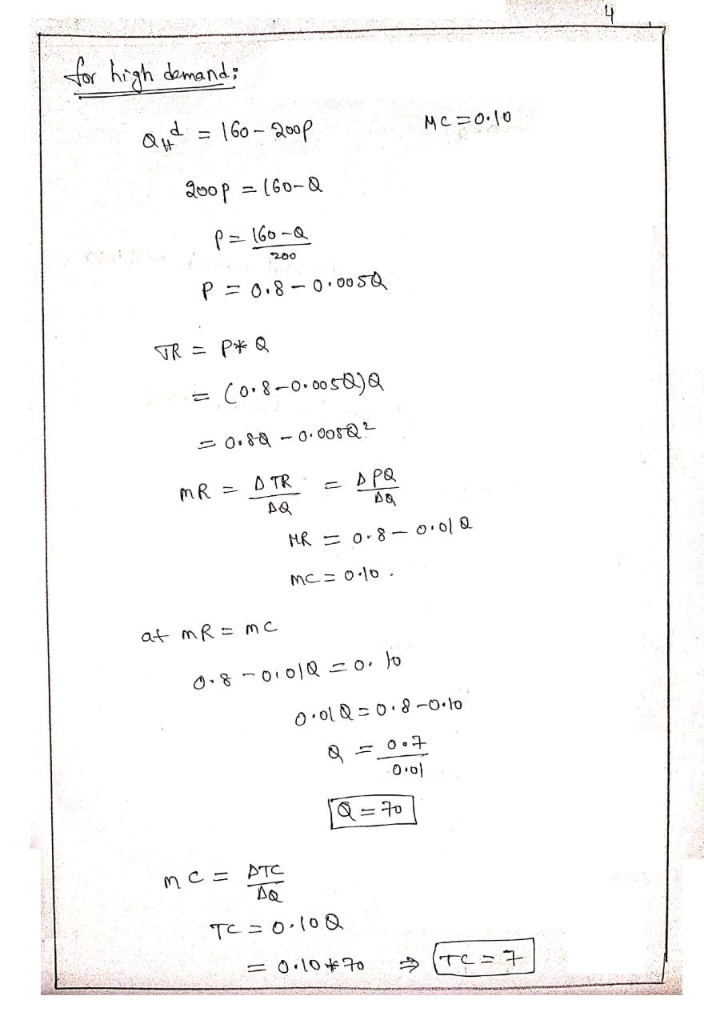
QdH=160−200P
for each high-demand consumer, where P is the per-minute
price in dollars. The marginal cost is $0.10 per minute. Suppose
the monopolist offers a menu of two-part tariff plans, with one
plan intended for each type of consumer. Suppose too that for any
per-minute price PL in the low-demand plan, the
fixed fee in the low-demand plan leaves a low-demand consumer with
zero surplus; that the number of minutes in the low-demand plan is
capped at the number of minutes desired by a low-demand consumer at
that plan's per-minute price; and that the high-demand plan has a
per-minute price of $0.10 per minute and a fixed fee that leaves
the high-demand consumer approximately indifferent between the low-
and high-demand plans. Suppose that there are 200 high-demand
consumers and 400 low-demand consumers. Will the monopolist's
profit be higher when the per-minute price in the low-demand plan
is $0.15 or $0.20?
Instructions: Round your answers to 2 decimal
places as needed.
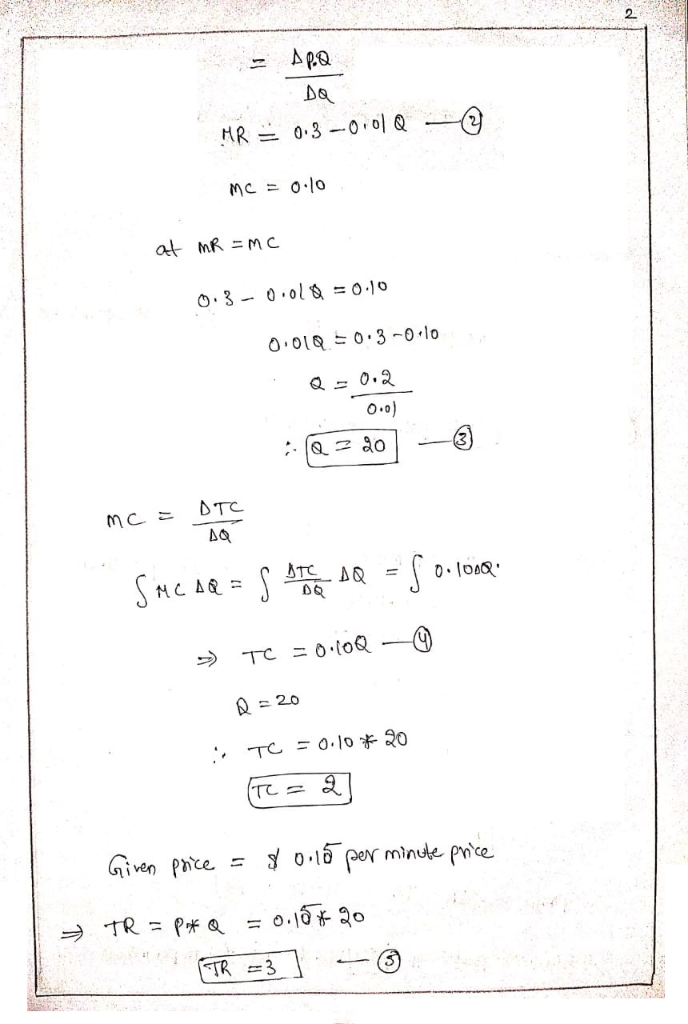
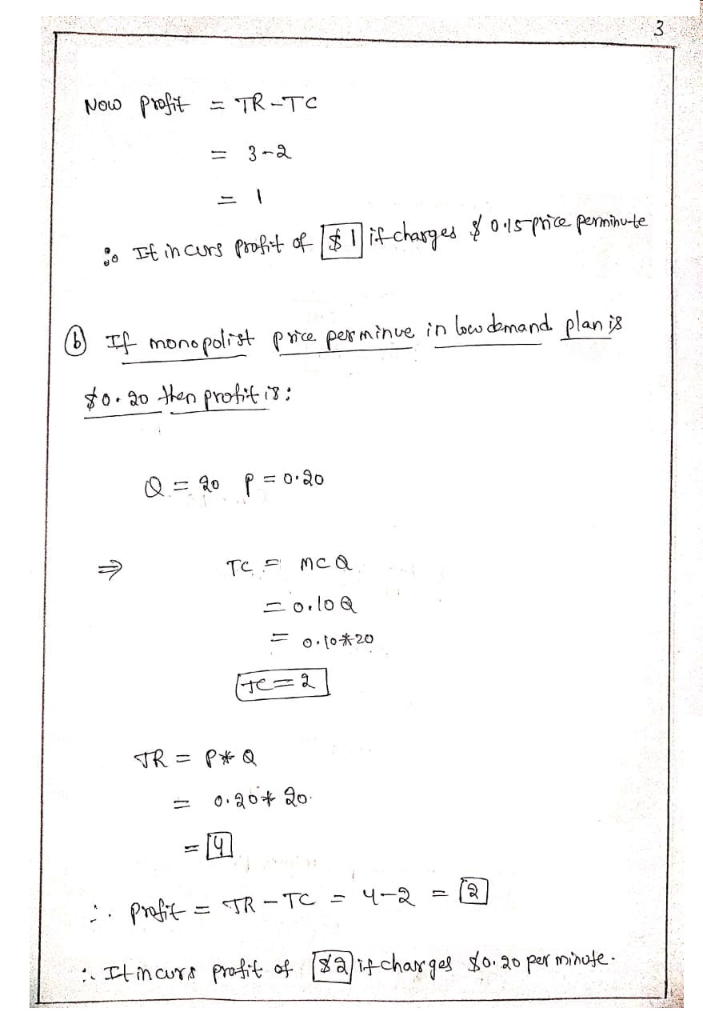
a. Suppose the monopolist's per-minute price in the low-demand plan
is $0.15.
Profit = $.
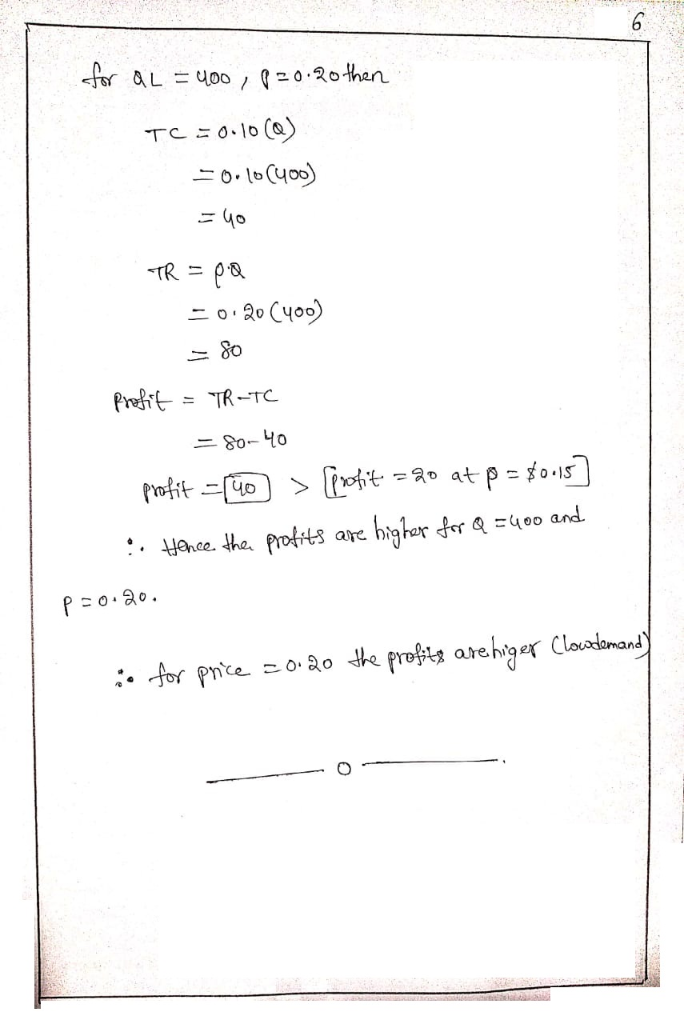
b. Now suppose the monopolist's per-minute price in the low-demand
plan is $0.20.
Profit = $.
Solutions
 Rahul Sunny answered 4 months ago
Related Solutions
Clearvoice is a wireless telephone monopolist in a rural area. There are 100 consumers in the...
Clearvoice is a wireless telephone monopolist in a rural area. There are 100 consumers in the...
Suppose there is a monopolist in the market for a specific video game facing a demand...
Suppose a monopolist faces consumer demand given by P=300?11Q with a constant marginal cost of ?$100...
1. Consider a monopolist facing the market demand function be QD = 200 -5P. Suppose that...
A monopolist is facing the following demand curve P = 50 − 5Q. The monopolist has...
Suppose a monopolist facing a downward sloping inverse demand curve p(q) sets prices and quantity (p...
a monopolist knows that there are 2 types of consumers, "high demand" and "low demand" types....
A monopolist knows that there are two types of consumers, “high demand” (H) and low demand...
A monopolist knows that there are two types of consumers, “high demand” (H) and low demand...
- On January 1, 2018, bonds with a face value of $ 79,000 were sold. The bonds...
- How do I make this sort in true alphabetical order instead of ascii(ABCabc) order? I am...
- As a healthcare provider in physical therapy, athletic training, or as an exercise scientist and personal...
- in the market for makeup artists, what happens after the invention of high-definition tv allowing viewers...
- 10. What are the three monetary policy tools of the Fed? Briefly describe how each tool...
- In what ways would the role of a manager working in a nonstandard international assignment arrangement...
- Write a Bash script called move that could replace the UNIX command mv. 'move' tries to...