Question
In: Physics
1. A mirror of focal length 22.4 cm creates an image with magnification -0.350. What is...
1. A mirror of focal length 22.4 cm creates an image with magnification -0.350. What is the image distance?
2. As light travels between media with different indices of refraction, which of the following wave properties changes: speed, frequency, wavelength?
Solutions
Expert Solution
1). A mirror of focal length 22.4 cm creates an image with magnification -0.350. What is the image distance
f= 22.4 cm
M= -0.350
The mirror equation expresses the quantitative relationship between the object distance (do), the image distance (di), and the focal length (f). The equation is stated as follows:
 Equation
.......................(1)
Equation
.......................(1)
The magnification equation relates the ratio of the image distance and object distance to the ratio of the image height (hi) and object height (ho). The magnification equation is stated as follows:

So that by the given data
M= -di/d0 = -0.350
di = 0.350d0 Equation .......................(2)
From the Eq.............(1)
di d0 = (di + d0 )f
From Eq .................(2)
0.350*d02 = d0 (1+0.350)22.4
=> d0 = (1.350*22.4)/0.350
= 86.4 cm.
by substituting the d0 value in equation .............(2)
di = 0.350* 86.4
= 30.24 cm.
The image distance is 30.24 cm.
2). As light travels between media with different indices of refraction, which of the following wave properties changes: speed, frequency, wavelength?
Symbols used: ? is wavelength, ? is frequency, c,v are speeds of light in vacuum and in the medium.
Alright. First, we can look at just frequency and determine if frequency should change on passing through a medium.
Frequency can't change
Now, let's take a glass-air interface and pass light through it. (In SI units) In one second, ? "crest"s will pass through the interface. Now, a crest cannot be distroyed except via interference, so that many crests must exit. Remember, a crest is a zone of maximum amplitude. Since amplitude is related to energy, when there is max amplitude going in, there is max amplitude going out, though the two maxima need not have the same value.
Also, we can directly say that, to conserve energy (which is dependent solely on frequency), the frequency must remain constant.
Speed can change
There doesn't seem to be any reason for the speed to change, as long as the energy associated with unit length of the wave decreases. It's like having a wide pipe with water flowing through it. The speed is slow, but there is a lot of mass being carried through the pipe. If we constrict the pipe, we get a jet of fast water. Here, there is less mass per unit length, but the speed is higher, so the net rate of transfer of mass is the same.
In this case, since ??=v, and ? is constant, change of speed requires change of wavelength. This is analogous to the pipe, where increase of speed required decrease of cross-section (alternatively mass per unit length)
Why does it have to change?
Alright. Now we have established that speed can change,
lets look at why. Now, an EM wave(like light), carries alternating
electric and magnetic fields with it. 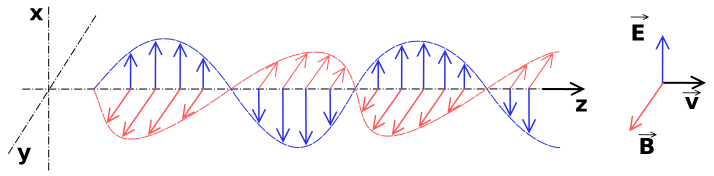 Here's an animation. Now, in any medium, the electric and magnetic
fields are altered due to interaction with the medium. Basically,
the permittivities/permeabilities change. This means that the light
wave is altered in some manner. Since we can't alter frequency, the
only thing left is speed/wavelength (and amplitude, but that's not
it as we shall see)
Here's an animation. Now, in any medium, the electric and magnetic
fields are altered due to interaction with the medium. Basically,
the permittivities/permeabilities change. This means that the light
wave is altered in some manner. Since we can't alter frequency, the
only thing left is speed/wavelength (and amplitude, but that's not
it as we shall see)
Using the relation between light and permittivity/permeability (?0?0=1/c2 and ??=1/v2), and ?=?r?0,?=?r?0,n=c/v (n is refractive index), we get n=?r?r?????, which explicitly states the relationship between electromagnetic properties of a material and its RI.
Basically, the relation ??=1/v2 guarantees that the speed of light must change as it passes through a medium, and we get the change in wavelength as a consequence of this.
Answers is speed and wave length will change.
 genius_generous answered 3 months ago
Related Solutions
A convex mirror has a focal length of ?35 cm. Where is the image if the...
For a diverging lens of focal length -20cm, for what object distance will the magnification of the image be 0.8?
A mirror creates an image that has a height of 2.50 cm that is behind the...
A concave spherical mirror with a focal length of 12 cm faces a plane mirror with...
A diverging lens has a focal length of 18.6 cm . A. What is the image...
A concave mirror has a focal length of 63.6 cm. (a) What is its radius of...
A converging lens has a focal length of 7.5 cm. (a) What are the image distances...
1. If a concave mirror has a focal length of 20 cm, at which object distance...
For a convex mirror, when p = -3f , the image magnification is
A concave mirror has a focal length of 43.8 cm. The distance between an object and...
- The output of the function is a dictionary whose keys represent the bins and whose values...
- The shape of a graph of a binomial distribution depends on the value of both n...
- In 2012, cost per Medicare beneficiary did what?
- 3. A. What techniques can a firm use to optimize demand deposit holdings? B. How do...
- The half-life of mercury-197 is 64.1 hours. If a patient undergoing a kidney scan is given...
- Double bonds react with Br2 to form a dibromide. Isobutylene undergoes cationic polymerization under conditions where...
- 1. Which sex chromosomes are limited to only one sex? A. X and Z B. X...