Question
In: Physics
1. What is the weight of a 87.4 kg object? w=? 2.What was the average speed...
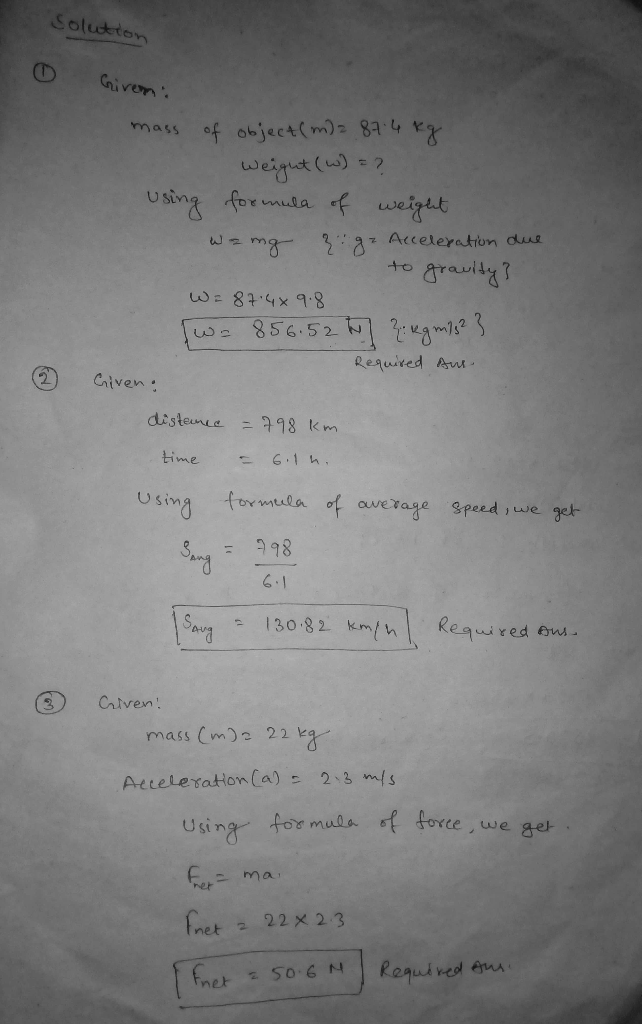
1. What is the weight of a 87.4 kg object? w=?
2.What was the average speed in km/h of a car that travels 798 km in 6.1h?
3. What net force is needed to give a 22 kg grocery cart an acceleration of 2.3 m/s2 ?
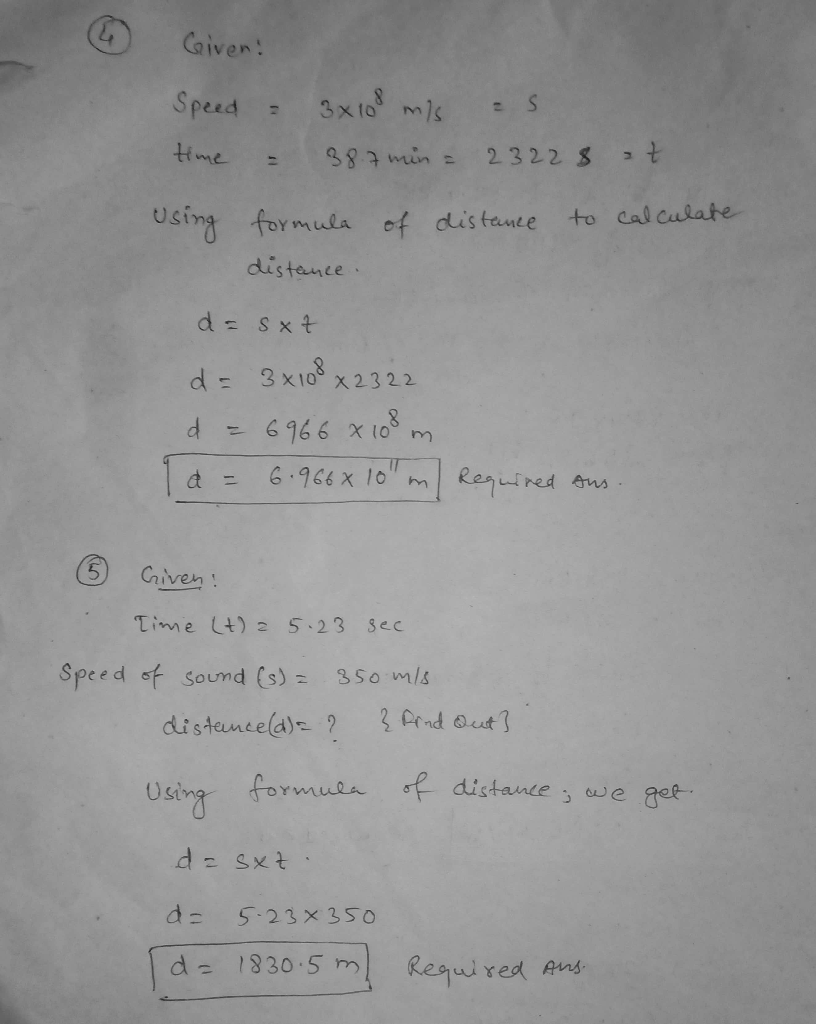
4.Suppose a radio signal travels from Earth and through space at a speed of 3.0 × 10⁸ m/s. How far into space did the signal travel during the first 38.7 minutes?
5. How far away was a lightning strike if thunder is heard 5.23 seconds after seeing the flash? Assume that sound traveled at 350.0 m/s during the storm.
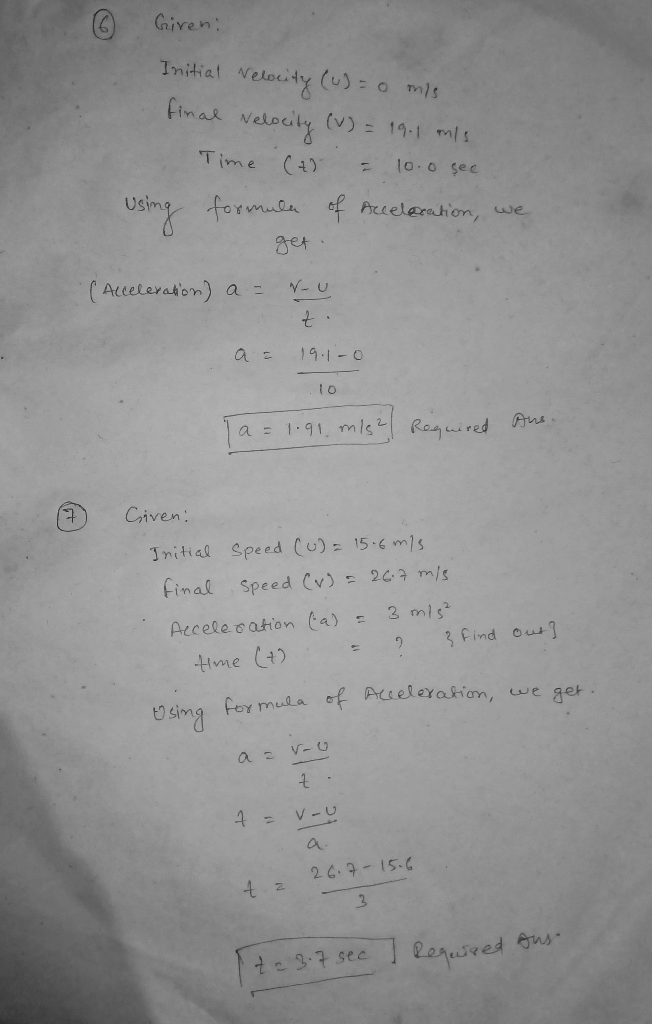
6.What is the acceleration of a car that moves from rest to 19.1 m/s in 10.0 s?
7. How long will be required for a car to go from a speed of 15.6 m/s to a speed of 26.7 m/s if the acceleration is 3.0 m/s2?
Solutions
 solved using concept of
motion.
solved using concept of
motion. genius_generous answered 3 months ago
Related Solutions
The weight of a 0.6 kg object at the surface of Planet V is 20 N....
The weight of a 0.6 kg object at the surface of Planet V is 20
N. The radius of the planet is 4 X 10⁶ m. Find the
gravitational acceleration at a distance of 2.0 X 10⁶ m
from the surface of this planet.
9 m/s2
13 m/s2
14.8 m/s2
11 m/s2
QUATION 2 PLEASE 1) The average female bobcat weight about 9.6 kg. Let's assume μ =...
QUATION 2 PLEASE
1) The average female bobcat weight about 9.6 kg. Let's assume μ
= 9.6 and σ = 1.65kg. a) Calculate Pr{Y > 10.3} b) Now assume
you have a sample of n = 26 male bobcats. Calculate Pr{ Ȳ >
10.3}. c) Which probability is lower? Why? 2) Refer to problem 1.
Now assume you take a sample of n = 4 male bobcats. a) What is the
probability of the sample average being within 0.75 kg...
An 10.6 kg object is pulled along a horizontal surface at constant speed. If the coefficient...
An 10.6 kg object is pulled along a horizontal surface at
constant speed. If the coefficient of friction is 0.11, what is the
force of friction?
An applied force of 10.9 N [right] provides a 9.46 kg object
with a net acceleration of 2.31 m/s2 [right] on a flat
surface. What is the magnitude of the force of friction acting on
the object?
A 6.2 kg object is pulled along a horizontal surface by a force
of 22.0N. If its...
Consider an object of mass m1 = 0.360 kg moving with a uniform speed of 5.40...
Consider an object of mass
m1 = 0.360 kg
moving with a uniform speed of 5.40 m/s on a frictionless
surface. This object makes an elastic head-on collision with
another object of mass
m2 = 0.645 kg
which is initially at rest.
(a) Find the speed of m1
immediately after collision. m/s
(b) Find the speed of m2
immediately after collision m/s
(1) A 190-kg object and a 490-kg object are separated by 4.40 m. (a) Find the...
(1) A 190-kg object and a 490-kg object are separated by 4.40
m.
(a) Find the magnitude of the net gravitational force exerted by
these objects on a 63.0-kg object placed midway between them.
[N]
(b) At what position (other than an infinitely remote one) can
the 63.0-kg object be placed so as to experience a net force of
zero from the other two objects? [m from the 490 kg mass toward the
190 kg mass ]
(2)
(a) What...
1) Object "A" has twice the weight of object "B" at a given point on the...
1) Object "A" has twice the weight of object "B" at a given
point on the moon's surface. "A" must have twice the mass of
"B". True or False
2) The two objects above are moved to Mars. At the same place on
the surface of Mars, the weight of "A" will be twice that of
"B." True or False
3) For a given object composed of a known material on a known
surface, the coefficient of kinetic friction is usually
expected to...
An object with mass m1= 3.00 kg is moving along the positive x-axis with a speed...
An object with mass m1= 3.00 kg is moving along the positive
x-axis with a speed v1i=2 m/s straight towards two objects
with masses m2= 2.00 kg and m3= 4.00 kg, which are initially at
rest. When they collide, object 1 comes to rest and object 2 moves
away with a speed of v2f=1.5 m/s at an angle of 50o from
the incoming path of object 1. For everything that follows, use a
coordinate system where the final path of...
object m1 = 1.50 kg starts at an initial height h1i = 0.290 m and speed...
object m1 = 1.50 kg starts at an initial
height h1i = 0.290 m and speed
v1i = 4.00 m/s, swings downward and
strikes (in an elastic collision) object m2 =
4.40 kg which is initially at rest.
Determine the height (in m) to which each ball swings after the
collision (ignoring air resistance).
m1= m
m2= m
The figure below gives the speed v versus time t for a 0.490 kg object of...
The figure below gives the speed v versus time
t for a 0.490 kg object of radius 6.50 cm that rolls
smoothly down a 30
SEX: Sex (1=Male 2=Female) WEIGHT: Body Weight (kg) 1 61.236 1 79.38 1 99.792 1 81.648...
SEX: Sex (1=Male 2=Female)
WEIGHT: Body Weight (kg)
1
61.236
1
79.38
1
99.792
1
81.648
1
72.576
1
61.236
1
83.916
1
97.524
1
88.452
1
79.38
2
57.607
2
64.184
2
63.958
2
133.358
2
62.143
2
58.968
2
58.514
2
61.69
2
107.503
2
83.009
Open Brain data. Claim: Male and female
subjects have different weight.
9. What test/procedure did you perform?
a. One-sided t-test
b. Regression
c. Two-sided t-test
d. Confidence interval
10. What is the...
ADVERTISEMENT
ADVERTISEMENT
Latest Questions
- QUESTION 5 Phoebe has gone to the local mobile phone store to purchase a new phone...
- Price the following option using the binomial method. Show all work Stock price = 10 Strike...
- 1-) Please submit the solution of your final as Ms-word or PDF document 2-) Complete THREE...
- Determine the magnitude of the force between two parallel wires. Express your answer to two significant...
- How many hours would be required to make a 3900 km trip across the United States...
- Using the following schema, write a SQL query to satisfy the question: What are the names...
- When glutamate binds to it's ionotropic receptors, including __, it can also cause an __ in...
ADVERTISEMENT