Question

In: Economics

Consider a monopolist with a linear demand curve: q = a − bp, where a;b >...

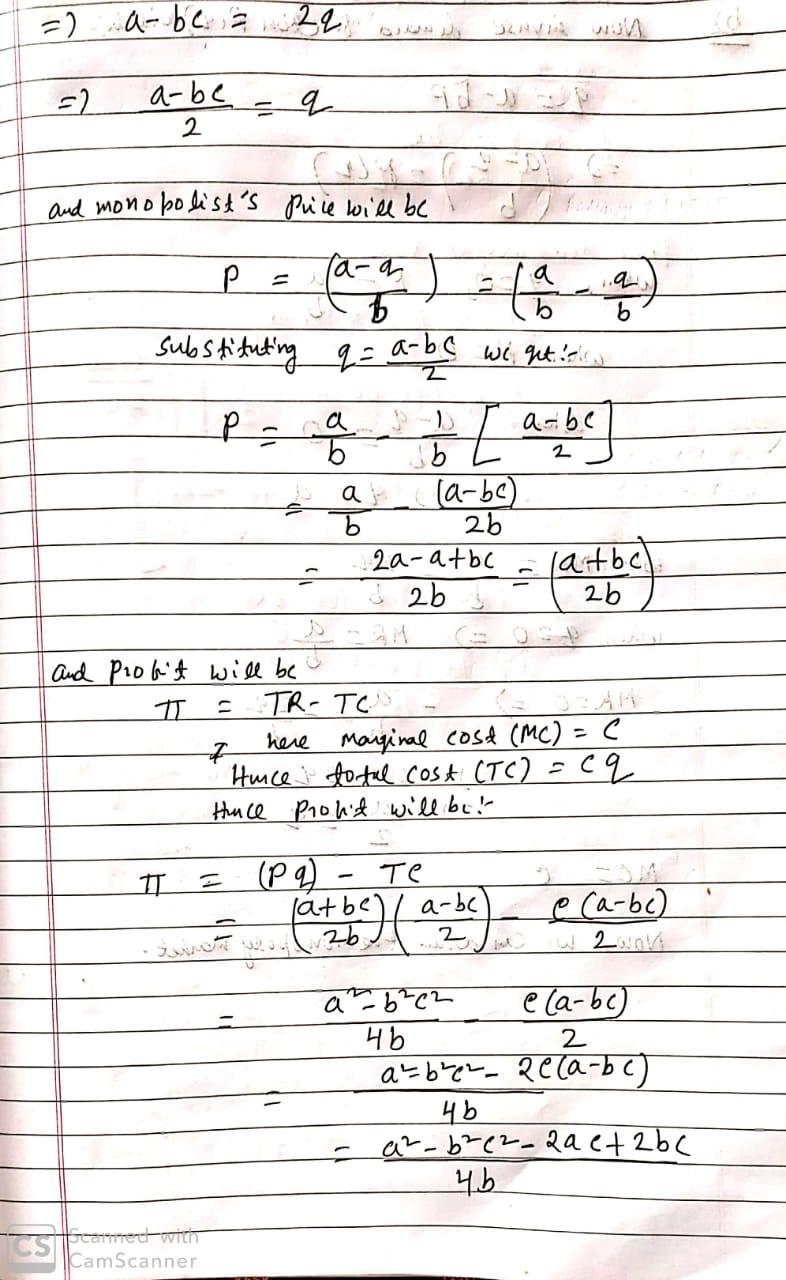
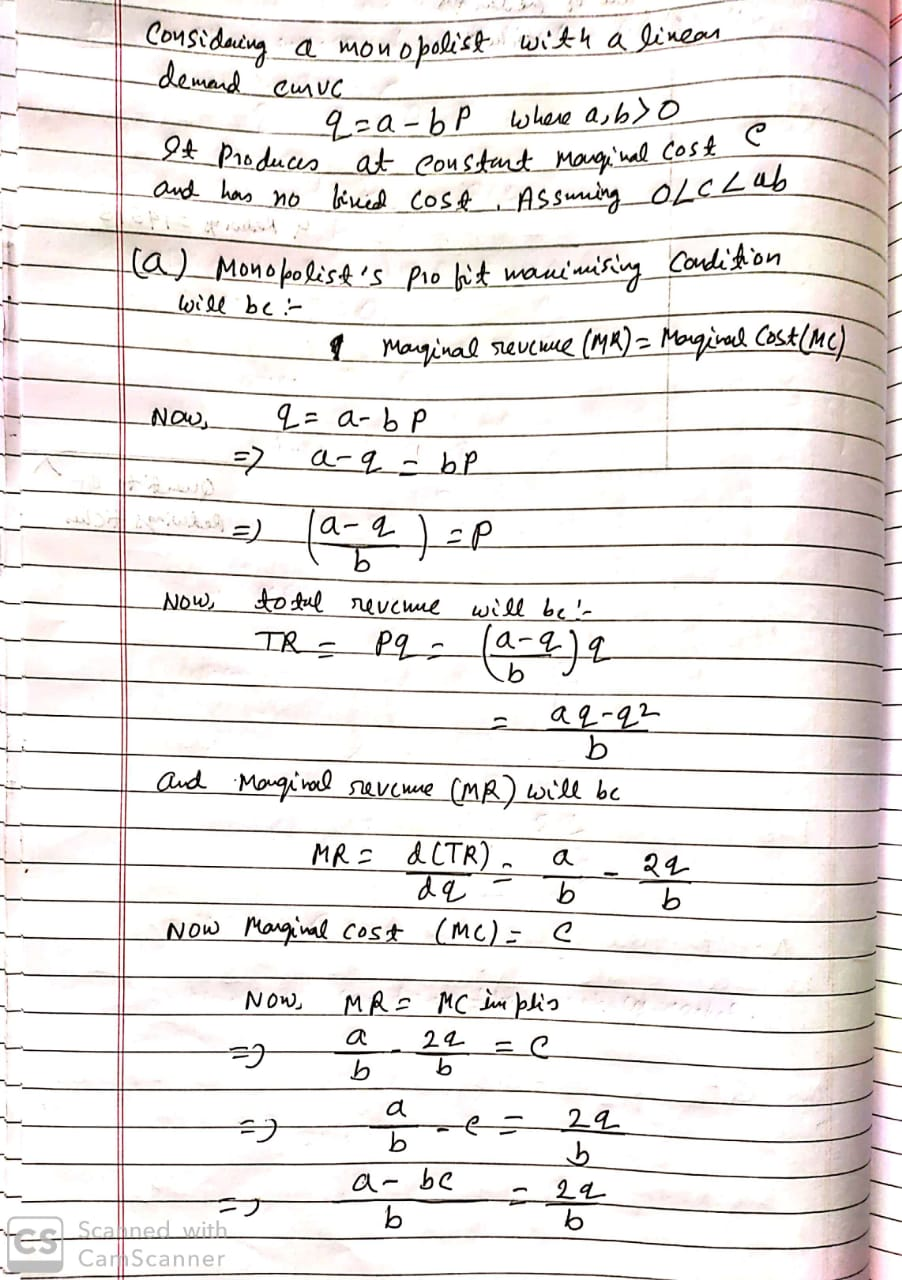
Consider a monopolist with a linear demand curve: q = a − bp, where a;b > 0. It produces at constant marginal cost c and has no fixed cost. Assume that 0 < c < a b.
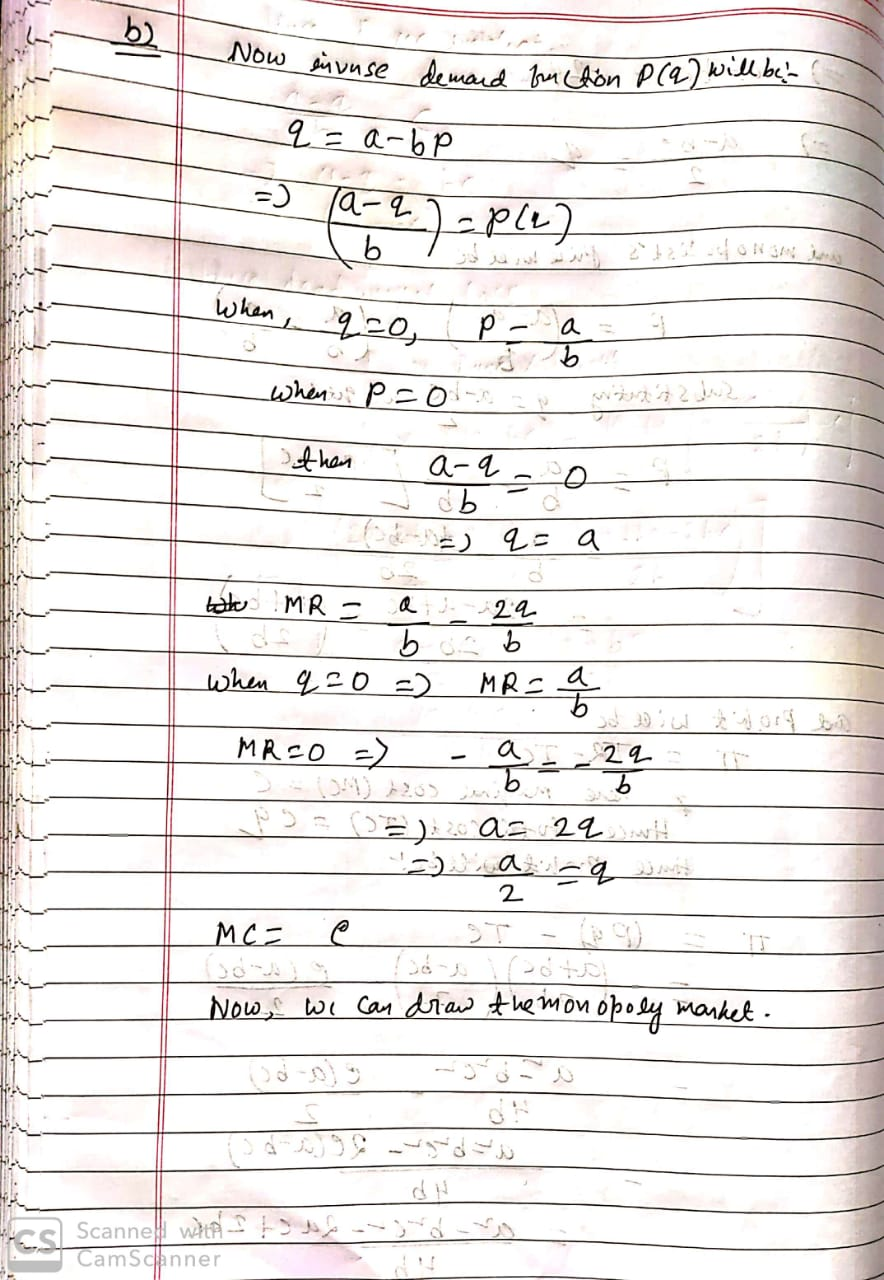
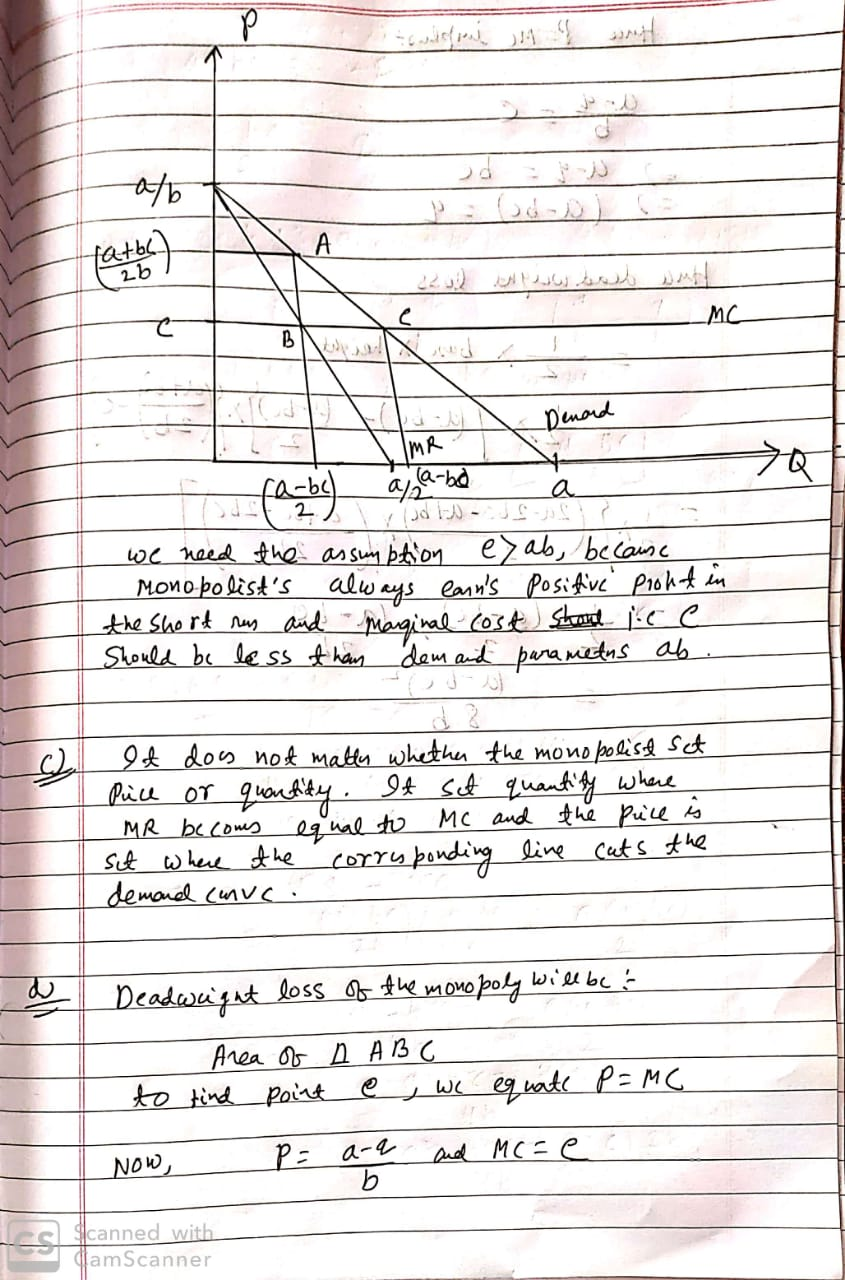
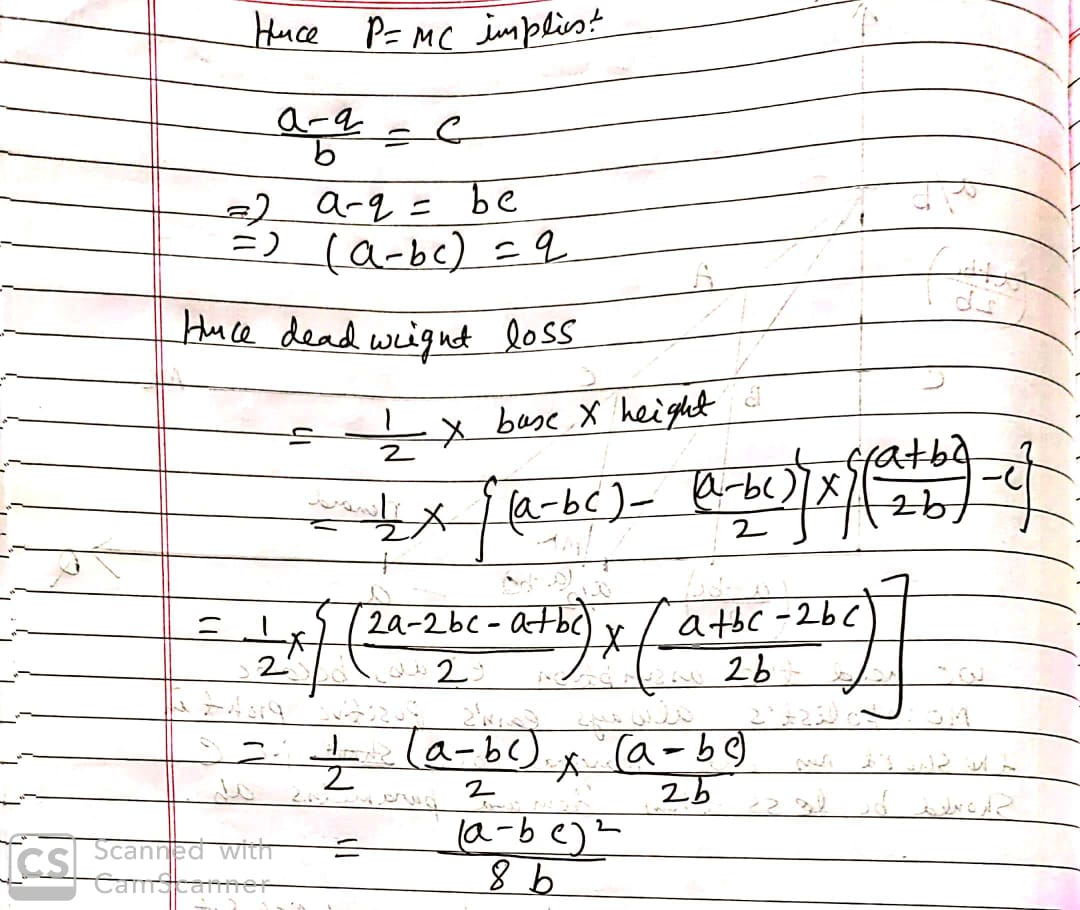
(a) Find the monopoly price, quantity, and profits. (b) Derive the inverse demand curve P(q). Draw P(q), the MRcurve, and the MC-curve in a diagram. Explain why we need the assumption c < a b. (c) Does it matter that the monopolist sets price instead of quantity? (d) Calculate the deadweight loss of monopoly. (e) A change in b results in two opposing effects on the deadweight loss. Calculate the effect of a change in b on the deadweight loss. (f) Derive the price elasticity of demand η for any price. How does η change with p? (g) Show mathematically as well as graphically that the price elasticity of demand η > 1 at the monopoly price.

Solutions
Expert Solution


Related Solutions

Monopoly with linear inverse demand. Consider a monopolist facing a linear inverse demand curve p(q)= a-...
Monopoly with linear inverse demand. Consider a monopolist facing a linear inverse demand curve p(q)= a- bq, and cost function C(q)= F + cq, where F denotes its fixed costs and c represents the monopolist's (constant) magical cost a>c 1. Graph demand, marginal revenue and marginal cost. Label your graph carefully, including intercepts 2. Solve the profit maximizing output q^m. To do this, first write down the expression for MR=MC and solve for the optimal quantity. Next find the price...
A monopolist faces a demand curve of Q = 164 – P, where P is price...
A monopolist faces a demand curve of Q = 164 – P, where P is price and Q is the output produced by the monopolist. What choice of output will maximize revenue? Group of answer choices 70 74 82 86 if monopolist produces good X and faces a demand curve X = 112 - 2P, where P is price. What is the monopolist's marginal revenue as a function of good X? Group of answer choices 44 - X 56 -...
A monopolist faces a demand curve P= 11 – Q, where P is measured in dollars...
A monopolist faces a demand curve P= 11 – Q, where P is measured in dollars per unit and Q in thousands of units. The monopolist has a constant average cost of $6 per unit. a. Draw the average and marginal revenue curves and the average and marginal cost curves. What are the monopolist’s profits-maximizing price and quantity? What is the resulting profit? Calculate the firm’s degree of market power using the lerner index. b. A government regulatory agency sets...
II. Consider a monopolist where the market demand curve for the produce is given by P...
II. Consider a monopolist where the market demand curve for the produce is given by P = 520 – 2Q. This monopolist has marginal costs that can be expressed as MC = 100 + 2Q and total costs that can be expressed as TC = 100Q + Q2 + 50. a. Given the above information, what is this monopolist’s profit maximizing price and output if it charges a single price? b. Given the above information, calculate this single price monopolist’s...
Consider a Monopolist where the inverse market demand curve for the produce is given by P...
Consider a Monopolist where the inverse market demand curve for the produce is given by P = 520 − 2Q. Marginal Cost: MC =100 + 2Q and Total Cost: 100 .50 2 TC = Q + Q + [1 + 1 + 1 = 3] Calculate: (a) Profit Maximizing Price and Quantity. (b) Single Price Monopolist Profit. (c) At the profit maximizing quantity, what is the Average Total Cost (ATC) for the Consider a Monopolist where the inverse market demand...
Consider a monopolist facing linear demand P(Q) = 16 – Q. Find the monopolist’s profit-maximizing choice...
Consider a monopolist facing linear demand P(Q) = 16 – Q. Find the monopolist’s profit-maximizing choice of price and quantity if the total cost function is C(Q) = 8Q. Find the monopolist’s profit-maximizing choice of price and quantity if instead C(Q) = 2Q2. Note that this cost function yields exactly the same total cost as the original cost function C(Q) = 8Q for the monopolist’s optimal quantity in 2.1. Explain why the monopolist’s optimum quantity, however, is not the same...
A monopolist faces the following average revenue (demand) curve: P = 100 – 0.01Q Where Q...
A monopolist faces the following average revenue (demand) curve: P = 100 – 0.01Q Where Q is weekly production and P is price, measured in cents per unit. The firm’s cost function is given by C = 50Q + 30,000. Assume that the firm maximizes profits. What is the level of production, price, and total profit per week? If the government decides to levy a tax of 10 cents per unit on this product, what will be the new level...
A monopolist faces the demand curve P =11 Q, where P is measured in dollars per...
A monopolist faces the demand curve P =11 Q, where P is measured in dollars per unit and Q in thousands of units. The monopolist has a constant average cost of $6 per unit. Answer the following questions, showing all workings. a) Calculate the monopolists profit-maximizing price and quantity. Calculate the monopolists profit. b) Draw the average and marginal revenue curves and the average and marginal cost curves for the monopolist including the area of profits (label the diagram accurately...
If a monopolist faces a linear demand curve, its marginal revenue curve will cross the quantity...
If a monopolist faces a linear demand curve, its marginal revenue curve will cross the quantity axis at the quantity related to: a. MR=MC b. the point of unit elasticity on demand curve c. the minimum of average total cost d. the profit maximizing price
Consider a linear demand curve Q=160-8P. a) (4 pts) What is the price elasticity of demand...
Consider a linear demand curve Q=160-8P. a) (4 pts) What is the price elasticity of demand at p=5? Is it elastic, inelastic or unit elastic at this specific point?   b) (4 pts) At what price is demand unit-elastic (i.e. elasticity=-1)? Explain what does unit-elastic mean.
ADVERTISEMENT
ADVERTISEMENT
ADVERTISEMENT