Question
In: Math
Suppose that over a year the daily percent change (+ or -) for the S&P 500...
Suppose that over a year the daily percent change (+ or -) for
the S&P 500 adjusted closing value is approximately normally
distributed with a mean of +0.03% and a standard deviation of
0.97%. Use this model to answer the following questions. Show all
calculations. Show the standardization calculations.
a) For a randomly selected trading day, what the is probability
that the percent change is less than +1.50%?
b) For what proportion of the trading days is the percent change between -2.00% and +2.00%?
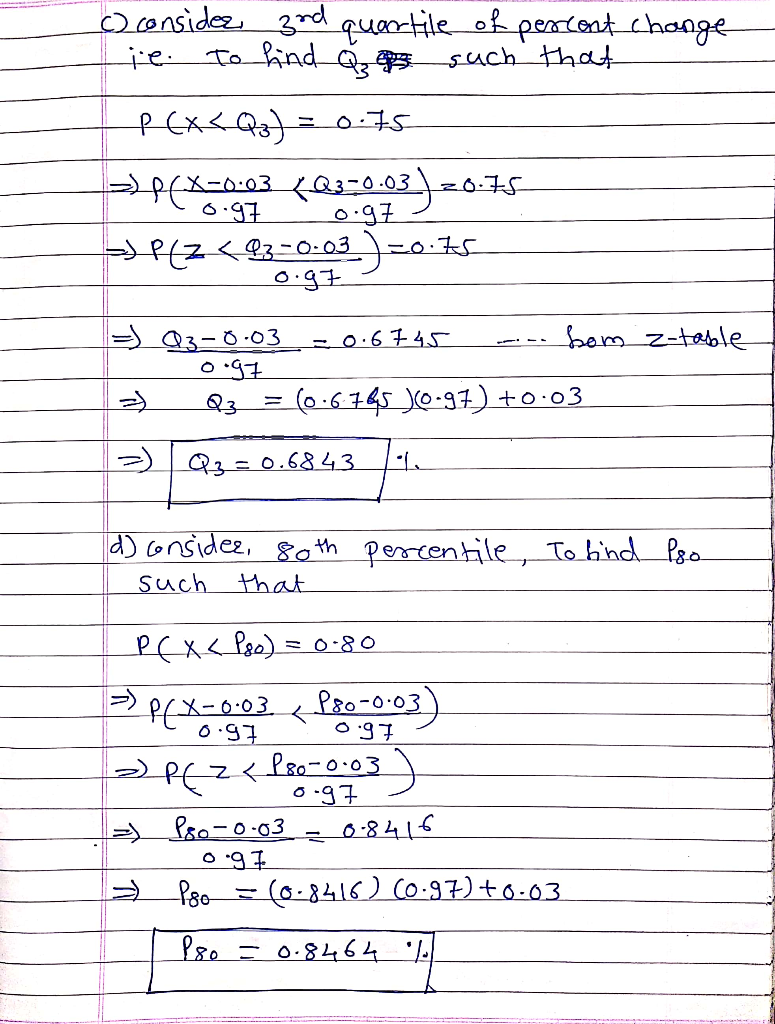
c) What is the 3rd quartile of the percent change?
d) The 80th percentile?
Solutions
Expert Solution
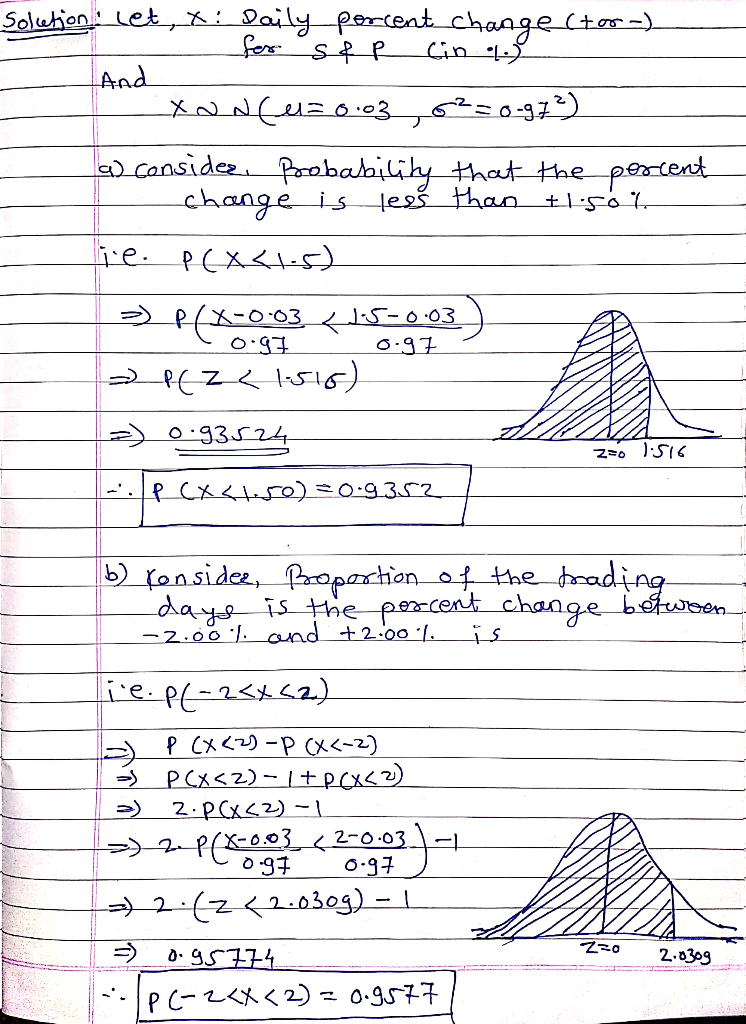
a) 0.9352
b) 0.9577
c) Q3= 0.6843%
d) P80 = 0.8464 %
 milcah answered 5 months ago
Related Solutions
Below are the closing values and daily return on the S&P 500 for the last ten...
Below are the closing values and daily return on the S&P 500
for the last ten days. What are the daily and annualized
standard deviations? You may use excel for this problem.
Enter your answers as percent rounded to two decimal places.
Date
Closing value
Return
9/25/2019
2984.87
0.0062
9/26/2019
2977.62
-0.0024
9/27/2019
2961.79
-0.0053
9/30/2019
2976.74
0.0050
10/1/2019
2940.25
-0.0123
10/2/2019
2887.61
-0.0179
10/3/2019
2910.63
0.0080
10/4/2019
2952.01
0.0142
10/7/2019
2938.79
-0.0045
10/8/2019
2893.06
-0.0156
The following table shows the annual returns over a six year period for the S&P 500...
The following table shows the annual
returns over a six year period for the S&P 500 market index and
MCH, Inc. Assume that the historical information represents a
population. Use this data to calculate the correlation between both
sets of security returns. Discuss your findings.
Year
S&P
500
MCH,
Inc.
2013
0.15
0.37
2014
0.13
0.09
2015
0.14
-0.11
2016
-0.09
0.08
2017
0.12
0.11
2018
0.09
0.04
Please show me each step. Thank you
The following table shows the annual returns over a six year period for the S&P 500...
The following table shows the annual
returns over a six year period for the S&P 500 market index and
MCH, Inc. Assume that the historical information represents a
population. Use this data to calculate the correlation between both
sets of security returns. Discuss your findings.
Year
S&P
500
MCH,
Inc.
2013
0.15
0.37
2014
0.13
0.09
2015
0.14
-0.11
2016
-0.09
0.08
2017
0.12
0.11
2018
0.09
0.04
Suppose the value of the S&P 500 Stock Index is currently $3,350. a. If the one-year...
Suppose the value of the S&P 500 Stock Index is currently
$3,350.
a. If the one-year T-bill rate is 4.6% and the
expected dividend yield on the S&P 500 is 4.2%, what should the
one-year maturity futures price be? (Do not round
intermediate calculations. Round your answer to 2 decimal
places.)
b. What would the one-year maturity futures price
be, if the T-bill rate is less than the dividend yield, for
example, 3.2%? (Do not round intermediate calculations.
Round your...
The S&P 500 and Nohr Corp had the following returns over the past five years Year ...
The S&P 500 and Nohr Corp had the following returns over the
past five years
Year S&P
500
Nohr
.12
.23
.01
-.05
.18
.20
.09
.12
.10
.20
a. What was the mean AND standard
deviation of returns (population version)
for Nohr for the 5 years?
b. What was the beta of Nohr relative to the S&P 500?
c. What was the geometric mean return for Nohr
for the 5 years?
Suppose you invest $15,000 in an S&P 500 Index fund (S&P fund) and $10,000 in a...
Suppose you invest $15,000 in an S&P 500 Index fund (S&P
fund) and $10,000 in a total bond market fund (Bond fund). The
expected returns of the S&P and Bond funds are 8% and 4%,
respectively. The standard deviations of the S&P and Bond funds
are 18% and 7% respectively. The correlation between the two funds
is 0.40. The risk-free rate is 2%. What is the expected return on
your portfolio? What is the standard deviation on your portfolio?
What...
The Daily S&P 500® Bull 3x ETF seeks daily investment results, before fees and expenses, of...
The Daily S&P 500® Bull 3x ETF seeks daily investment
results, before fees and expenses, of 300% of the performance of
the S&P 500® Index and Daily S&P 500® Bear 3x ETF seeks
daily investment results, before fees and expenses, of 300% of the
inverse (or opposite) of the performance of the S&P 500® Index.
For the purposes of this question, disregard the effects of
expenses and fees. Let the returns on S&P 500® Index on three
consecutive days be,...
Suppose the value of the S&P 500 Stock Index is currently $2,050. If the one-year T-bill...
Suppose the value of the S&P 500 Stock Index is currently
$2,050. If the one-year T-bill rate is 5.5% and the expected
dividend yield on the S&P 500 is 5.0%.
a. What should the one-year maturity futures
price be? (Do not round intermediate
calculations.)
Futures price
$
b. What would the one-year maturity futures
price be, if the T-bill rate is less than the dividend yield, for
example, 4.0%? (Do not round intermediate
calculations.)
Futures price
Suppose that the S&P 500, with a beta of 1.0, has an expected return of 12%...
Suppose that the S&P 500, with a beta of 1.0, has an expected return of 12% and T-bills provide a risk-free return of 3%.
a.
What would be the expected return and beta of portfolios constructed from these two assets with weights in the S&P 500 of (i) 0; (ii) .25; (iii) .50; (iv) .75; (v) 1.0? (Leave no cells blank - be certain to enter "0" wherever required. Do not round intermediate calculations. Round your answers to 2 decimal...
Suppose that the S&P 500, with a beta of 1.0, has an expected return of 11%...
Suppose that the S&P 500, with a beta of 1.0, has an
expected return of 11% and T-bills provide a risk-free return of
6%.
a. What would be the expected return and beta
of portfolios constructed from these two assets with weights in the
S&P 500 of (i) 0; (ii) 0.25; (iii) 0.50; (iv) 0.75; (v) 1.0?
(Leave no cells blank - be certain to enter "0" wherever
required. Do not round intermediate calculations. Enter the value
of Expected return...
ADVERTISEMENT
ADVERTISEMENT
Latest Questions
- The output of the function is a dictionary whose keys represent the bins and whose values...
- The shape of a graph of a binomial distribution depends on the value of both n...
- In 2012, cost per Medicare beneficiary did what?
- 3. A. What techniques can a firm use to optimize demand deposit holdings? B. How do...
- The half-life of mercury-197 is 64.1 hours. If a patient undergoing a kidney scan is given...
- Double bonds react with Br2 to form a dibromide. Isobutylene undergoes cationic polymerization under conditions where...
- 1. Which sex chromosomes are limited to only one sex? A. X and Z B. X...
ADVERTISEMENT