Question
In: Economics
Use the classical model for determining the long-run outcome of the economy to answer the following...
Use the classical model for determining the long-run outcome of the economy to answer the following question. Suppose a government in debt crisis (such as Greece) moves to reduce its budget deficit by reducing the annual funding for tertiary education and healthcare drastically.
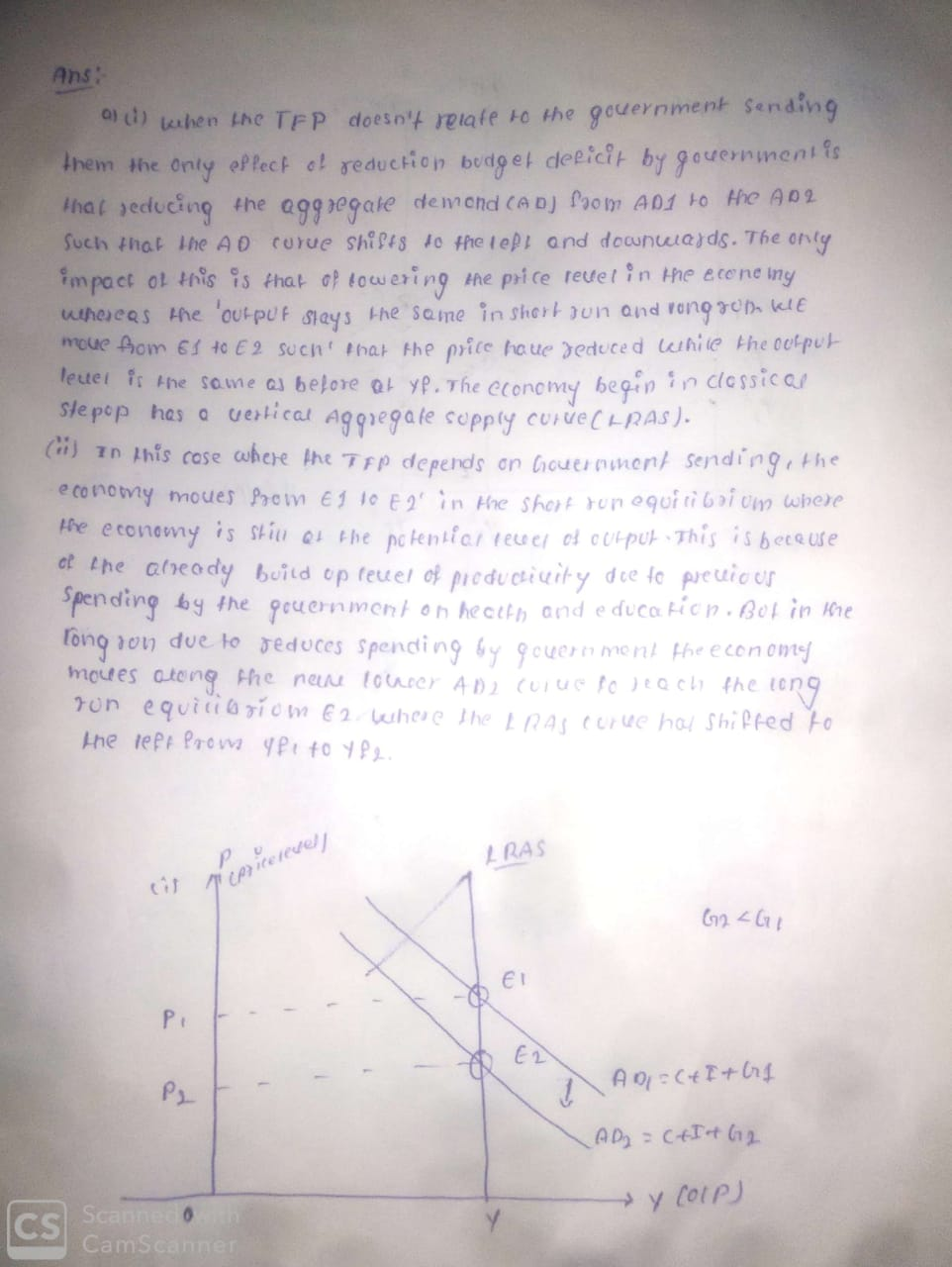
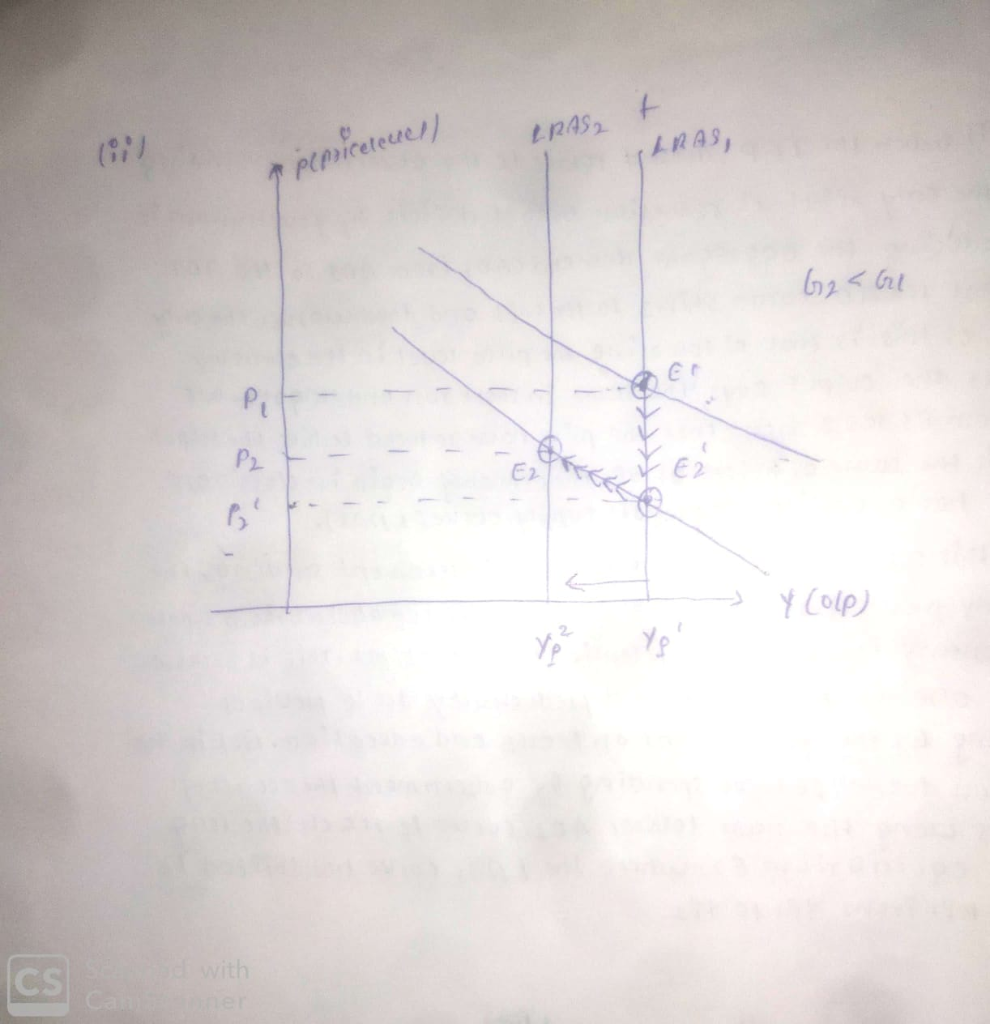
(a) Graphically illustrate the impact of such a reduction in the government's budget deficit:
i. First, by assuming that the total factor productivity (TFP) does not depend on the government spending on health and education.
ii. Second, by assuming that the TFP increases with government spending on health and education but by a limited amount. [Be sure to label: the axes; the curves; the initial equilibrium values; the direction curves shift; and the terminal equilibrium values.]
(b) State and explain in words what happens to the real interest rate, national saving, investment, consumption, and output.
(c) Discuss the likely impact of such policy on the inequality of income between the educated and uneducated labour. Support your answer with graphical illustrations.
(d) Suppose the above policy causes a sudden emigration of workers with no education to neighbouring countries for easier access to education and health facilities. Assume TFP does not decrease following the government policy shock, as in part a (i), and following the labour migration. How would your answer to (b) and (c) change?
Solutions
 Rahul Sunny answered 5 months ago
Related Solutions
Use the classical model for determining the long-run outcome of the economy to answer the following...
Full Employment Model: Consider the long-run model of the economy and answer the following questions: a....
4- Classical Model: The Long Run 1.1 Open Economy Solve for the following Y, W P...
1. Use the AD-AS model to answer the following questions. Suppose that an economy is initially in its long-run equilibrium.
A closed economy can be described by the long-run classical model: Y = 2KαL1–α C =...
Draw a Classical Economic Model that is operating at the long-run equilibrium. In the short run,...
a) “According to the long-run classical model, there will be a decrease in the world interest...
A closed economy can be described by the long-run classical model: Y = 5K 1/4L 3/4...
What determines the unemployment rate in the Long Run? Explain using the Classical model, Keynesian model...
Tenement Yaard is a small open economy described by the following long-run classical equations where Y...
- in your own opinion, It has been said that a smartphone is a computer in your...
- Use the internet to read more about journaling file systems such as NTFS, extfs2, and extfs3....
- Consider the quick sort algorithm. The quick sort algorithm is a divide and conquer approach which...
- Tesla 1. How to make these weaknesses into strengths? Burn through cash, high prices, bottlenecking/product delays,...
- Assignment # 12: Email Presentation Learning Objectives and Outcomes Design a PowerPoint presentation appropriate for middle...
- Identify which of the perspectives you believe is the BEST for accurately explaining human behavior and...
- What trade policies should a country adopt? why? Explain. Also, find some reference materials on this...